Silk, cashmere and linen are the three fibres brands most often buy on trust. Each carries a price premium over the fibres that imitate it, each is hard to identify by eye or by hand, and each has a cheaper look-alike that passes a quick inspection: polyester satin for silk, fine wool or yak for cashmere, cotton or viscose blends sold as linen.
China is where most of this trade runs through. It is the largest exporter of raw silk, of pure silk fabric and of woven linen in the trade data. It is also the largest producer of raw cashmere. So the question for a brand is rarely whether a Chinese supplier can make the product. It is whether the supplier in front of you is who it says it is, and whether the fibre in the bulk is the fibre on the label.
This guide covers where each fibre is made in China, starting with the Hangzhou and Suzhou silk belt, how each one is specified, and then the verification steps: the company record, the certificates and the composition test.
Before you read: China Clothing Manufacturer places and manages production for brands from 100 pieces per style with documented factories in China. Trade, cluster and regulatory figures in this guide come from the published sources listed at the end. Exact MOQ and price are confirmed with the factory once you send a brief.
What matters most
- China leads all three trades. In 2024 China exported more raw silk, pure silk fabric and finished linen fabric than any other country, with Italy next in each line (WITS).
- Silk sits around Hangzhou and Suzhou. Silk has been a pillar industry in Hangzhou for more than 1,300 years; Shengze in Suzhou's Wujiang district is a traditional silk hub that now makes mostly chemical fibre fabric.
- Write momme for silk. One momme is 4.340 g/m², and a weave name alone spans a wide weight range.
- Cashmere has a legal definition in the US. Average fibre diameter of 19 microns or less, and no more than 3% by weight of fibres above 30 microns.
- Linen is mostly European flax spun in China. About 90% of European scutched flax goes to Asia for spinning, 80% of it to China.
- Verify the company first. The business licence and China's National Enterprise Credit Information Publicity System show the legal name, status and business scope.
- Then verify the fibre. Certificates cover chemicals and organic claims, not fibre identity. A composition test on bulk does that.
Where Is Silk Made in China?
Mostly in Zhejiang and southern Jiangsu, with Hangzhou as the historic centre. A 2014 China Daily report quoted the chairman of the Hangzhou Silk Association: silk has been a pillar industry in Hangzhou for more than 1,300 years, since the Tang Dynasty, and Hangzhou silk then accounted for 30 percent of domestic market share, with more than 1,000 silk companies in the city (China Daily, 2014). The same report cited an estimate from the China International Silk Forum that over the previous decade China made nearly 80 percent of the world's silk.
Hangzhou also has the trade floor. China Hangzhou Silk City, built in 1987, is home to more than 400 shops which turn over 2 billion yuan in annual trade, according to the city's official English portal in 2020 (eHangzhou, 2020). A wholesale market like this sells finished fabric and goods from many mills. It is a good place to see the range, and a poor place to learn who wove a particular cloth.
The second centre is Suzhou. Shengze, a town in Suzhou's Wujiang district, has long been known as China's traditional silk hub, but China Daily described it in 2025 as one of China's top production hubs for chemical fiber fabrics, with more than 2,500 industrial textile companies and over 10,000 textile trade firms, according to the township government's data (China Daily, 2025). That shift matters for verification. A supplier's Shengze address tells you it sits in a large weaving cluster; it does not tell you the cloth is silk. Polyester satins and silk-like synthetics are a large part of what the town weaves.
Around both cities the province carries the weight. Zhejiang's textile and garment industry generated 1.12 trillion yuan in revenue in 2025, 25.5 percent of the national total and first in China (China Daily, 2026). For more on the two provinces, see our pages on clothing manufacturers in Zhejiang and clothing manufacturers in Jiangsu.
Quick read: Silk has been a pillar industry in Hangzhou for more than 1,300 years, according to the Hangzhou Silk Association as quoted by China Daily in 2014. Shengze in Suzhou's Wujiang district is a traditional silk hub that China Daily now describes as one of China's top production hubs for chemical fiber fabrics, so a Shengze address alone does not prove a cloth is silk.
What Do the Trade Figures Show?
China is the largest exporter at each step of the silk chain. In 2024 it exported $183.7 million of raw silk, against $32.2 million from Italy, the next country on the list; that was 2,687,030 kg of raw silk, about $68.37 a kilogram on average by our arithmetic (WITS). In woven fabric containing 85 percent or more silk, China exported $304.2 million, ahead of Italy at $132.4 million and India at $104.4 million (WITS).
The trend is less flattering. China's exports of pure silk fabric were $544.3 million in 2019, fell to $240.8 million in 2020, recovered to $410.1 million in 2022 and were $304.2 million in 2024, about 44% below 2019 (WITS). Italy was the largest buyer in 2024 at $75.2 million, about 25% of the total, followed by India, Hong Kong, Sri Lanka and Pakistan. A lot of this cloth is finished or made into garments in other countries, which is one reason a garment's country of origin says little about where its fabric was woven.
Linen follows the same pattern at larger scale. China exported $563.2 million of woven linen with 85 percent or more flax that was dyed, printed or otherwise finished (HS 5309.19), against $103.8 million from Italy, and a further $214.9 million of bleached or unbleached linen fabric (WITS, WITS). By weight the finished line was 20,957,500 kg, about $26.87 a kilogram on average.
Two cautions on these numbers. They are customs records, so they count what was declared, not what was tested; a mislabelled shipment is counted under the line its paperwork claims. And they are values at export, before freight, duty and the brand's margin. Use them to judge where capacity is, not what your fabric should cost.
Quick read: According to World Bank WITS data, China exported $304.2 million of pure silk fabric (HS 5007.20) in 2024, more than any other country but about 44% below its 2019 value of $544.3 million. It also led raw silk and finished linen fabric (HS 5309.19), with Italy the next-largest country in all three lines.
How Is Silk Specified?
By fibre, weight and weave. Each one changes the fabric, and a brief that names only one leaves the other two to the supplier.
Fibre. Silk is a protein fibre, composed mainly of fibroin (75 to 80%) with a coating of sericin (20 to 25%). The best-known silk comes from the cocoons of the mulberry silkworm, Bombyx mori, reared in captivity (Wikipedia, Silk). Wild silks such as tussah come from other caterpillars; they differ in colour and texture and are less uniform. They are real silk and should be described as what they are, not sold as mulberry silk.
Weight. Silk is weighed in momme, written mm. It is the weight in pounds of a piece of fabric 45 inches by 100 yards, and one momme equals 4.340 g/m² (Apparel Search). So 16 momme is about 69 g/m², 19 momme about 82 g/m² and 22 momme about 95 g/m². Write the momme on the order and on the fabric approval; an order placed without a weight is filled at whatever weight the supplier considers standard.
Weave. Charmeuse, crepe de chine, habutai, chiffon, organza and noil are different fabrics, not grades of one fabric, and each covers a range of weights. Charmeuse alone runs from 12 to 30 momme; crepe de chine from 12 to 16 (Wikipedia, Units of textile measurement). The higher the momme, the more durable the weave.
Satin is a weave, not a fibre. A satin weave floats warp yarns over weft yarns to give the lustre, and a satin can be woven from filament fibres such as silk, polyester or nylon (Wikipedia, Satin). That is the single most useful sentence for a silk buyer: a supplier quoting "satin" has told you the weave and nothing about the fibre. Ask for the fibre, the weave and the momme in writing, for example mulberry silk charmeuse with its momme stated.
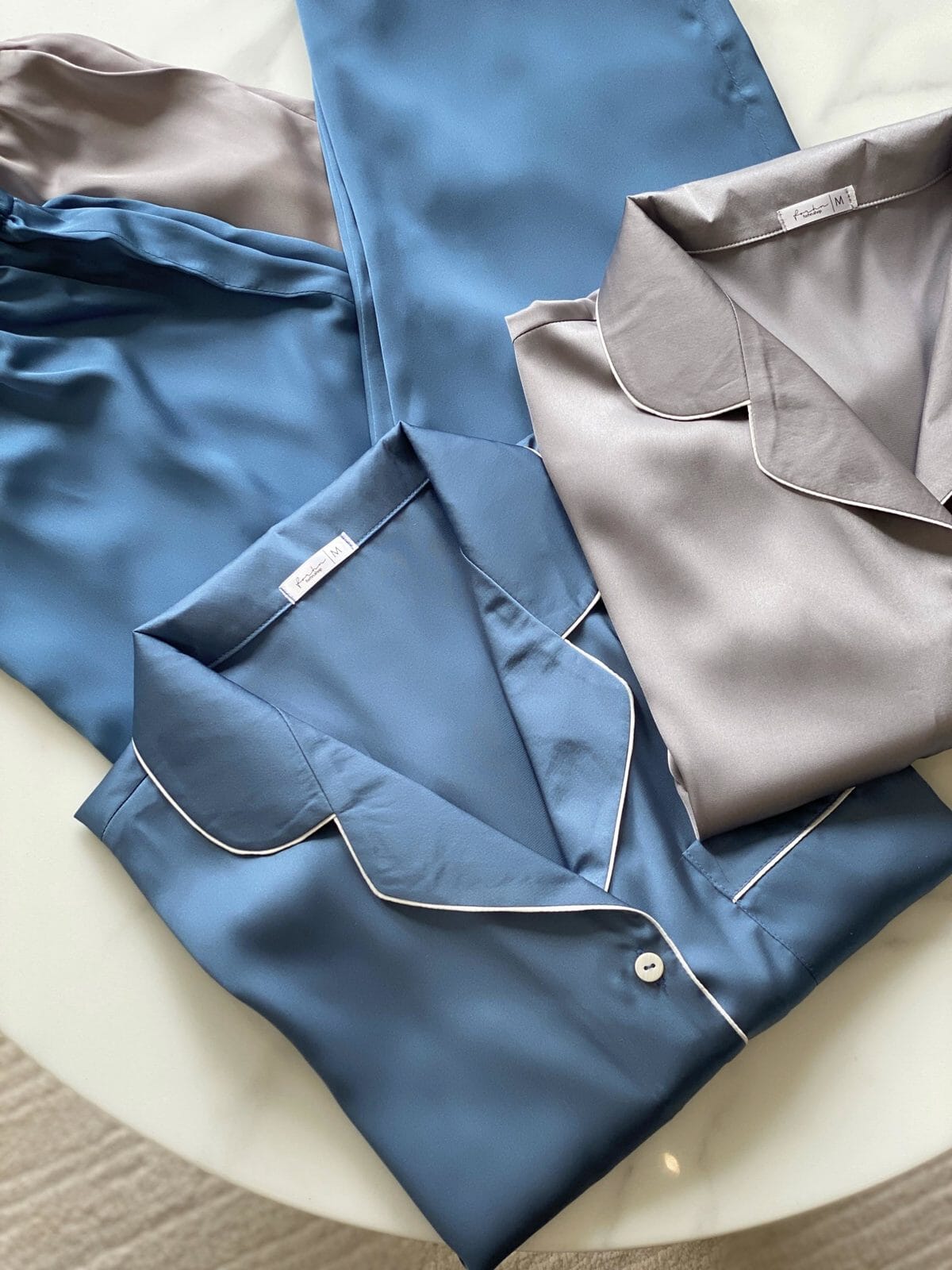
Two behaviours belong in the brief because customers notice them. Silk loses up to 20% of its strength when wet, and it has a moisture regain of 11% (Wikipedia, Silk). Care labels, seam allowances and the wash test on the sample should reflect that, especially for garments that will be hand-washed at home.
Silk fabric sold for garments also varies in finish: sand-washed, printed, yarn-dyed or piece-dyed. Each finish is a separate process, often at a separate dyehouse, and each is a point where the fabric can change hands. Name the finish and ask who does it.
Quick read: Silk is specified by fibre, weight and weave. Weight is given in momme, the weight in pounds of a piece 45 inches by 100 yards, with one momme equal to 4.340 g/m², so 19 momme is about 82 g/m². Satin is a weave that can be made from silk, polyester or nylon, so a quote for satin says nothing about fibre content.
Where Does Chinese Cashmere Come From?
From the herding regions of the north, and then from one county in Hebei that has no herds at all. China is the largest producer of raw cashmere, with production estimated at 19,200 metric tons in hair in 2016, ahead of Mongolia at 8,900 tons (Wikipedia, Cashmere wool).
Ordos, Inner Mongolia is the fibre end. Ordos has over 6.9 million cashmere goats and produces more than 3,500 metric tons of raw cashmere annually, which accounts for 58.7 percent of Inner Mongolia's output, 25 percent of China's and 15 percent of the global total, according to the city's investment portal in 2025 (Ordos investment portal, 2025). The local Albas cashmere goat produces cashmere with an average fineness of 14.6 to 15.5 microns, China Daily reported in 2024 (China Daily, 2024).
Qinghe, Hebei is the processing end. Despite being devoid of natural grasslands or sheep farms, Qinghe processes 8,000 tonnes of cashmere and 50,000 tonnes of wool annually, 60 percent and 90 percent of China's total, Xinhua reported in April 2026. The county has more than 1,700 cashmere-related businesses employing over 100,000 people, and its industry generated 47 billion yuan in 2024 (Xinhua, 2026). A 2020 China Daily supplement counted more than 50,000 cashmere carding machines, about 140 spinning production lines and more than 10,000 computerized flat knitting machines in the county (China Daily, 2020).
For a buyer the geography is a verification clue. Dehairing and spinning happen in Qinghe and Inner Mongolia; knitting happens there and in many other places that buy the yarn. A sweater supplier that cannot name its yarn spinner is buying yarn on the open market, and its claims about micron and fibre length are second-hand. For knitwear capacity in general, see our guide to sweater manufacturers in China.
Quick read: China is the largest producer of raw cashmere. Ordos in Inner Mongolia produces more than 3,500 metric tons of raw cashmere a year, about 25 percent of China's output, and Qinghe County in Hebei processes 8,000 tonnes of cashmere a year, 60 percent of China's total, according to Xinhua, despite having no grasslands or sheep farms.
How Is Cashmere Graded?
By fibre diameter and fibre length, and in the United States by law. Under the Wool Products Labeling Act a product may be labelled cashmere only if it is the fine (dehaired) undercoat fibre of a cashmere goat, the average fibre diameter does not exceed 19 microns, and no more than 3 percent by weight of the cashmere fibres have average diameters above 30 microns; the coefficient of variation around the mean may not exceed 24 percent (Wool Products Labeling Act, US Code, FTC wool rules).
Those numbers make a cashmere claim testable. A supplier who can state the average micron of its yarn, and give you a test report for it, is describing a specification. One who offers only "pure cashmere" is describing a category. Two garments can both be entirely cashmere and differ in softness and pilling, because diameter governs softness and fibre length governs how readily the fibre works loose and pills.
The substitutions to watch for are fine sheep's wool, yak and camel hair. They are good fibres in their own right; the problem is when they are not declared. ISO 17751-1, the light microscopy method for cashmere, wool and other speciality animal fibres, notes that these fibres exhibit great similarities in their physical and chemical properties, so their blends are difficult to distinguish by mechanical and chemical methods, and that the accuracy of the analysis depends heavily on the experience of the fibre analyst (BSI, ISO 17751-1:2016). In practice: use a laboratory that does animal-fibre microscopy routinely, and ask which method it uses.
Fibre content also changes the duty. In the US tariff schedule, a knitted top of cashmere that is wholly of cashmere (6110.12.10) carries a general rate of 4%, while one that is not wholly cashmere (6110.12.20) carries 16% (USITC HTS). A small percentage of nylon or wool in the yarn moves the garment into the higher line, so the composition on the commercial invoice has to be the composition in the goods. Goods from China can carry additional duties on top.
Quick read: In the United States a product may be labelled cashmere only if its average fibre diameter does not exceed 19 microns and no more than 3 percent by weight of its fibres exceed 30 microns (Wool Products Labeling Act). ISO 17751-1 notes that cashmere, sheep's wool, yak and camel are difficult to tell apart by mechanical and chemical methods, so composition is checked by microscopy.
Where Does Chinese Linen Come From?
Mostly from European flax. Linen is a textile made from the bast fibres of the flax plant (Wikipedia, Linen). France is the world's leading producer of flax fibre, with more than 65% of global production, and about 90% of European scutched flax is exported to Asia for spinning, 80% of it to China and 10% to India; with about 60 spinning mills, China accounts for the bulk of global flax processing capacity (Carbone 4). An earlier 2017 overview put China's imports of raw flax at 60,000 tons a year, including most of Europe's flax fibre (ASEF culture360, 2017).
So "European flax, spun and woven in China" is the normal route, not a red flag. The questions are whether the yarn is flax at all, what percentage, and whether any origin claim on the label can be traced to paperwork. A claim like "French linen" on a garment woven in China is a marketing statement that needs documents behind it; ask for the yarn supplier's invoice or a certificate that names the fibre origin.
On the label, the rule is simple. US rules require fibres present at 5 percent or more of the total fibre weight to be named by their generic names, for example cotton, rayon, silk, linen or nylon (FTC textile rules). "Linen look", "linen touch" and "linen feel" are not fibre names. A garment sold with those words can contain no flax at all, and the composition label is where the truth has to appear.
Two more points for the brief. Linen's poor elasticity means that it easily wrinkles, and it has no lint or pilling tendency (Wikipedia, Linen). Creasing is the fibre behaving normally; a hangtag that says so prevents returns. And linen is often softened or garment-washed, so name the finish and approve it on a washed sample, because unwashed linen is noticeably stiffer.
Quick read: Linen is made from flax. France produces more than 65% of the world's flax fibre, and about 90% of European scutched flax is exported to Asia for spinning, 80% of it to China, according to Carbone 4. US rules require fibres at 5 percent or more of fibre weight to be named generically, so linen look is not a fibre claim.
How Do You Verify a Chinese Supplier?
In two layers: the company, then the fibre. A company check tells you who you are paying and what it is licensed to do. It cannot tell you what is in the cloth. A composition test tells you what is in the cloth. It cannot tell you whether the company will still exist next season. You need both.
1. Ask for the business licence. Every legally registered Chinese company has one, issued by the administration for market regulation. It shows the legal name in Chinese, the unified social credit number, registered capital, company type, legal representative, date of incorporation, expiration date and business scope, with the red stamp of the registration authority (China Justice Observer). A supplier that will not show its licence has answered your question.
2. Look the company up yourself. China's National Enterprise Credit Information Publicity System (gsxt.gov.cn) is a website of the State Administration for Market Regulation and the most authoritative platform to verify the legal status of Chinese enterprises. It is in Chinese and can be used from outside China; search by the legal Chinese name and check whether the company is in existence, revoked or deregistered (China Justice Observer). The more reliable search key is the 18-character Unified Social Credit Code, and the record can also show business scope, penalties and abnormal-operation records (hicom-asia.com).
3. Compare the record with the pitch. If a supplier claims to own a factory, the business scope, registered address and entity type should support that claim; if it appears to be a trading business, ask further questions before paying a deposit (hicom-asia.com). Trading companies are a normal way to buy silk and cashmere, but they add a step between you and the mill, and your verification has to reach past them.
4. Check that the geography fits the product. A silk weaver near Hangzhou or in Wujiang, a cashmere spinner in Qinghe or Inner Mongolia, a linen mill buying European flax: each is plausible. One small company offering silk, cashmere and linen at equally sharp prices is almost certainly buying all three from others. Ask it to name the mill or spinner for each, and write those names into the order.
5. Make the invoice and the licence agree. The legal name on the contract, the proforma invoice and the bank account should be the same entity you looked up. A payment request to a different company name, or to a personal account, is the moment to stop and ask why.
If you want a broader method for vetting factories across categories, our guide to finding and vetting clothing suppliers in China covers it, and our guide to common supplier scams covers the payment-side warning signs.
Quick read: Verify a Chinese supplier in two layers. First the company: ask for the business licence and look up the 18-character Unified Social Credit Code on the National Enterprise Credit Information Publicity System (gsxt.gov.cn), checking status, business scope and abnormal-operation records. Then the fibre: certificates and a composition test on bulk.
What Do Certificates Prove?
Less than they are often offered to prove. Certificates verify processes and chemical properties. None of the common ones confirms that the silk or cashmere percentage on your label is right.
- OEKO-TEX STANDARD 100 is a label for textiles tested for harmful substances; every thread, button and accessory is tested against a list of over 1,000 harmful substances, with stricter requirements the more intensive the skin contact (OEKO-TEX). Check a label number in the OEKO-TEX Label Check; label numbers are case sensitive (OEKO-TEX Label Check). It confirms chemical safety. It does not confirm fibre identity.
- GOTS covers organic fibre claims through the supply chain. Certified entities can be searched in the GOTS certified suppliers database by location, field of operation and certified products (GOTS database). It matters for organic cotton or organic linen claims, not for silk or cashmere grade.
- A test report from a laboratory is not a certificate. It describes the specimen that was sent. Ask which piece was tested, when, and by which method, and keep the report with the tested specimen.
When a supplier shows you a certificate, check three things: that the number resolves on the issuer's own database, that the company name on it is the company you are paying, and that the scope covers the product you are buying. A valid certificate for a different mill, or for a different product group, is common and proves nothing about your order.
Quick read: OEKO-TEX STANDARD 100 tests textiles against a list of over 1,000 harmful substances and can be checked by label number in the OEKO-TEX Label Check; GOTS entities can be searched in the GOTS certified suppliers database. Neither confirms the silk or cashmere percentage on a label. Fibre identity in a shipment is established by testing that shipment.
How Does Fibre Substitution Happen?
Rarely as a dramatic swap. More often through one of four quieter routes, and each tells you where to look.
- The sample is right and the bulk is not. The development sample is made from the specified fabric; the bulk is made from something cheaper. Testing the sample verifies almost nothing.
- The blend drifts. A stated cashmere and wool blend arrives with less cashmere than stated. It is harder to detect than a wholesale swap and does most of the damage.
- The supplier was misled. The factory bought yarn or fabric described as one thing and it was another. That is genuine, and it does not change whose name is on the label.
- The description was never precise. "Silk scarf" was ordered, silk-look polyester was understood, and nobody wrote the fibre, the percentage or the weight down. This is the most preventable of the four.
The defence is the same each time: write the fibre, the percentage and the weight or micron into the purchase order, and make a composition test on bulk a condition of the order rather than a request after delivery.
How Do You Test Composition?
With a laboratory fibre analysis, organised around three rules. Test bulk, not samples, because the sample is the piece made to be approved. Test per production lot where the premium is large, because a supplier that passed once is not verified forever. And keep the tested specimen with its report, so a later dispute has physical goods behind the paper.
Microscopy separates protein fibres such as silk, wool and cashmere from plant fibres such as cotton and flax, and from synthetics. Separating cashmere from fine wool or yak is the hard case, as ISO 17751-1 notes, and is where most of the price difference sits. Ask the laboratory for the method and for the percentage by weight, not only a pass or fail.
A burn test on a loose thread is a quick screen, not evidence. Protein fibres such as silk and cashmere smell of burnt hair and leave a crushable ash; plant fibres such as linen smell of burning paper; most synthetics melt into a hard bead. It proves nothing on paper. It tells you whether a laboratory test is urgent.
Quick read: Fibre composition is established by laboratory analysis of bulk goods, not samples, per production lot where the premium is large, with the tested specimen kept alongside the report. A burn test is a screen: silk and cashmere smell of burnt hair, linen of burning paper, and most synthetics melt into a bead.
Checklist Before You Order
Before you order silk, cashmere or linen
- Silk: fibre (mulberry or wild), momme and weave, in writing. "Satin" alone is not a specification.
- Cashmere: percentage, average micron and the spinner's name. In the US, the word cashmere requires an average of 19 microns or less and at most 3% by weight of fibres above 30 microns.
- Linen: flax percentage by weight, fabric weight and finish. Origin claims need documents.
- Company: business licence, then your own lookup of the Unified Social Credit Code on gsxt.gov.cn.
- Record against pitch: business scope and entity type fit the claim to be a factory or a trader.
- Certificates: number resolves on the issuer's database, name and scope fit your order.
- Composition test on bulk, per lot, by a laboratory that states its method; keep the specimen.
- Contract, invoice and bank account all in the name you verified.
None of this is exotic, and most of it costs little next to the premium you are paying for the fibre. Specification and a bulk test cover most of the risk; the company check covers the rest.
We are a group of documented clothing factories in China. Send a reference garment or a design with the fibre, weight and market, and we place production with the factory in our group built for the product. Our team replies within 24 hours. Samples, invoices and shipping run straight between you and the factory; our fee is flat and we take nothing from the factory side.
Send your brief China factory list, $49No spec sheet yet? We draw one style as a factory-ready tech pack for $79. What the $79 covers.
Frequently Asked Questions
Where is silk made in China?
Mostly in Zhejiang and southern Jiangsu. Silk has been a pillar industry in Hangzhou for more than 1,300 years, and Shengze in Suzhou's Wujiang district is a traditional silk hub that now weaves mostly chemical fibre fabric.
What does momme mean?
Momme is the traditional weight unit for silk: the weight in pounds of a piece 45 inches by 100 yards. One momme equals 4.340 g/m², so 19 momme is about 82 g/m².
What makes a product cashmere in the US?
Under the Wool Products Labeling Act it must be the fine dehaired undercoat of a cashmere goat, with an average fibre diameter of 19 microns or less and no more than 3 percent by weight of fibres above 30 microns.
Where does Chinese cashmere come from?
Raw fibre comes largely from Inner Mongolia, where Ordos alone produces more than 3,500 metric tons a year. Processing is concentrated in Qinghe County, Hebei, which handles about 60 percent of China's cashmere.
Is linen made in China real linen?
It can be. Most of Europe's flax fibre is exported to Asia for spinning, much of it to China. What decides it is the flax percentage on the composition label and a test on bulk; linen look is not a fibre name.
How do I check that a Chinese supplier is a real company?
Ask for the business licence, then look up the company yourself on China's National Enterprise Credit Information Publicity System (gsxt.gov.cn) by its Chinese legal name or 18-character Unified Social Credit Code, and check its status and business scope.
Does an OEKO-TEX certificate prove my silk is silk?
No. OEKO-TEX STANDARD 100 tests for harmful substances. Fibre identity in your shipment is established by a laboratory composition test on bulk goods.
Sourcing notes: all company names, certification marks and trademarks referenced here are the property of their owners. Cluster figures come from government and media sources reported in different years. Duty rates are general rates and do not include additional duties. Reviewed and updated 15 November 2026 by David Stan.
Where the figures come from
- China Daily: The long and winding silk road, February 2014.
- eHangzhou: Hangzhou to build specialist silk precinct, April 2020.
- China Daily: Wujiang's innovation ecosystem evolving rapidly, June 2025.
- China Daily Ningbo: Zhejiang textile industry embraces smart manufacturing, March 2026.
- World Bank WITS: Top exporters of HS 500200 (raw silk), 2024.
- World Bank WITS: Top exporters of HS 500720 (woven silk fabric), 2024.
- World Bank WITS: Top exporters of HS 530919 (woven flax fabric), 2024.
- World Bank WITS: Top exporters of HS 530911 (bleached or unbleached flax fabric), 2024.
- World Bank WITS: China exports of HS 500720, 2024.
- World Bank WITS: China exports of HS 500720, 2023.
- World Bank WITS: China exports of HS 500720, 2022.
- World Bank WITS: China exports of HS 500720, 2021.
- World Bank WITS: China exports of HS 500720, 2020.
- World Bank WITS: China exports of HS 500720, 2019.
- Wikipedia: Silk.
- Wikipedia: Satin.
- Wikipedia: Units of textile measurement: mommes.
- Apparel Search: Mommes.
- Wikipedia: Cashmere wool.
- investordos.goinnermongolia.com.cn: Ordos cashmere industry secures 427m-yuan deal, May 2025.
- China Daily via chinaservicesinfo.com: Ordos shines globally with world-class cashmere industry, October 2024.
- Xinhua: North China county builds cashmere hub, April 2026.
- China Daily: Qinghe, Hebei: a city of cashmere, September 2020.
- Legal Information Institute: Misbranded wool products (US Code).
- eCFR: 16 CFR Part 300, Rules and Regulations under the Wool Products Labeling Act.
- eCFR: 16 CFR Part 303, Rules and Regulations under the Textile Fiber Products Identification Act.
- BSI: BS EN ISO 17751-1:2016, light microscopy method for cashmere and other animal fibres.
- US International Trade Commission: Harmonized Tariff Schedule, subheading 6110.12.
- Wikipedia: Linen.
- Carbone 4: Low-carbon linen textile article.
- ASEF culture360: About linen: a European fiber processed in China, December 2017.
- China Justice Observer: How to check China company registration number, May 2022.
- hicom-asia.com: How to check a Chinese company with NECIPS.
- State Administration for Market Regulation: National Enterprise Credit Information Publicity System.
- OEKO-TEX: STANDARD 100.
- OEKO-TEX: Label check.
- Global Organic Textile Standard: Certified suppliers database.
Related Reading
- Shengzhou Ties: Silk and Interlining
- Sweater Manufacturers in China: Gauge, Yarn and Linking
- Fabric Suppliers in China
- Textile Factories in China
- Clothing Manufacturers in Zhejiang
- Clothing Suppliers in China: How to Find and Vet a Factory
No commission and no mark-up on the factory price: the factory invoices you itself.