Knitwear is not sewn from fabric. It is knitted into shape, which makes it the one apparel category where the garment and the material are created in the same operation, on the same machine, at the same moment.
That changes everything about how you buy it. There is no roll of fabric to inspect, no cutting table, and the minimum order is set by yarn rather than by cloth. It also means the machine gauge decides what the garment can look like before anyone discusses design.
This guide covers gauge, fully-fashioned versus cut-and-sew knit, the yarn families and what pills, linking quality, why knitwear minimums work differently, the export data and US duty lines, and how to check a knitwear factory in China.
Before you read: China Clothing Manufacturer places and manages production for brands from 100 pieces per style with documented factories in China. This guide quotes no sweater prices or factory minimums: the trade, duty and fibre figures come from the public sources listed at the end, and we confirm the exact minimum and price with the factory when you send a brief.
What matters most
- Gauge is the machine's needle density and it sets how fine or chunky the knit can be.
- Fully-fashioned knitting shapes panels on the machine; cut-and-sew cuts them from knitted cloth.
- Linking is how panels are joined, and a linked neckline is a visible quality marker.
- Pilling is a fibre and yarn-twist issue, not a finishing fault.
- MOQ is driven by yarn dye lots, so colour count matters more than quantity.
- Knitwear sampling is faster than cut-and-sew because there is no pattern to cut.
- Known sweater clusters include Puyuan in Zhejiang and Dalang in Dongguan, though their published output claims are promotional.
- China exported $20.6 billion of knitted tops under HS 6110 in 2024, sweatshirts included. It led the world in knitted cashmere tops by value and came second to Italy in wool.
- US general duty runs from 4% for wholly cashmere to 32% for most synthetics, so fibre is a cost decision as well as a design one.
What Is Gauge, and Why Does It Decide Everything?
Gauge is the number of needles per inch on the knitting machine, written as 3gg, 7gg, 12gg and so on. It determines how fine the stitch is, and it is the first specification a knitwear factory needs. It is also a capability question, because a factory equipped for chunky 5gg work cannot knit 14gg on the same machines.
3gg to 5gg is chunky. Heavy winter sweaters, visible stitch texture, bulky cables. Fast to knit because each stitch is large, and it uses more yarn per garment.
7gg is the mid-weight workhorse. Classic crewnecks and cardigans, enough definition for cables without the bulk.
12gg is fine. Lightweight sweaters, close-fitting knits, the gauge where a garment starts reading as refined rather than cosy.
14gg and above is very fine, approaching jersey in appearance. Slower to knit, more expensive in machine time, and the gauge used for fine merino and luxury cashmere.
The constraint that surprises brands: a factory has machines at specific gauges, and it cannot knit a gauge it does not own. Asking a 7gg house to make a 14gg sweater is not a price negotiation, it is a different factory.
| Gauge | What it produces | Speed and yarn use | What it suits |
|---|---|---|---|
| 3gg to 5gg | Chunky knit with visible stitch texture and bulky cables | Fast to knit, because each stitch is large. Uses the most yarn per garment | Heavy winter sweaters |
| 7gg | Mid-weight, enough definition for cables without the bulk | Moderate on both | Classic crewnecks and cardigans. The workhorse gauge |
| 12gg | Fine, lightweight, close-fitting | Slower, less yarn | Where a garment starts reading as refined rather than cosy |
| 14gg and above | Very fine, approaching jersey in appearance | Slowest, and the most expensive in machine time | Fine merino and luxury cashmere |
Gauge is a capability question before it is a design one. A factory owns machines at specific gauges and cannot knit one it does not have, so asking a 7gg house for a 14gg sweater is not a price negotiation. It is a different factory.
Quick read: Knitwear gauge refers to needle density on the knitting machine, expressed as 3gg through 14gg and above. Lower gauges produce chunky, textured knits quickly while consuming more yarn; higher gauges produce fine, refined fabric more slowly. A factory can only knit the gauges its machines are built for, making gauge a supplier-selection criterion rather than a price negotiation.
Developing knitwear and unsure what gauge you need? Send a reference and we will tell you. No cost. Send it here.
Fully-Fashioned or Cut-and-Sew Knit?
Two completely different production methods that produce garments which look similar on a hanger and behave differently on a body. Fully-fashioned panels are knitted to shape and linked. Cut-and-sew panels are cut from knitted fabric, which wastes yarn and cuts through the knit structure. Whole-garment knitting produces the piece in one operation with no seams at all.
Fully-fashioned. Each panel is knitted to its finished shape, with the machine adding and removing stitches to create the armhole curve, the shoulder slope and the neckline. No cutting, so no yarn is wasted and no knitted edge is raw. The shaping marks where stitches were transferred are visible on quality knitwear and are a deliberate detail rather than a flaw.
Cut-and-sew knit. A large piece of knitted cloth is produced, then panels are cut from it and sewn like woven fabric. Faster, cheaper, and it wastes yarn at the cutting table. Cut edges must be secured or they unravel, and the garment loses the clean shaped edge of a fashioned panel.
Whole-garment knitting is the third option, where the machine produces a complete seamless garment. It needs no sewing or linking, and it requires specific machinery, so the factory base is narrower. People's Daily reported in 2025 that imported whole-garment machines in Dalang cost over 1 million yuan each, and that domestic alternatives cost less than a tenth of that. Ask whether a factory owns these machines before assuming it does, and ask for the minimum separately.
How to tell them apart on a reference garment: look at the armhole from the inside. A fashioned panel has a shaped selvedge following the curve. A cut panel has a cut edge with an overlocked or bound finish.
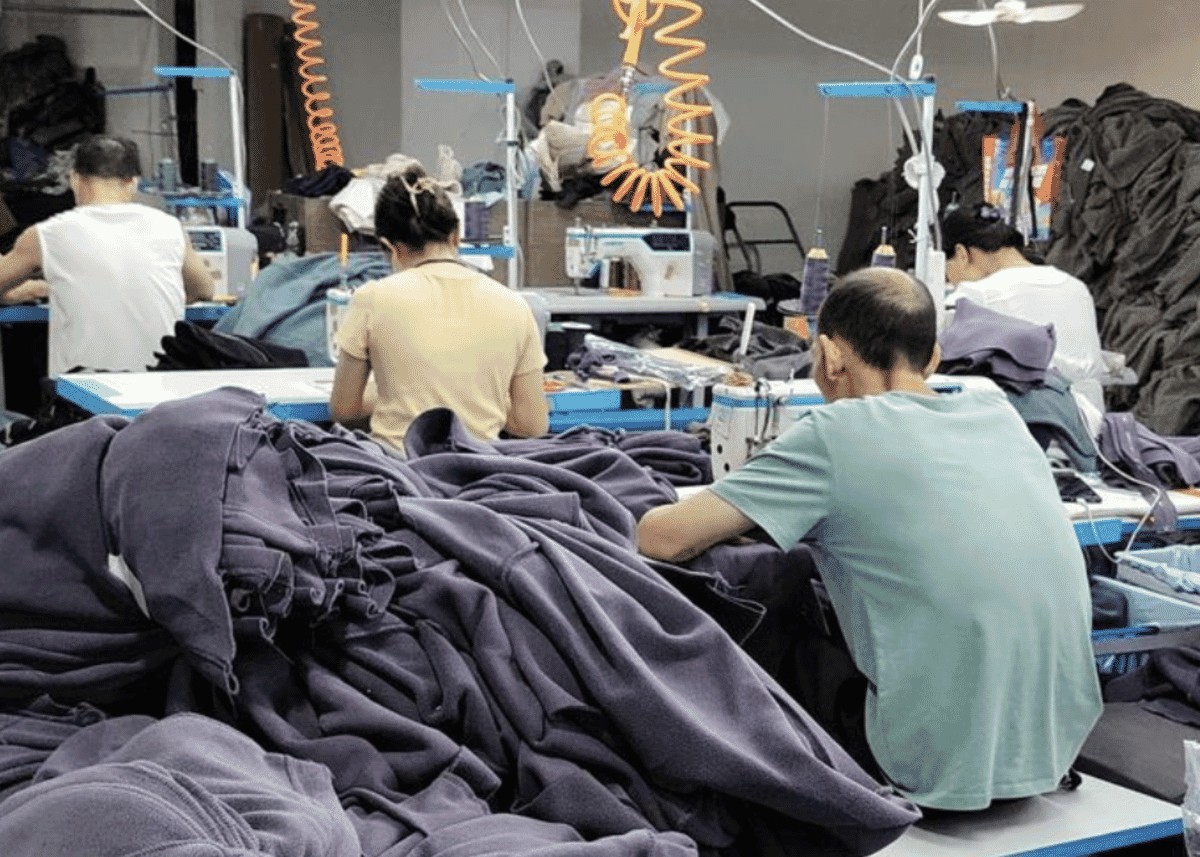
Shortlist faster: our China factory list ($49) sorts documented factories by city, product and capability and shows where each one stands on verification. Pay once and download it straight away.
Quick read: Fully-fashioned and cut-and-sew knit are two different production methods producing garments that look similar. Fully-fashioned panels are knitted to shape and linked; cut-and-sew panels are cut from knitted fabric, which wastes yarn and cuts through the knit structure. Whole-garment knitting makes the piece in a single operation, seamless throughout.
Which Yarn, and What Pills?
Yarn choice sets price, hand-feel, warmth and one of the things customers complain about most, which is pilling. Merino, lambswool, cashmere, cotton and acrylic blends each behave differently, and pilling is governed by fibre length and twist rather than by softness. The yarn that feels softest in the hand frequently pills first.
Merino wool. Fine, soft, breathable, temperature regulating, and it resists odour. The reliable premium default for everyday knitwear.
Lambswool. Warmer and springier, slightly coarser, and considerably cheaper than merino. The traditional sweater yarn.
Cashmere. Very fine, very soft, very expensive, and it pills readily because the fibres are short and fine. Blending it with wool or silk changes both the pilling and the price, and it also changes the US duty line, as covered below.
Cotton. Breathable, machine washable, heavier, and it stretches out of shape more readily than wool because it lacks wool's natural recovery.
Acrylic and blends. Cheap, colourfast, washable, and the volume material for fast fashion knitwear. It pills, it does not breathe, and it is what most inexpensive sweaters are.
On pilling, the honest explanation: pills form when short fibre ends work loose from the yarn, tangle and ball up. Short fibres and loose twist produce more pilling. This means cashmere pills because it is cashmere, not because it is badly made, and a supplier promising a non-pilling cashmere is promising something the fibre cannot deliver. Tighter twist and longer fibre reduce it, and both cost money.
| Yarn | What it gives you | Pilling | Where it suits |
|---|---|---|---|
| Merino wool | Fine, soft, breathable, temperature regulating, resists odour | Low to moderate. Longer fibre and good twist | The reliable premium default for everyday knitwear |
| Lambswool | Warmer and springier, slightly coarser | Moderate | The traditional sweater yarn, and considerably cheaper than merino |
| Cashmere | Very fine, very soft, very expensive | High. Short, fine fibres pill because they are cashmere, not because the garment is badly made | Luxury positioning. Blends change the pilling, the price and the duty line |
| Cotton | Breathable, machine washable, heavier | Low | Warm climates and year-round ranges. It stretches out of shape more readily, lacking wool's recovery |
| Acrylic and blends | Cheap, colourfast, washable | High, and it does not breathe | Volume and fast fashion. What most inexpensive sweaters are |
Pills form when short fibre ends work loose, tangle and ball up, so short fibre and loose twist produce more of them. Tighter twist and longer fibre reduce pilling, and both cost money. A supplier promising non-pilling cashmere is promising something the fibre cannot deliver. The pilling ratings in this table are our general guidance rather than test results.
Ask for a test, not an adjective. The ISO 12945 series covers pilling in parts: the pilling box in Part 1, the modified Martindale in Part 2 and the random tumble in Part 3. The standard itself notes that no single test suits every fibre, yarn and fabric, so agree the method and the pass grade in writing, and test bulk yarn in a knitted swatch rather than yarn on the cone.
Check cashmere claims against the law where you sell. In the United States, the Wool Products Labeling Act treats a product labelled as cashmere as misbranded if the average fibre diameter exceeds 19 microns, or if more than 3% by weight of the cashmere fibres have average diameters above 30 microns. So ask for the spinner's fibre data and a test report for the lot, because the label on the garment is your responsibility as well as the factory's.
Quick read: Sweater yarn sets price, hand-feel, warmth and one of the things customers complain about most, which is pilling. Merino, lambswool, cashmere and cotton behave differently, and pilling is governed by fibre length and twist rather than by softness. A yarn that feels softest in the hand is frequently the one that pills first.
What Is Linking, and Why Does It Show?
Linking is how knitted panels are joined together, and it is one of the clearest visible markers of knitwear quality. Linking joins the panels loop to loop, so the seam stretches with the garment and is almost invisible. An overlocked seam cuts across the knit structure and is felt. Turn any sweater inside out and the method is obvious.
Linking places the loops of one panel onto the points of a linking machine alongside the loops of the other, so the seam is a continuation of the knit structure. It is flat, almost invisible from the outside, adds little bulk, and it is slow skilled work, especially at fine gauges. Shoulder seams and neckline joins on quality knitwear are linked this way.
Overlocked seams join panels with a sewing machine. Fast, cheap, and it produces a ridge inside the garment that is visible at the neckline and felt at the shoulder.
Check a reference garment at the inside neckline. A linked neck has no seam ridge and the rib flows into the body. An overlocked neck has a stitched seam with a visible allowance.
This one detail is part of the price difference between apparently identical sweaters, and it is easy to leave out of a brief. If your reference garment is linked and your brief does not say so, do not be surprised if the sample comes back overlocked, looking cheaper for reasons the reviewer cannot articulate.
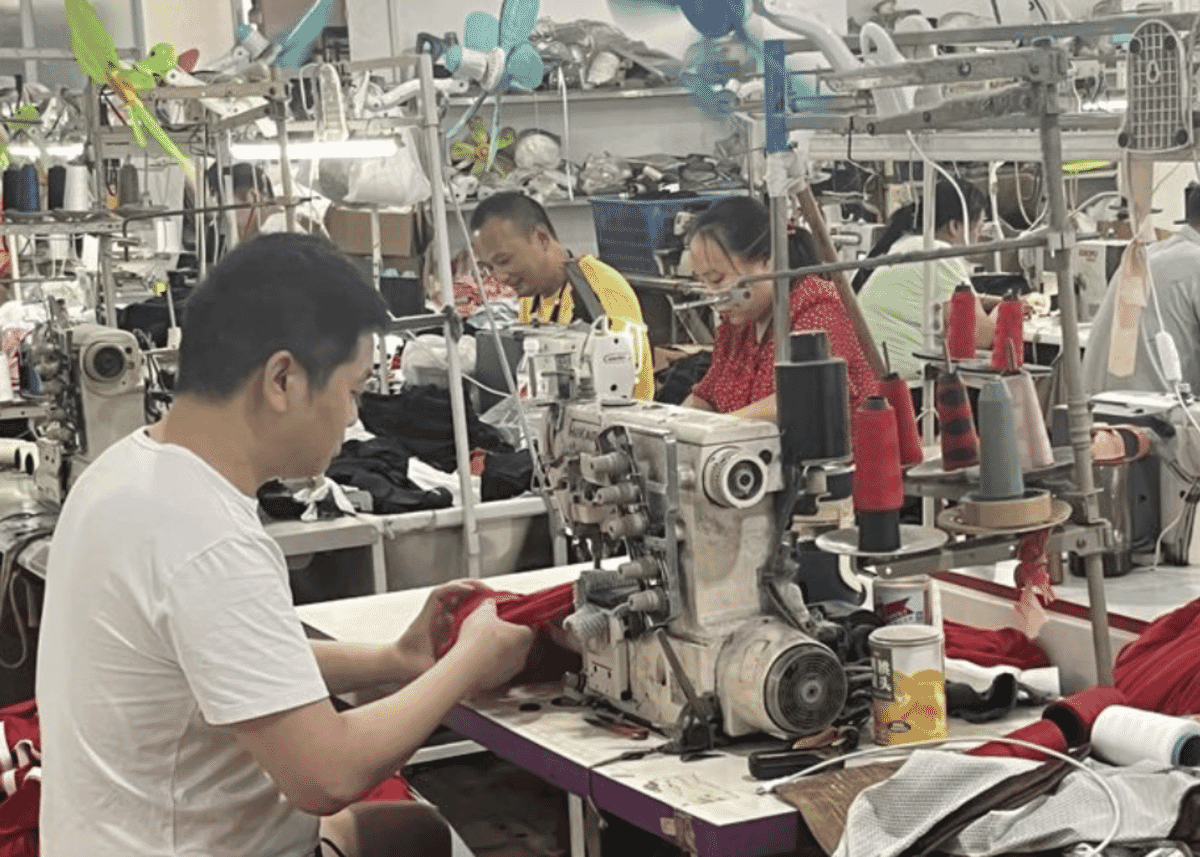
Quick read: Linking joins knitted panels loop by loop so the seam continues the knit structure, producing a flat invisible join with no added bulk. Overlocking joins panels with a sewing machine, creating a visible ridge at the neckline and shoulder. Linking is slow skilled work and is one reason visually similar sweaters are priced differently.
Why Do Knitwear Minimums Work Differently?
Because there is no fabric. The mill minimum that dominates woven and jersey production does not apply, and the constraint moves to yarn. Yarn is bought by weight and by colour, and machines are set up per gauge and per design. That combination is why a sweater in a stock yarn colour can often run at a lower quantity than the same sweater in a custom colour.
Yarn is dyed in lots, and each colour carries a minimum weight. That is the real floor. A sweater in a stock yarn colour can be produced in smaller quantities, because the factory buys yarn off the shelf and knits to order. The same sweater in a custom colour requires a dye lot, and the spinner sets that minimum in kilograms rather than in garments, so ask for the number in kilograms and divide by your garment weight.
Two useful consequences. Chunky garments hit the yarn minimum sooner, because a 3gg sweater uses far more yarn than a 12gg one, so a heavy sweater in a custom colour reaches a viable dye lot at a lower piece count. And colour count is the lever, exactly as in woven production, with a stock yarn colour as the simplest way to pull it.
Machine time is the second cost driver. Finer gauges and complex stitch structures take longer per garment, and a cable-heavy 12gg sweater occupies a machine for much longer than a plain one.
Free tool: get a directional FOB range per piece with the China production cost calculator. No signup to see the range.
Quick read: Knitwear minimums work differently because there is no fabric. The mill minimum that dominates woven and jersey production does not apply, since panels are knitted directly from yarn. Minimums are set by yarn purchase and machine set-up instead, which is why colour count moves a knitwear order so much.
How Does Knitwear Sampling Work?
Faster than cut-and-sew, and the process is different enough to be worth describing. There is no pattern to cut and no fabric to wait for, so a first knit can follow quickly once the specification is clear. What takes the time is measurement after washing, because knitted structures relax and the finished dimension is a post-wash number.
There is no pattern in the cut-and-sew sense. The factory programs the knitting machine with stitch counts and shaping instructions, which is closer to writing a specification than to drawing a pattern. Changing a measurement means editing the program rather than recutting.
The sequence is a knit-down first, which is a swatch in the actual yarn, gauge and stitch, used to confirm hand-feel and the stitch appearance. Then a first sample garment. Then fit corrections and a pre-production sample.
Approve the knit-down carefully. It is the cheapest and fastest decision point in the whole process, and it tells you about hand-feel, stitch definition and how the yarn behaves before anyone commits to a garment. Brands that skip it end up making fabric decisions from a finished sweater, which is slower and more expensive.
Ask for the knit-down to be washed before you judge it. Wool relaxes and blooms after washing, and an unwashed swatch shows you the yarn rather than the garment.
Where Is Knitwear Made in China?
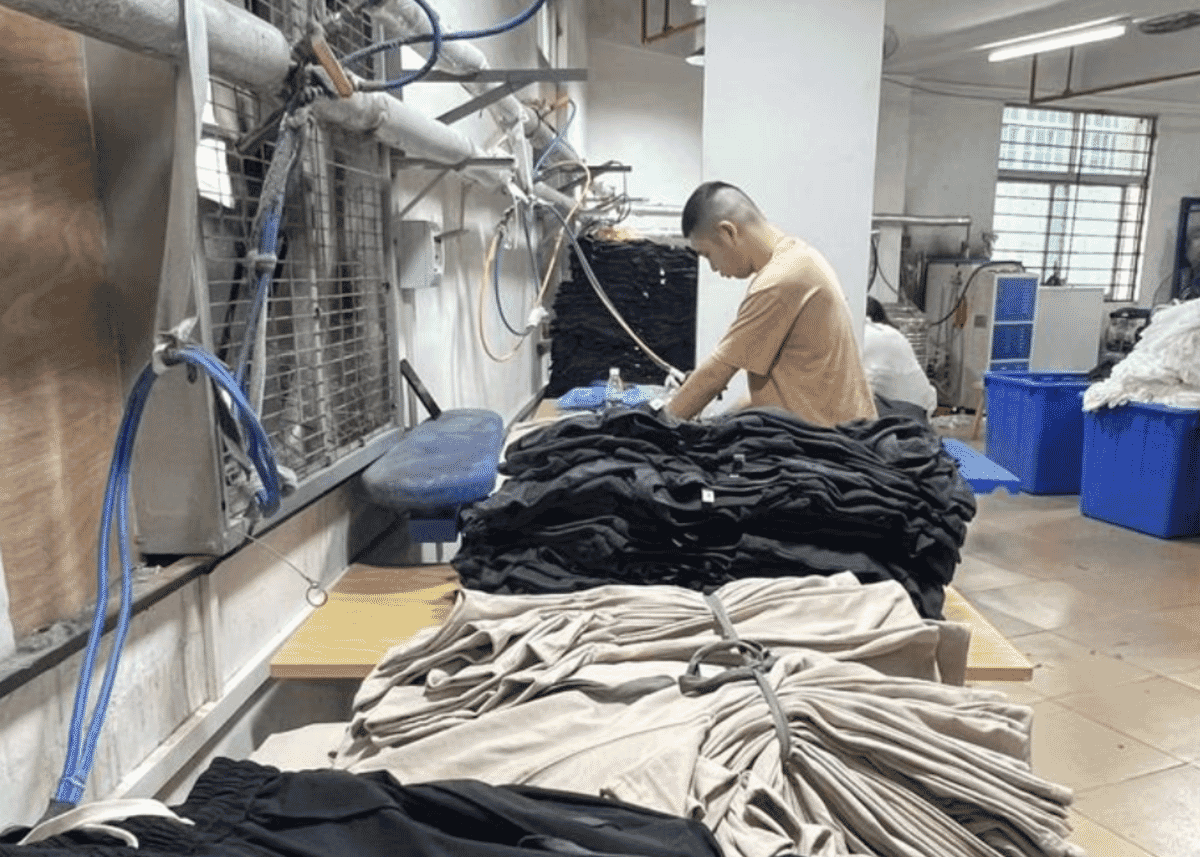
Knitwear clusters separately from woven apparel, because it needs knitting machinery rather than only cutting and sewing lines. Two towns dominate the published story: Puyuan in Zhejiang and Dalang in Dongguan, Guangdong. A general apparel factory usually does not knit, so the first question is who owns the machines.
Puyuan, Zhejiang. A town in Tongxiang, Jiaxing. A China Daily advertorial calls it a sweater distribution centre and reports sweater turnover of 120.85 billion yuan for January to November 2023. That is trade through the town, not output from its factories, so a seller based there may be a trader rather than a knitter. The province around it is heavyweight: Zhejiang generated 1.12 trillion yuan of textile and garment revenue in 2025, about a quarter of the national total (China Daily Ningbo, 2026).
Dalang, Dongguan. People's Daily reported in 2025 that Dalang makes 900 million sweaters a year, and that its flat-knitting machines can turn a design into a finished product in about two hours. The same report says 80% of the whole-garment machines in the town are domestically produced. A trend-driven range fits this model, where one company interviewed there updates styles almost weekly.
Inner Mongolia for cashmere. China Daily reported in 2024 that Ordos produces 13% of the world's raw cashmere and a quarter of its finished cashmere products. Where the fibre comes from and where the garment is knitted can be different places, so ask for both.
Jiangsu. Changshu and Jiangyin appear on published maps of the province's apparel clusters, but we did not find a reliable sweater-specific figure for them, so treat any Jiangsu capability claim as something to check at factory level.
Read the town-level claims with care. The Puyuan advertorial says seven of every ten sweaters in the world originate in the town, and the People's Daily report says one in five comes from Dalang. Neither figure names a source and they sit awkwardly together, so we would not plan around either. Customs data is a firmer base.
The practical read mirrors other specialised categories. A cut-and-sew factory in Guangzhou offering sweaters may well be subcontracting the knitting, and the useful question is not whether that is acceptable but who you speak to when the gauge is wrong. Our knitwear manufacturing page explains what we cover in this category.
What Does China's Sweater Export Data Show?
China exported $20.63 billion of knitted tops under HS heading 6110 in 2024, about 3.25 billion pieces, according to UN Comtrade data. That heading covers sweatshirts and pullovers as well as sweaters, so the totals overstate sweaters proper. Man-made fibre carried $12.53 billion and cotton $6.01 billion, figures also published through the World Bank's WITS database.
The animal-fibre lines are the cleaner read on actual sweaters. China was the largest exporter of knitted cashmere tops by value at $660.8 million, ahead of Italy at $580.3 million. In wool the order reverses narrowly: Italy $1,091.5 million, China $1,061.2 million.
The money per piece is far apart. Dividing declared value by quantity gives about $32 for a Chinese cashmere piece against $260 for an Italian one, and about $17 against $82 in wool. The weight data adds something a price comparison misses: the average Chinese cashmere piece weighs about 263 g net, against about 366 g for Italy. Those lines also include blends in which that fibre predominates, so an average hides a wide range.
| Line | Pieces | Value per piece | Net weight per piece | Value per kg |
|---|---|---|---|---|
| China, cashmere | 20.4m | $32.46 | 263 g | $123.64 |
| Italy, cashmere | 2.2m | $260.24 | 366 g | $711.97 |
| China, wool | 61.3m | $17.32 | 356 g | $48.64 |
| Italy, wool | 13.3m | $81.76 | 380 g | $215.29 |
| China, cotton | 945.2m | $6.36 | 388 g | $16.39 |
| China, man-made fibre | 2,190.1m | $5.72 | 358 g | $15.98 |
Source: our calculation from UN Comtrade data for 2024. Cashmere is HS 611012, wool 611011, cotton 611020 and man-made fibre 611030. These are averages across very different garments, not factory prices or a verdict on quality.
The buyers matter too. The United States took $269.6 million of China's knitted cashmere tops in 2024, about 41% of the total, and $161.7 million of the wool line, about 15%. It also took $1.79 billion of the cotton line and $3.08 billion of the man-made line, according to WITS. So US duty rates are a live cost question for this category, not a footnote.
Quick read: China exported $20.63 billion of knitted tops under HS 6110 in 2024, sweatshirts included, per UN Comtrade data. It was the largest exporter of knitted cashmere tops by value at $660.8 million, while Italy narrowly led wool at $1,091.5 million against China's $1,061.2 million.
What Duty Do Sweaters Pay in the US?
It depends almost entirely on the fibre. On the USITC Harmonized Tariff Schedule checked on 6 November 2026, a wool sweater under 6110.11.00 has a general rate of 16%, cotton under 6110.20.20 pays 16.5%, and most synthetics under 6110.30.30 pay 32%. Goods of Chinese origin can carry additional duties on top of those rates, and they change, so confirm the current total with your broker.
Three lines reward attention at the specification stage. A garment wholly of cashmere under 6110.12.10 pays 4%, while a cashmere garment that is not wholly cashmere falls to 6110.12.20 at 16%, so a small percentage of another fibre can quadruple the general rate. A synthetic sweater containing 23% or more by weight of wool or fine animal hair falls to 17% under 6110.30.15, against 32% without it. And a synthetic garment with 30% or more silk drops to 6.3% under 6110.30.20.
That makes the yarn composition a commercial decision, and one to fix before sampling, since a blend chosen purely for hand-feel can land on the wrong side of a line. Hold the spinner's composition data, because that is what supports the classification on your entry. Our guide to importing clothing from China covers how the rest of the landed cost builds up.
Where you link can matter less than where you knit. Under 19 CFR 102.21, a good counts as knit to shape if half or more of its exterior surface comes from major parts knitted directly to shape, and the rules for such goods generally look to the country where it was knit. A fully-fashioned sweater knitted in China and linked elsewhere should therefore not be assumed to lose its Chinese origin, while a cut-and-sew knit falls under different rules. Take a ruling or your broker's advice before planning around this.
Where the Money Goes
| Element | Effect on cost | What to decide |
|---|---|---|
| Yarn | Often the largest share, and it varies hugely | Fibre and stock versus custom colour |
| Gauge | Finer gauge means more machine time | Choose for the look, not for a number |
| Stitch complexity | Cables and jacquard slow the machine | Where design cost really lands |
| Fashioning | Fully-fashioned costs more than cut | Visible at the armhole |
| Linking | Linking is skilled slow work | The invisible quality marker |
| Washing and finishing | Small per unit, changes the hand | Never cut this |
Where Knitwear Orders Fail
It grows or shrinks after washing. Knitted structures relax, and the amount depends on fibre, gauge and finishing. Ask for the measurement after washing and specify finished dimensions post-wash. This one comes first because a customer discovers it at home rather than in the shop.
It pills immediately. Short-fibre yarn, loose twist, or a cheaper blend than the sample. Verify the yarn composition on bulk rather than trusting the label.
The neckline is overlocked when the reference was linked. Not specified, so the factory used the cheaper method.
Colour varies between garments. Split yarn dye lots. Ask that one style runs from one lot, as with fabric.
The shoulder drops. Knitted garments stretch under their own weight over time, and heavier gauges do it more. Shoulder tape is the fix, and it is a specification the brief has to contain.
How Do You Check a Knitwear Factory?
- Ask which gauges their machines are, since this is a hard constraint rather than a preference.
- Ask whether they link or overlock necklines, and ask to hold both.
- Request a washed knit-down before approving any yarn.
- Get the post-wash measurement and specify finished dimensions after washing.
- Ask which pilling test and grade they work to, and get the result on bulk yarn.
- Verify fibre claims. OEKO-TEX label check for chemical safety, and Textile Exchange for responsible wool and recycled content claims.
- Ask about shoulder taping on any garment above mid-gauge.
- Confirm the gauge first, and confirm the factory owns machines at that gauge.
- Decide fully-fashioned or cut-and-sew, and check the reference at the armhole.
- Specify linked or overlocked necklines explicitly.
- Ask for a washed knit-down before approving the yarn.
- Use stock yarn colours if quantities are small, since the dye lot is the real floor.
- Specify finished measurements after washing, not before.
- Ask for shoulder tape on anything heavier than fine gauge.
- UN Comtrade (2024): China and world exports of HS 611011, 611012, 611019 and 611090 by value, quantity and net weight, and China's exports by partner.
- World Bank WITS, UN Comtrade data (2024): exporters of HS 611030. The same table for HS 611020 gives the cotton figures.
- World Bank WITS, China exports of HS 611030 by partner (2024). The same table for HS 611020 gives the cotton partner figures.
- USITC Harmonized Tariff Schedule: general duty rates in heading 6110.
- 19 CFR 102.21: textile rules of origin, including knit to shape goods.
- 15 U.S.C. 68b, Wool Products Labeling Act: when a product labelled as cashmere is misbranded.
- ISO 12945: fabric propensity to surface fuzzing and to pilling.
- China Daily Ningbo (2026): Zhejiang textile and garment revenue.
- China Daily, Puyuan advertorial (2023): Puyuan sweater turnover and its share claim.
- People's Daily Online (2025): Dalang sweater output and whole-garment machines.
- China Daily (2024): Ordos share of raw cashmere and finished cashmere products.
- Faxian Gongchang, Jiangsu region page: provincial apparel cluster map.
- Textile World (2009): whole-garment knitting with no sewing or linking.
- Isobaa: knit gauge as needles per inch.
- OEKO-TEX Label Check: public verification of certificate numbers.
- Textile Exchange: certified company finder for responsible wool and recycled content claims.
- Office of the United States Trade Representative: Section 301 tariff actions.
- Clothing Suppliers in China: How to Find and Vet a Factory
- Fabric Suppliers in China
- Textile Factories in China
- Hat and Cap Manufacturers in China
- Importing Clothing from China
Before you order knitwear
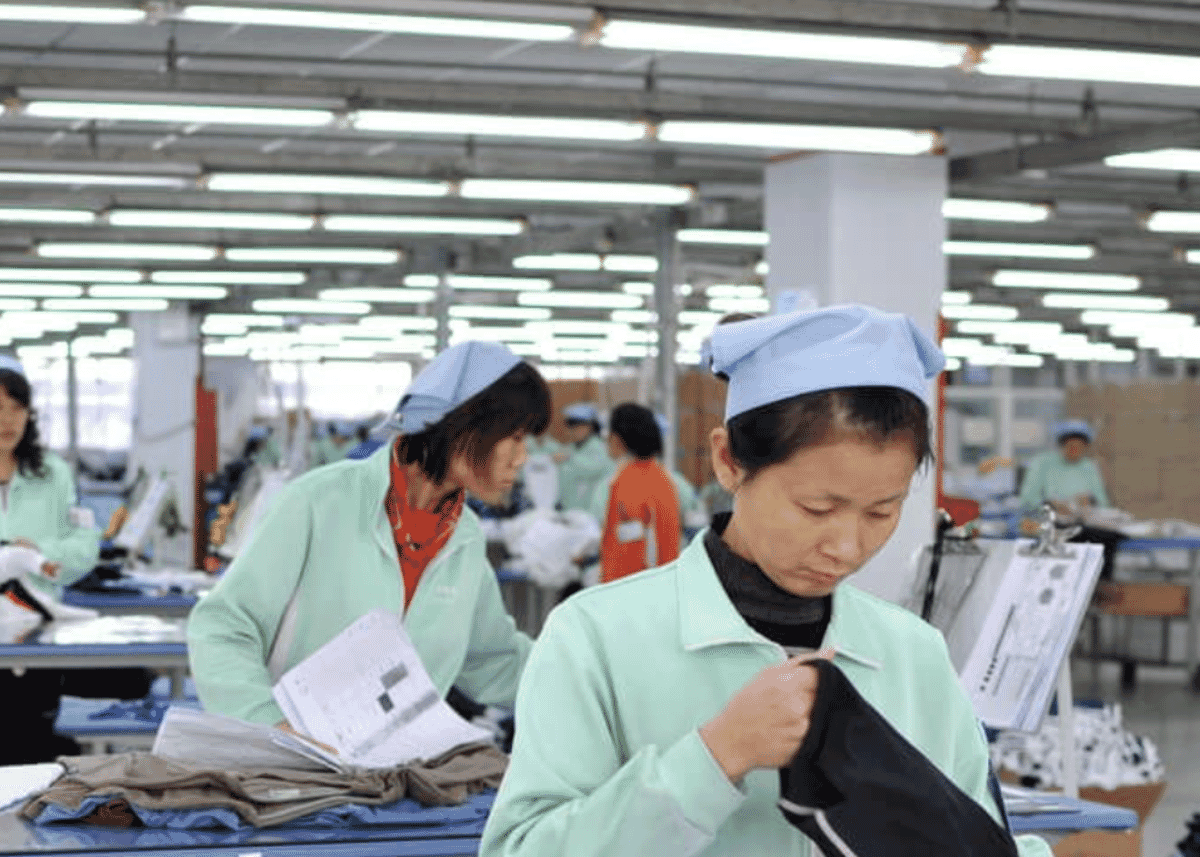
Knitwear is bought by yarn and made by machine. Both decisions are made before anyone sees a garment.
Conclusion
Knitwear rewards specification in places most briefs never reach. Gauge, fashioning, linking and shoulder tape are all decisions, and each of them is visible in the finished garment to a customer who cannot name what they are looking at. That is the useful part. The customer registers the difference without being able to explain it, which is exactly what a specification is for.
On yarn, the useful honesty is that softness and durability trade against each other. Cashmere pills because the fibres that make it soft are short and fine. A supplier offering non-pilling cashmere is either blending it or overstating it, and asking which is a fair question.
Minimums can behave better here than in woven production, because there is no cloth to commission and stock yarn colours are an option. A small brand can bring its quantity down by choosing from a yarn range rather than commissioning a colour, and our group produces from 100 pieces per style.
Then there is fibre. It sets the hand-feel, the pilling and the US duty line at the same time, so settle it early and keep the spinner's data on file.
And approve the knit-down washed. It is the cheapest decision point in the process and it tells you almost everything about how the finished garment will feel.
Our team places and manages production with the documented factories in our China group, from 100 pieces per style. Send a reference sweater or a sketch: our team replies within 24 hours with the gauge, the yarn options and the real minimum. Samples, invoices and shipping run straight between you and the factory; our fee is flat and we take nothing from the factory side.
Send your brief China factory list, $49No spec sheet yet? We draw one style as a factory-ready tech pack for $79. What the $79 covers.
Frequently Asked Questions
What does gauge mean in knitwear?
Gauge is the number of needles per inch on the knitting machine, written as 3gg to 14gg and above. Lower gauges make chunky textured knits using more yarn; higher gauges make fine refined fabric more slowly. A factory can only knit the gauges its machines are built for.
What is the difference between fully-fashioned and cut-and-sew knitwear?
Fully-fashioned panels are knitted to their finished shape with the machine adding and removing stitches, so there is no cutting and no raw edge. Cut-and-sew panels are cut from knitted cloth and sewn, which wastes yarn and leaves a cut edge that must be secured.
Why does my cashmere sweater pill?
Because cashmere fibres are short and fine, which is exactly what makes them soft, and short fibre ends work loose and tangle into pills. No finish eliminates it. Longer fibre and tighter yarn twist reduce pilling, and both cost more.
What is linking and does it matter?
Linking joins knitted panels loop by loop so the seam continues the knit structure, giving a flat invisible join. Overlocking joins them with a sewing machine and leaves a visible ridge at the neckline. Linking is slow skilled work and is one reason similar sweaters are priced differently.
What sets the minimum order for knitwear?
Yarn dye lots, not fabric. A sweater in a stock yarn colour can be made in smaller quantities because the factory buys yarn off the shelf. A custom colour requires a dye lot, and the spinner sets that minimum in kilograms rather than in garments.
How much duty do sweaters pay in the US?
On the USITC tariff schedule checked on 6 November 2026, general rates are 16% for wool, 16.5% for cotton, 32% for most synthetics and 4% for garments wholly of cashmere. Goods of Chinese origin can carry additional duties on top, and those change.
Where are sweaters made in China?
Published coverage centres on Puyuan in Tongxiang, Zhejiang, and on Dalang in Dongguan, Guangdong, with Ordos in Inner Mongolia prominent in cashmere. Town-level output claims are often promotional, so confirm at factory level which machines and gauges are actually on the floor.
Sourcing notes: all company names, certification marks and trademarks referenced here are the property of their respective owners, and naming a source does not imply any relationship with it. Trade figures are UN Comtrade data for 2024, partly as published by the World Bank WITS database, and per-piece and per-kilogram values are simple averages of declared export data, not prices from any factory. Duty rates are the USITC general rates checked on 6 November 2026 and exclude any additional duties on goods of Chinese origin, which change. Town-level figures are as published by the outlets named, and we have not verified them independently. Check your own HTS code and agree terms with the factory in writing before you pay a deposit.
Where the figures come from
Related Reading
No commission and no mark-up on the factory price: the factory invoices you itself.