If you buy socks from China, there is a good chance they were knitted in one place. Datang, a subdistrict of Zhuji in Zhejiang province, produces approximately 25 billion pairs of socks a year according to Xinhua, more than 70 percent of China's output and one-third of the world's.
That concentration is useful to a brand, because the yarn spinners, dye houses, knitting floors, boarding and packing suppliers sit in the same few streets. It also means the questions that decide a good sock order are the same wherever the factory is: which needle count the machine runs, how the toe is closed, what holds the cuff up, and what you check before the balance payment leaves your account.
This guide covers the Datang cluster and what the published figures say about it, China's sock export trade, the needle, toe and cuff specifications to write into a brief, US duty and labelling, and an AQL inspection plan built for socks.
Before you read: China Clothing Manufacturer places and manages production for brands from 100 pieces per style with documented factories in China. Socks are different: they are quoted per pair, per style and per colour, and sock knitters work to higher minimums than our garment factories. Cluster and trade figures in this guide come from the published sources listed at the end. Exact MOQ and price are confirmed with the factory once you send a brief.
What matters most
- Datang is the sock town. Xinhua reported in 2024 that it makes approximately 25 billion pairs a year, more than 70 percent of China's output and one-third of the world's.
- China dominates sock exports. WITS data show about $6.00 billion of cotton and synthetic sock and hosiery exports in 2024, and 71% of US synthetic sock imports came from China.
- Needle count is the sock's gauge. Sock machines run cylinders of about 3.5 to 6 inches, and the needles in the cylinder set fineness and pattern detail.
- Toe closing belongs in the brief. Many modern sock machines close the toe on the machine; open-toe socks are closed in a separate operation. Name the method you want.
- The cuff decides whether socks stay up, through its elastic, depth and rib, not through the leg length.
- Minimums run per pair, style and colour, driven by machine set-up and yarn dye lots.
- Use AQL before the balance. At ISO 2859-1 level II, a lot of 3,201 to 10,000 pairs is sampled at 200, accepted at AQL 2.5 with 10 defects or fewer.
Where Are Socks Made in China?
Above all in Datang. Zhuji is a county-level city in Zhejiang province, and Datang is one of its subdistricts. In February 2024 Xinhua described it as the world's largest sock manufacturing base, producing approximately 25 billion pairs of socks yearly, accounting for more than 70 percent of the output of China and one-third of the whole world (Xinhua via gov.cn, 2024).
Other reports give slightly different figures, which is normal for local industry statistics. A 2022 China Daily report put the town's output at as many as 27 billion pairs worth 75 billion yuan ($11.14 billion) a year, 70 percent of the national market and 35 percent of the global market, made by over 6,000 enterprises, a number that would be nearly 10,000 if individual businesses and family mills were counted (China Daily, 2022). A Xinhua report in October 2025 said Datang produces over 25 billion pairs annually and is home to the world's largest hosiery industrial cluster, with an industrial scale exceeding 70 billion yuan, about $9.9 billion (Xinhua, 2025).
The cluster grew from very small beginnings. According to People's Daily Online, the hosiery industry in Datang sprouted in the late 1970s and took off in the mid-1980s, when 70 percent of local residents started knitting socks at home as a sideline, and Datang's first textile market opened in 1991 (People's Daily Online, 2023). China Daily records that Datang produced 9 billion pairs in 2004, which made it the world's largest sock producer, and that 150,000 people work in its hosiery industry (China Daily, 2022).
Output has not simply kept rising. The same People's Daily report says annual output exceeded 25.8 billion pairs in 2014, when many manufacturers supplying other companies on an OEM basis were stuck competing on price, and that although overall output has since subsided, the production base's total output value has quadrupled over 20 years (People's Daily Online, 2023). For a buyer, the practical reading is that Datang today offers both very low-cost basic socks and factories that have invested in automated machines, design and finer yarns. Which of the two you are talking to is a question to ask, not to assume.
At city level, a 2022 report from the Zhejiang government's English portal said Zhuji is home to more than 10,000 sock firms and a comprehensive industrial chain, and that the Zhuji Socks Association has 110 affiliated firms. The 16th China Datang International Socks Expo, held that year, drew more than 3,000 professional visitors from 21 countries (ezhejiang.gov.cn via China Daily, 2022). For other categories made in the province, see our page on clothing manufacturers in Zhejiang.
Read these numbers for what they are: local government and media figures, reported in different years and counting slightly different things. They agree on the point that matters. Datang is the deepest concentration of sock knitting capacity anywhere, and a sock bought from a general supplier in China may well have been knitted there.
Quick read: Datang, a subdistrict of Zhuji in Zhejiang province, is the world's largest sock production base. Xinhua reported in 2024 that it makes approximately 25 billion pairs of socks a year, more than 70 percent of China's output and one-third of the world's. China Daily counted over 6,000 sock enterprises there in 2022, and the industry has grown from home knitting in the late 1970s to a hosiery cluster with an industrial scale above 70 billion yuan.
How Big Is China's Sock Export Trade?
Socks fall under HS heading 6115, which also covers tights and stockings. World Bank WITS reports China's trade under the 1992 version of the code list, in which socks and other hosiery of cotton are line 6115.92 and those of synthetic fibres are 6115.93. The current US tariff schedule numbers the same goods 6115.95 and 6115.96.
According to WITS, China exported $2.69 billion of cotton socks and hosiery in 2024 on a reported weight of 263,390,000 kg, and $3.31 billion of synthetic fibre socks and hosiery on 389,947,000 kg (WITS, cotton, WITS, synthetic). Together that is about $6.00 billion. Both lines dipped in 2020 and peaked in 2022, when synthetic exports reached $3.41 billion.
Divide value by weight and cotton socks left China at about $10.21 per kg in 2024 and synthetic socks at about $8.50 per kg. Those are averages across every style and grade, from basic multipacks to technical sports socks, not prices any factory will quote.
No other country comes close. In the 2024 WITS table of cotton sock exporters, China's $2.69 billion compares with $744.4 million for Turkey, $421.0 million for Pakistan, $412.9 million for the Netherlands and $410.7 million for Germany (WITS). In synthetic socks the gap is wider: Turkey, again second, exported $201.6 million (WITS).
The US import records show the same pattern from the buying side, with one twist. In 2024 the United States imported $1.53 billion of synthetic fibre socks and hosiery, of which $1.10 billion came from China, followed by El Salvador at $108.0 million and Vietnam at $91.1 million (WITS). China supplied about 71% of the total.
Cotton socks are different. The US imported $708.7 million of them in 2024, and China was third: Pakistan supplied $178.4 million, Honduras $132.3 million and China $129.8 million, about 18% of the total (WITS). For a US brand buying cotton basics, China is one option among several; for synthetic and blended socks it is the main source.
| US cotton sock imports, 2024 | US$ million |
|---|---|
| Pakistan | 178.4 |
| Honduras | 132.3 |
| China | 129.8 |
| El Salvador | 70.2 |
| Cambodia | 53.0 |
| All suppliers | 708.7 |
Source: World Bank WITS (UN Comtrade data), United States imports of HS 611592 by partner, 2024.
Two cautions. Exporter and importer statistics rarely agree, because they value goods at different points and record timing differently, so use each side's figure for its own question. And these are China totals, not Datang figures: customs data records the country a sock was exported from, not the town that knitted it.
Quick read: According to World Bank WITS data, China exported $2.69 billion of cotton socks and hosiery and $3.31 billion of synthetic fibre socks and hosiery in 2024, about $6.00 billion together. China was the largest exporter in both lines, at about 3.6 times Turkey in cotton. In US records, China supplied 71% of synthetic sock imports in 2024 but only 18% of cotton sock imports, behind Pakistan and Honduras.
What Is Needle Count, and Why Does It Decide the Design?
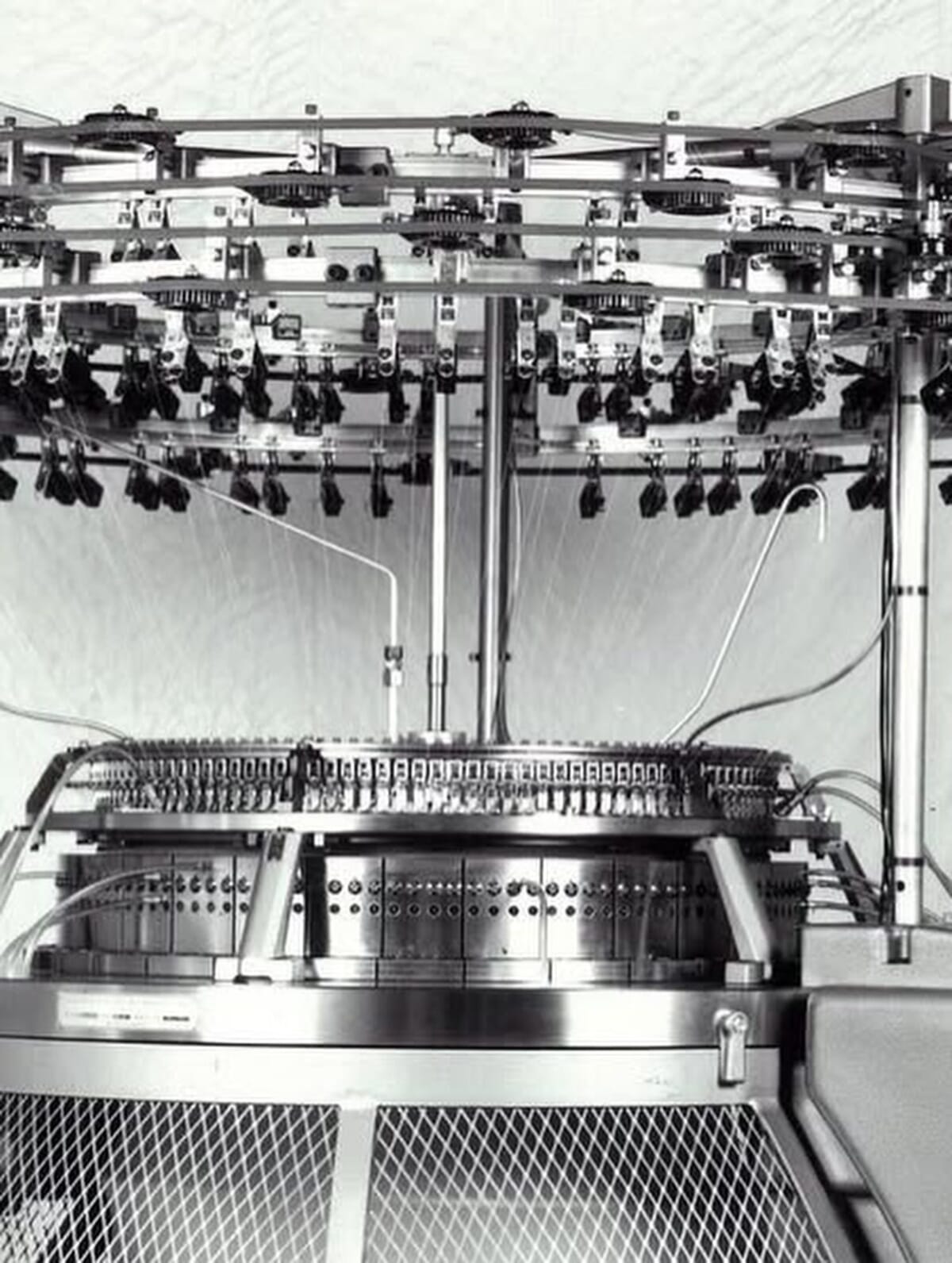
Needle count is the number of needles around the knitting cylinder, and for socks it plays the role that gauge plays for sweaters. Sock machines are small-diameter circular knitting machines. Groz-Beckert, which makes needles for them, says they are offered with typical diameters from 3.5 to 6 inches, and that unlike large-diameter circular machines they knit individual socks rather than continuous tubular fabric (Groz-Beckert).
On the same cylinder diameter, more needles means a finer, smoother knit and more room for pattern detail, and fewer needles a coarser, thicker sock. Two examples from published machine descriptions show the range. The University of Zagreb's textile faculty lists a sock machine with a 95 mm (3 3/4 inch) cylinder and 108 needles, gauge E9, designed for medium cotton or sports socks (University of Zagreb). Knitting Industry reported Lonati machines at a 2018 Shanghai show with a 3.5 inch cylinder and 200 needles for jacquard socks, and 120 needles for baby socks (Knitting Industry, 2018).
Three things follow for a brief:
- Needle count is a capability, not a setting. A factory owns machines at particular cylinder sizes and needle counts. A sock outside that range means a different machine, often a different factory, not a different price.
- Design detail must fit the needles. A small logo, fine text or a gradient that reads clearly at a high needle count can blur at a low one. If the factory says a mark will not resolve, simplify the mark.
- Single or double cylinder matters for rib. Groz-Beckert notes that links needles are used in double cylinder machines, for instance for classy ribbed men's socks, while single cylinder machines with transfer needles make lace and rib patterns of their own (Groz-Beckert).
Ask the supplier which cylinder sizes and needle counts it runs before you send artwork. It is one question, and it decides what the design can be. Our guide to sweater manufacturers in China covers gauge on flat knitting machines, which follows the same logic.
Quick read: Needle count is the number of needles in a sock machine's cylinder and works as the sock equivalent of gauge. Sock machines have cylinders of about 3.5 to 6 inches, according to Groz-Beckert; published examples range from 108 needles on a 95 mm cylinder for medium cotton socks to 200 needles on a 3.5 inch cylinder for jacquard socks. Factories own machines at fixed needle counts, so the design has to fit the machine.
How Is the Toe Closed, and Why Should the Brief Say So?
A sock machine knits from the cuff down, shapes the heel, knits the foot and finishes at the toe, which is left open unless the machine closes it. That closure is the one join a wearer presses against all day, so the method is worth naming.
Many modern machines close the toe themselves. Groz-Beckert explains that toe closing systems remove the sock from the knitting cylinder and sew it on the machine, so the sock emerges finished and manual closing becomes unnecessary, with stitch-precise closing and the least possible waste (Groz-Beckert). Knitting Industry reported in 2018 that the vast majority of Lonati machines incorporated automatic toe closing, with open-toe machines down to around 12% of the company's production (Knitting Industry, 2018).
There are three outcomes to choose between, in practice:
| Toe closure | How it is done | What the wearer feels | Where it fits |
|---|---|---|---|
| Linked, loop by loop | Each loop of the last course is joined to its opposite loop, on the machine or on a linking machine | A flat, nearly invisible join | Premium and fine-gauge socks |
| Closed on the knitting machine | An automatic toe closing device sews the toe before the sock leaves the machine | Usually a small, soft seam | Common on modern machines |
| Open toe, sewn off the machine | Socks leave the machine open and an operator closes them, often on an overlock machine | A ridge across the toes, more noticeable | Older lines and some low-cost basics |
Linking is still developing. In 2023 Knitting Industry reported that a Florence machinery company had developed a patented loop-by-loop toe linking device that can be fitted to single cylinder sock machines in diameters of 3 1/2, 3 3/4, 4, 4 1/2 and 5 inches, and that it is suitable for fine-gauge socks (Knitting Industry, 2023). The point for a buyer is that a flat toe is no longer only a hand operation, but it is still a specific capability a factory has or does not have.
Write the closure into the tech pack, ask for it on the sample, and check it in production: turn the sock inside out and look at the toe. A sample with a flat linked toe followed by bulk with an overlocked ridge is the kind of change an inspection should catch.
Have a reference sock you want to reproduce? Send photos of the outside, the inside of the toe and the cuff, and the composition label, and our team comes back with the needle, toe and cuff questions a sock knitter will ask. Send it here.
Quick read: A sock is knitted as a tube that ends open at the toe. Many modern sock machines close the toe automatically before the sock leaves the machine; Lonati's open-toe machines were down to around 12% of its production in 2018. Loop-by-loop linking gives the flattest join, and an overlocked toe sewn off the machine leaves a ridge, so the closure method belongs in the specification and in the inspection.
Why Do Socks Slide Down?
Because of the cuff, and almost never because of the leg length. The cuff, or welt, is the ribbed band at the top of the sock, usually knitted with an elastic yarn laid in. Groz-Beckert notes that sock machines use transfer jacks to make the welt (Groz-Beckert), which is a reminder that the cuff is knitted into the sock rather than sewn on, and that its grip comes from the yarns and the structure chosen for it.
Three variables decide whether it holds:
- The elastic yarn. Covered elastane, wrapped in nylon or polyester, recovers better and lasts longer than a bare rubber thread, which degrades with heat and washing.
- The cuff depth. A deeper ribbed band spreads the grip over more of the leg, which holds better and marks the skin less than a narrow tight band.
- The rib and the tension. A 1x1 rib grips differently from a 2x2, and the tension the elastic is laid in at sets the final holding power.
There is a second elastic that briefs often forget. Elastic laid into the arch, and in some socks around the ankle, keeps the foot section in place inside a shoe. Without it the heel pocket can twist under the foot and the sock feels loose however well the cuff grips.
Write the cuff as numbers and names: cuff height, rib type, the elastic yarn and its covering, and whether arch support is included. Then test it the way customers will, by washing the sample several times and checking that the cuff recovers.
Which Yarn and Which Construction?
Socks can be made from a wide range of fibres. Wikipedia's article on the sock lists cotton, wool, nylon, acrylic, polyester and olefins such as polypropylene, notes that nylon arrived in socks in 1938 and started the practice of blending two or more yarns that continues today, and says merino wool offers warmth and comfort and retains its shape better when blended with other materials (Wikipedia, Sock).
- Combed cotton. Short fibres removed before spinning, giving a smoother, stronger yarn that pills less than carded cotton. For a cotton sock it is the specification that matters most.
- Merino wool. Warm, comfortable across a wide temperature range and better with moisture than cotton. Usually blended with nylon for strength.
- Synthetics. Nylon and polyester add abrasion resistance and are present in most durable socks as a minority component at the heel and toe, where pure natural fibres wear through first.
- Elastane. A small share of covered elastane gives recovery through the foot as well as at the cuff.
Construction adds a second layer of choice. Terry socks feed extra yarn during knitting to form loops on the inside face, which compress underfoot as cushioning. Terry can be applied to the whole sock, to the foot only so the leg stays thin enough for trousers, or to zones at the heel and ball of the foot, as in many running socks. Zoning uses less yarn than full terry, but the machine and its programme have to support it.
For the US market, the fibre label must give the generic names and percentages by weight of the fibres present in amounts of 5 percent or more, and each imported textile product must be labelled with the country where it was processed or manufactured (16 CFR Part 303). Agree the label wording from the yarn specification before bulk, because a sock's composition changes with every yarn in the heel, toe and cuff. Our guide to label manufacturers in China covers care and content labels.
Chemical safety matters for a product worn against the skin. If a supplier claims an OEKO-TEX STANDARD 100 certificate for its yarn or finished socks, confirm it by number on the OEKO-TEX label check and check that the scope covers the articles you are buying.
Try it free: pressure-test your landed cost with the China production cost calculator. About a minute, and no email asked.
What Sets Sock Minimums?
Machine set-up and yarn, in that order, and neither is about the number of pairs. A sock machine is programmed and threaded for a needle count, a yarn set and a design, and the time spent setting it up produces nothing. That cost is spread across the run, so one design in a long run costs far less per pair than many designs in short runs, even when the total number of pairs is the same.
Yarn adds the second minimum. Every custom colour is a dye lot with its own minimum weight, and a sock uses little yarn per pair, so reaching a dye lot takes many pairs. That is why sock knitters hold a wide range of stock yarn colours, and why stock colours are the cheapest way to a small first order.
This is also why socks are quoted per pair, per style and per colour, and why sock minimums are higher than the garment minimums on the rest of this site. Sizes are usually mixed within that quantity, with the split confirmed by the factory. Three levers bring the real minimum down:
- Fewer designs, more pairs each. A narrow, deep first range pays fewer set-ups.
- Stock yarn colours. No new dye lot, no new yarn minimum.
- Standard packaging. Bands, hangers and boxes carry their own minimums, and custom packaging can need more units than the sock order itself.
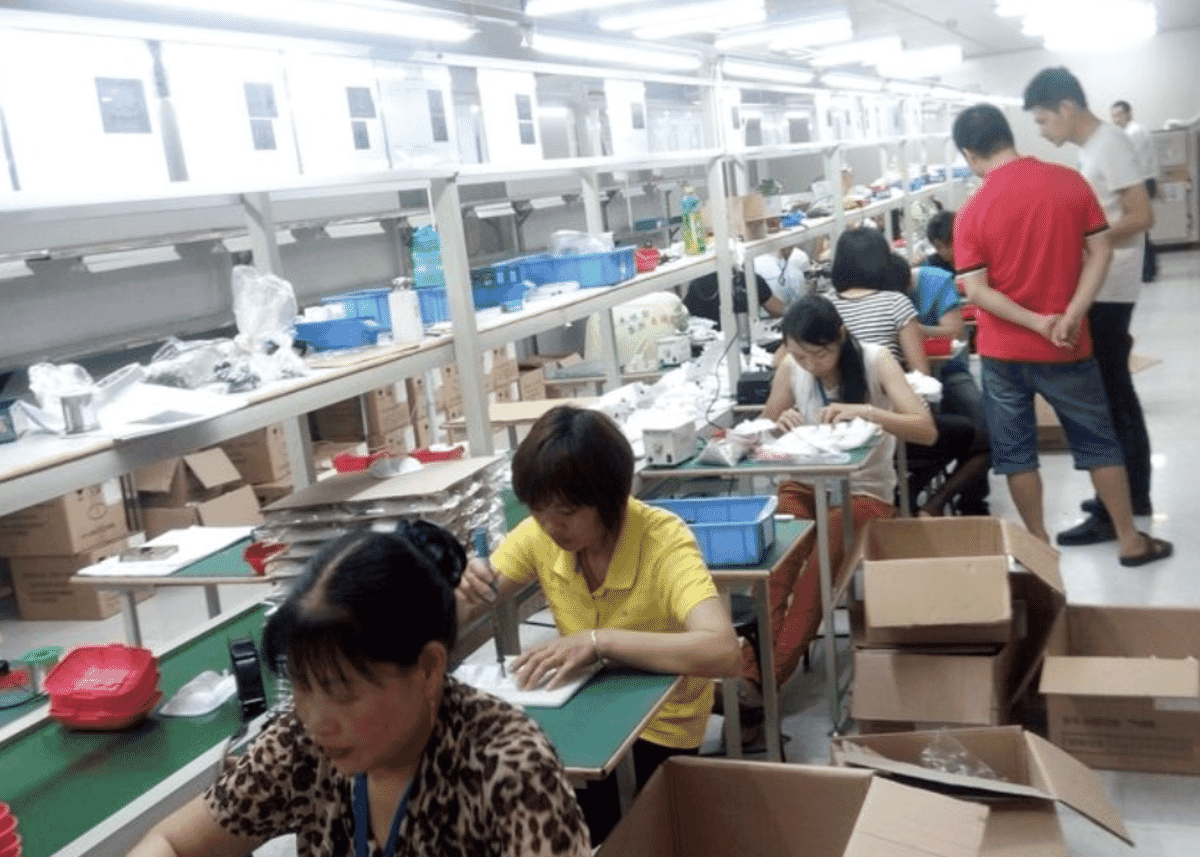
Our guide to packaging suppliers in China covers retail packaging minimums in more detail.
What US Duty Applies to Socks From China?
The US tariff schedule splits socks by fibre and by whether they contain lace or net. Cotton socks carry a general rate of 13.5%, or 10% when they contain lace or net (USITC HTS 6115.95). Synthetic fibre socks carry 14.6%, or 18.8% when they contain lace or net (USITC HTS 6115.96).
| HTS line | What it covers | General US duty |
|---|---|---|
| 6115.95.60.00 | Socks and hosiery of cotton, containing lace or net | 10% |
| 6115.95.90.00 | Socks and hosiery of cotton, other | 13.5% |
| 6115.96.60 | Socks and hosiery of synthetic fibres, containing lace or net | 18.8% |
| 6115.96.90 | Socks and hosiery of synthetic fibres, other | 14.6% |
Source: US International Trade Commission, Harmonized Tariff Schedule, checked November 2026. Additional duties on Chinese goods are not included.
These are general rates. Goods from China can carry additional duties, and the schedule changes, so check the current position for your exact line before you price. Fibre content decides the line: a sock that is mostly cotton by weight and one that is mostly nylon fall under different rates. Our guide to importing from China covers the wider process.
AQL Before the Balance: What to Inspect Before You Pay
The balance payment is the last point at which you have leverage, and the goods are still in the factory. That makes it the right moment for an independent check against your specification and the approved sample. QIMA, an inspection company, describes its pre-shipment inspection as an examination conducted when 80% of your production order is complete (QIMA).
The sample size comes from ISO 2859-1, the sampling standard behind AQL inspection tables. At general inspection level II, the usual level, the table gives the sample size by lot size. You choose the acceptable quality limit (AQL) for each defect class, and the table gives an accept and reject number. For a lot of 3,201 to 10,000 pairs the sample is 200, and at AQL 2.5 the order is accepted with 10 defects or fewer and rejected at 11. For a smaller lot of 1,201 to 3,200 pairs the sample is 125, accepted at 7 and rejected at 8 (ISO 2859-1 tables, QC Advisor).
Decide before the inspection whether a unit is a pair or a single sock, and write it into the inspection brief. Beyond the usual workmanship, colour and packing checks, a sock inspection should include:
- Toe closure: socks turned inside out to confirm the closing method and look for holes, dropped loops or a ridge where the sample was flat.
- Measurements: total length, foot length, leg length and cuff width, measured flat or on a sock board as your size chart specifies, against its tolerance.
- Cuff recovery: the cuff stretched and released, and a few pairs washed and dried on your specified cycle, then checked again.
- Pairing: both socks in a pair the same length, shade and pattern placement, and no mixed sizes inside a pack.
- Knitting faults: holes, needle lines, dropped stitches, yarn knots and pattern errors, especially in jacquard logos.
- Heel and toe reinforcement: the nylon or reinforcement yarn present where the specification puts it.
- Labels and packing: composition and origin labels, bands or cards, barcodes, inner packs and carton marks as agreed.
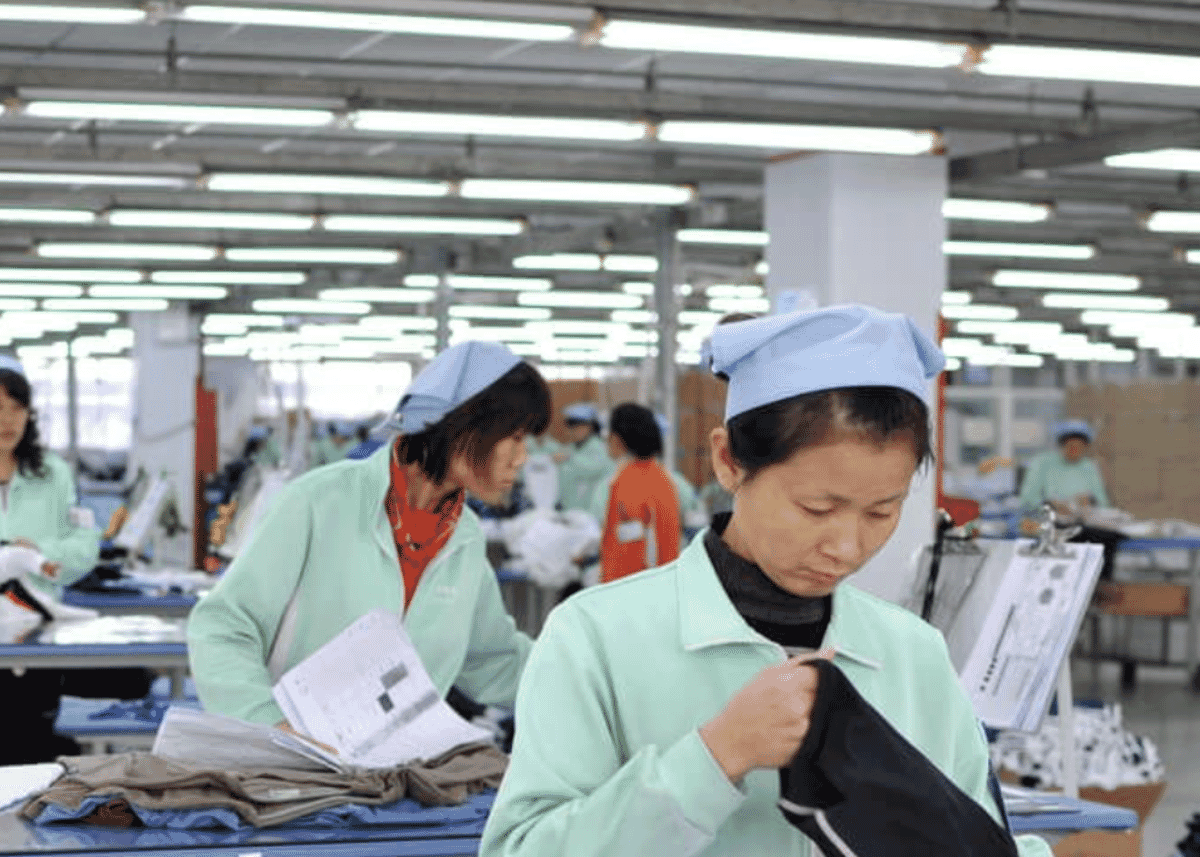
Make the balance depend on the report. If the toe closure or the cuff fails, the time to discuss rework or a price adjustment is before the money moves, not after the cartons arrive. Our guide to hoodies from China uses the same pre-balance check for fleece.
Quick read: A pre-shipment inspection is run when about 80% of a production order is complete, with the sample size taken from ISO 2859-1. At general inspection level II, a lot of 3,201 to 10,000 pairs is sampled at 200 and accepted at AQL 2.5 with 10 defects or fewer. For socks, add a toe closure check, a cuff recovery test after washing and a pairing check before the balance is paid.
Where the Money Goes in a Sock
| Element | Effect on cost | What to decide |
|---|---|---|
| Machine set-up | Paid per design and colourway, not per pair | Fewer designs, longer runs |
| Needle count | Finer machines knit more slowly | Fit the needle count to the design detail |
| Yarn | Combed cotton and merino cost more; custom colours need dye lots | The main quality lever |
| Toe closure | Linking needs the right machines | Linked, machine-closed or sewn |
| Terry | Uses more yarn where applied | Zone it rather than apply it everywhere |
| Packaging | Own minimums, which can exceed the sock order | Check before designing it |
| Duty into the US | 13.5% to 14.6% on most socks, before extra duties | Fibre content and HTS line |
Where Sock Orders Fail
They slide down. Cuff elastic too weak, cuff too shallow, or no arch support. It is the complaint customers voice most, because they feel it every day.
The toe seam is felt. A sewn, overlocked toe where the sample had a linked or machine-closed toe. Name the closure and inspect it.
They wear through at the heel. Not enough nylon, or none at the heel and toe. State the composition and the reinforcement zones.
The logo is illegible. Design detail beyond what the needle count can resolve. Simplify the mark rather than changing factory.
Sizing is wrong. Sock sizes follow several conventions, and Wikipedia notes that what range of shoe sizes a sock size covers varies between markets (Wikipedia, Sock). State the shoe size range for every sock size.
Packaging holds the order. Custom bands or boxes with a longer lead time or a higher minimum than the socks. Order packaging decisions first.
Before you order socks in China
- Ask which cylinder sizes and needle counts the factory runs before finalising the design.
- Name the toe closure: linked, machine-closed or sewn.
- Specify cuff height, rib, elastic yarn and arch support.
- Write the composition by yarn, with nylon at heel and toe, and agree the fibre label.
- Zone terry where cushioning is needed instead of applying it to the whole sock.
- Cut the number of designs and colours, not the pairs, to lower the real minimum.
- State the shoe size range for each sock size.
- Book an AQL inspection at about 80% complete, with toe, cuff and pairing checks, before the balance.
How Do You Check a Sock Supplier in Datang?
Ask questions that only a sock knitter answers easily:
- Machinery. Which cylinder sizes and needle counts it runs, single or double cylinder, and how many machines close the toe automatically.
- Finishing. Whether boarding, pairing and packing are done in-house or sent out, and who checks the socks at each step.
- Yarn. Which stock colours it holds, and the minimum for a custom dye lot.
- Testing. Whether it wash-tests samples and checks cuff recovery, and how it records the approved yarn references.
- Certificates. Certificate numbers, not logos, for any chemical or social compliance claims, checked with the issuing body.
A general apparel supplier that offers socks without its own machines is likely to be placing the order with a knitter elsewhere, probably in Zhejiang, which adds a step between you and the people knitting it. That can be worth paying for if you need the support, but it is a question to ask directly. For sports socks to go with a sportswear range, see our activewear guide, and for knitted gloves, which come off related machines, our guide to glove manufacturers in China.
Conclusion
China exports about $6 billion of socks and hosiery a year, and a large share of the world's socks comes from one subdistrict of Zhuji. The capacity is there, at every price point. What arrives in your warehouse still depends on what you write down and what you check.
For the product, start with the machine: the needle count decides what the design can be. Then name the toe closure, write the cuff as numbers and names, and specify nylon at the heel and toe. For the range, keep designs and colours few, because set-up and dye lots drive the minimum. For the order, book an AQL inspection before the balance, with toe, cuff and pairing checks, and pay when the report says the bulk is what you approved.
We are a group of documented clothing factories in China. Send a reference pair or a design with your yarn, size range and market, and we place production with the factory in our group built for the product. Socks are quoted per pair, per style and per colour, and the factory confirms the exact minimum. Our team replies within 24 hours. Samples, invoices and shipping run straight between you and the factory; our fee is flat and we take nothing from the factory side.
Send your brief China factory list, $49No spec sheet yet? We draw one style as a factory-ready tech pack for $79. What the $79 covers.
Frequently Asked Questions
Where are most socks made in China?
In Datang, a subdistrict of Zhuji in Zhejiang province. Xinhua reported in 2024 that Datang produces approximately 25 billion pairs of socks a year, more than 70 percent of China's output and one-third of the world's.
How much does China export in socks?
According to World Bank WITS data, China exported $2.69 billion of cotton socks and hosiery and $3.31 billion of synthetic fibre socks and hosiery in 2024, about $6.00 billion together.
What is needle count in socks?
The number of needles in the knitting cylinder, which works like gauge in knitwear. More needles on the same cylinder give a finer knit and more design detail. Factories own machines at fixed needle counts, so the design has to fit the machine.
Why can I feel the seam in my socks?
Because the toe was closed with a sewn seam. Socks are knitted as a tube and the toe is closed at the end, either on the machine, by loop-by-loop linking, or by sewing off the machine. Linking gives the flattest join. Name the closure in your specification.
What is the US import duty on socks?
Cotton socks carry a general rate of 13.5% (10% with lace or net) and synthetic fibre socks 14.6% (18.8% with lace or net). Goods from China can carry additional duties.
What AQL should I use for socks?
There is no single required AQL: you choose one for each defect class and write it into the inspection brief. If you choose AQL 2.5 at general inspection level II, ISO 2859-1 samples a lot of 3,201 to 10,000 pairs at 200 and accepts it with 10 defects or fewer.
Sourcing notes: all company names, certification marks and trademarks referenced here are the property of their owners. Cluster figures come from local government and media sources reported in different years. Reviewed and updated 13 November 2026 by David Stan.
Where the figures come from
- Xinhua via gov.cn: Production lines of sock companies in E China operate in full swing to meet orders, February 2024. Datang output and shares.
- China Daily: East Chinese town of Datang socks it to world, June 2022. Enterprises, output, history, employment.
- Xinhua via chinaservicesinfo.com: Pearls and socks: East China city's dual global triumphs, October 2025. Output and cluster scale.
- People's Daily Online via chinaservicesinfo.com: Transformation story of E China's Datang subdistrict, socks capital of the world, August 2023.
- ezhejiang.gov.cn via China Daily: Digital transformation reshapes socks industry in Zhuji, October 2022. Firms, association, expo.
- Wikipedia: Datang, Zhuji.
- World Bank WITS: China exports of HS 611592 (hosiery of cotton), 2024, by partner.
- World Bank WITS: China exports of HS 611593 (hosiery of synthetic fibres), 2024, by partner.
- World Bank WITS: China exports of HS 611592, 2023.
- World Bank WITS: China exports of HS 611593, 2023.
- World Bank WITS: China exports of HS 611592, 2022.
- World Bank WITS: China exports of HS 611593, 2022.
- World Bank WITS: China exports of HS 611592, 2021.
- World Bank WITS: China exports of HS 611593, 2021.
- World Bank WITS: China exports of HS 611592, 2020.
- World Bank WITS: China exports of HS 611593, 2020.
- World Bank WITS: China exports of HS 611592, 2019.
- World Bank WITS: China exports of HS 611593, 2019.
- World Bank WITS: Top exporters of HS 611592, 2024.
- World Bank WITS: Top exporters of HS 611593, 2024.
- World Bank WITS: United States imports of HS 611593 by partner, 2024.
- World Bank WITS: United States imports of HS 611592 by partner, 2024.
- Groz-Beckert: Needles and system parts for small diameter circular knitting machines (legwear).
- University of Zagreb, Faculty of Textile Technology: Automatic sock-knitting machine, equipment catalogue.
- Knitting Industry: Lonati shoe upper machine debuts in China, October 2018.
- Knitting Industry: Loop introduces new toe closing technology, September 2023.
- Wikipedia: Sock. Materials, nylon, merino, sizes.
- QIMA: Pre-shipment inspection.
- QC Advisor: ISO 2859-1 sample size table and single sampling plan for normal inspection (PDF).
- US International Trade Commission: Harmonized Tariff Schedule, subheading 6115.95, general duty rates.
- US International Trade Commission: Harmonized Tariff Schedule, subheading 6115.96, general duty rates.
- eCFR: 16 CFR Part 303, Rules and Regulations under the Textile Fiber Products Identification Act.
- OEKO-TEX: Label check.
Related Reading
- Clothing Manufacturers in Zhejiang
- Sweater Manufacturers in China
- Glove Manufacturers in China
- Packaging Suppliers in China
- Hoodies from China
- Clothing Suppliers in China: How to Find and Vet a Factory
No commission and no mark-up on the factory price: the factory invoices you itself.