- Terry, loopback or fleece
- What fleece GSM tells you
- China's sweatshirt exports
- Cotton, polyester or blend
- Shrinkage and how it is tested
- Writing the fleece spec
- Printing on fleece
- Details that read as quality
- Youth drawstring rules
- Where hoodies are made
- The pre-balance check
- Where hoodie orders fail
- Where the money goes
- Conclusion
- FAQ
- Where the figures come from
- Keep reading
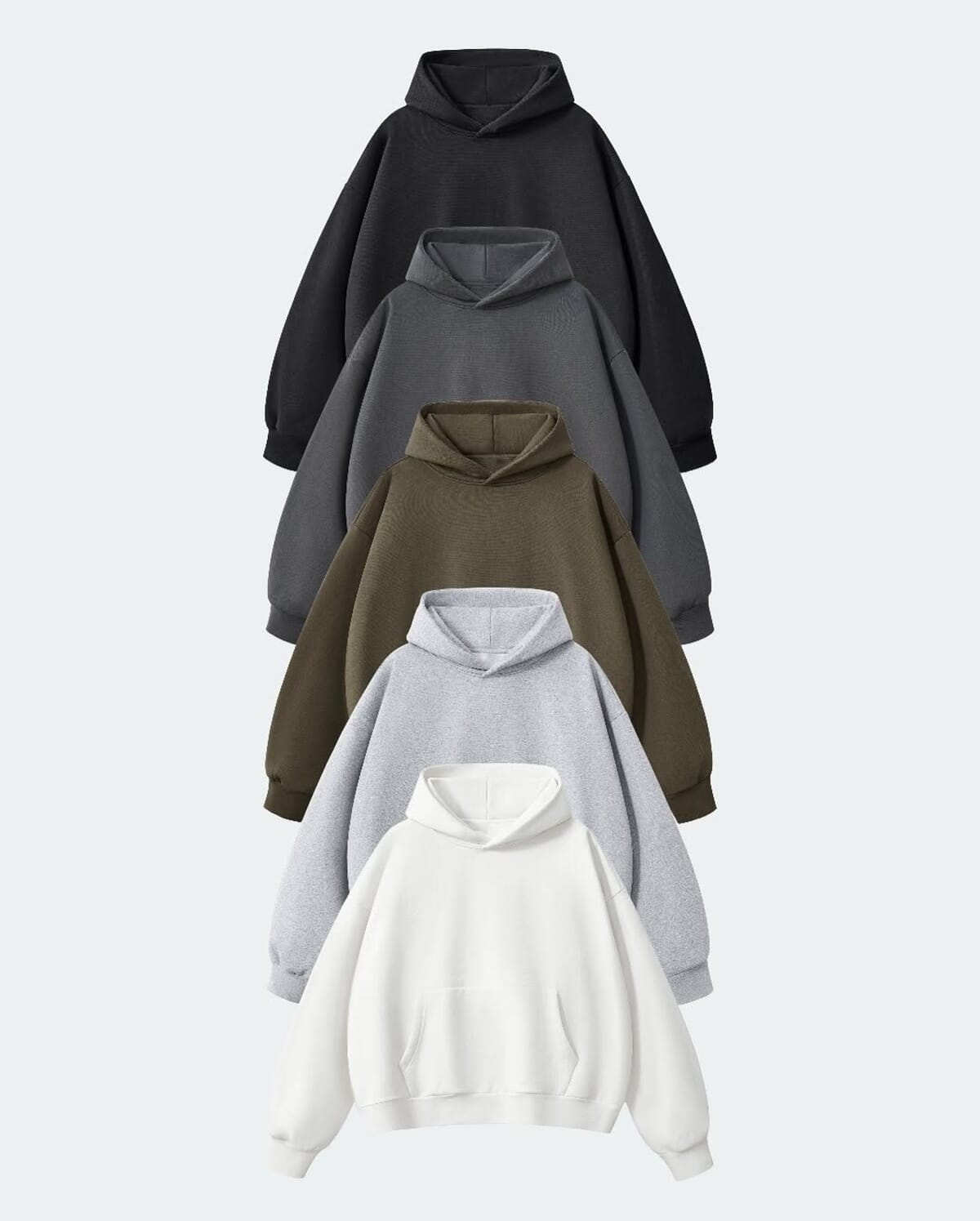
A hoodie made in China succeeds or fails on two things you can write down before the order and one thing you can check before you pay for it. The first is the fleece: its construction and its weight in GSM, stated together, with a tolerance and a test method. The second is shrinkage: how the fabric is stabilised, how it is tested, and which measurements the size chart refers to. The third is the check before the balance, when the bulk is finished, packed and still in the factory, and you can still ask for a fix.
Most hoodie complaints trace back to one of those three. A hoodie that feels thinner than the sample usually had its weight specified and its construction left open. A hoodie that comes back two sizes shorter after a wash was measured unwashed. And a problem that reaches your warehouse was usually visible on the factory floor, to anyone who weighed a panel or washed three pieces before the balance went out.
This guide covers French terry, loopback and brushed fleece, what fleece GSM does and does not tell you and how it is measured, cotton and polyester blends, why hoodies shrink and how China's knitted casual wear standard tests it, the drawstring rules for youth sizes, the size of China's sweatshirt export trade, and a pre-balance checklist built for fleece.
Before you read: China Clothing Manufacturer is a group of documented clothing factories in China, producing for brands from 100 pieces per style; hoodie details are on our hoodie manufacturing page. Standards and trade figures in this guide come from the published sources listed at the end. Exact MOQ and price are confirmed with the factory once you send a brief.
What matters most
- Name the construction with the weight. A French terry and a brushed fleece at the same weight are different garments, so name both, plus a tolerance and a test method.
- GSM is measured on finished fabric. ASTM D3776 covers fabric mass per unit area for most fabrics; agree the method and where the swatch is cut.
- Ring-spun yarn changes hand-feel and print surface more than ten or twenty extra grams do.
- Shrinkage is a process question. Compacting or a wash process before cutting controls it, and the size chart should give finished measurements after washing.
- China's FZ/T 73020-2019 tests dimensional change on knitted casual wear after one wash on the GB/T 8629-2017 4N programme, then line drying. If your customers tumble dry, write your own test into the spec.
- Youth drawstrings are regulated. In the USA, children's upper outerwear in sizes 2T to 16 with drawstrings must conform to ASTM F 1816-97 under 16 CFR Part 1120; in Europe the reference is EN 14682:2014.
- Check before the balance. A pre-shipment inspection is run when at least 80% of the order is complete, with the sample size drawn from ISO 2859-1.
French Terry, Loopback or Brushed Fleece?
Three constructions, and the difference is what the inside of the fabric looks like. French terry leaves the loops uncut and sits lighter. Loopback is the same principle, usually in a heavier, denser loop. Brushed fleece has the loops raised by brushing, which is the soft interior most people picture when they think of a hoodie. The construction decides warmth, drape and how a print behaves, before the weight figure decides anything.
French terry has uncut loops on the inside face. It is smooth on the outside, looped inside, and it breathes well because the loops are open. It feels lighter than its weight suggests, it drapes rather than standing away from the body, and it is the fabric for a year-round hoodie or a warmer market.
Loopback is essentially the same structure, and the two terms are often used interchangeably. Where a mill does distinguish them, loopback usually means a heavier, denser loop, which is why heavyweight streetwear hoodies are often loopback rather than brushed.
Brushed fleece starts as a looped fabric whose inside face is brushed mechanically, which breaks the loops into a soft raised nap. It feels warmer and softer and breathes less. Brushing also weakens the inside face, which is why a poorly finished fleece goes flat and matted after a few washes.
The consequence for the brief is direct. A heavyweight French terry and a heavyweight brushed fleece at the same GSM are the same weight and completely different garments. Specify the construction and the weight together, or the factory will choose the fleece it runs most often, and you will discover the choice when the bulk arrives.
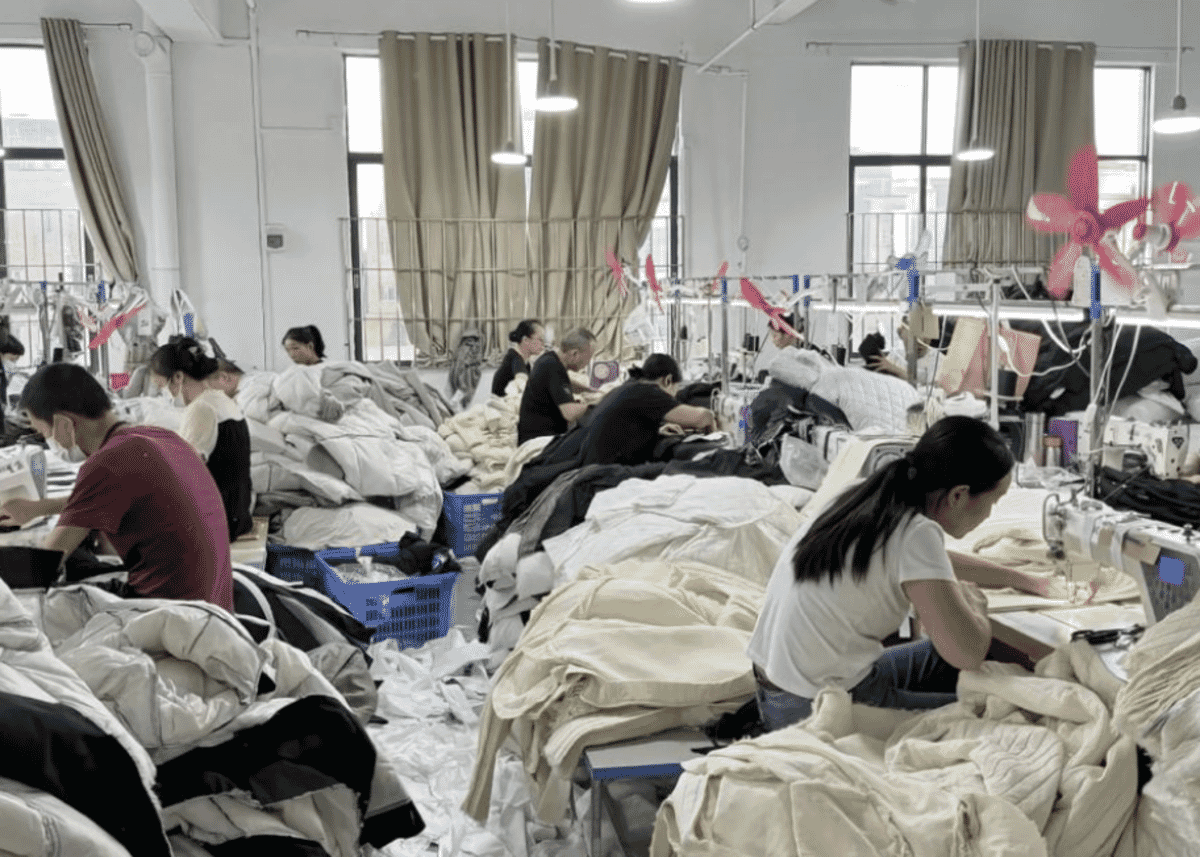
Quick read: Hoodie fabrics divide into French terry and loopback, which keep uncut loops on the inside face and breathe well, and brushed fleece, where the loops are brushed into a soft raised nap that feels warmer but breathes less and mats more readily. Two fabrics at the same GSM in different constructions produce different garments, so a hoodie spec names both.
What Does Fleece GSM Tell You, and How Is It Measured?
GSM is grams per square metre, the fabric's mass per unit area, and it is the headline number in nearly every hoodie brief. It tells you how much fibre is in the cloth. It does not tell you how the cloth feels, how warm it is, or how it will print, because yarn type, knit structure and finishing all change those at the same weight.
Working ranges used in streetwear briefs give a sense of scale. Around 240 to 280 gsm reads as a lightweight hoodie for layering. Around 300 to 350 gsm is a mid-weight that suits most ranges. Around 380 to 450 gsm is heavyweight and structured, the band streetwear labels chase. Above that, the garment becomes stiff and heavy on purpose. These are not standards; they are shorthand, and two mills can deliver very different fabrics inside the same band.
What makes a GSM figure useful in a contract is the method behind it. ASTM D3776 is the standard test method for mass per unit area of fabric and, in ASTM's own words, it is applicable to most fabrics. It has four approved options, depending on whether you weigh a full roll, a full-width sample or a small specimen. Whatever method the mill uses, three points belong in your spec:
- Measure finished fabric. Brushing, washing and compacting all change the weight, so the GSM you approve should be the weight after finishing, not the greige weight off the knitting machine.
- Give a tolerance. Agree an acceptable band around the target weight and write it down. Without one, a lighter fabric is a disagreement rather than a defect.
- Say where the swatch comes from. Ask for a weight check on the bulk fabric before cutting, from more than one roll, not only on the fabric used for the approved sample.
Two things govern hand-feel more than the weight figure does. Yarn type comes first. Ring-spun yarn is smoother and softer, with fewer protruding fibres; open-end yarn is faster to make, cheaper and coarser. A ring-spun mid-weight can feel better than an open-end heavyweight, and it prints better because the face is smoother. Finishing comes second. Enzyme washing, silicone softening and peaching all change the hand, and some trade softness against print adhesion or pilling, so name the finish if you have a reference garment you like.
Have a hoodie reference you want to reproduce? Send the photo and the fabric composition label, and our team comes back with the construction and weight questions the spec needs to answer. Send it here.
Quick read: GSM measures a fabric's mass per unit area, and ASTM D3776 is the standard test method for it, applicable to most fabrics. A hoodie spec should give the target GSM on finished fabric, a written tolerance and the test method, because brushing, washing and compacting all change the weight after knitting.
How Big Is China's Sweatshirt Export Trade?
Hoodies sit in the customs heading for knitted jerseys, pullovers, cardigans, waistcoats and similar articles, HS 6110, alongside sweaters and sweatshirts. The heading splits by fibre. HS 6110.20 covers cotton, and HS 6110.30 covers man-made fibres such as polyester. The World Bank's WITS database, which republishes UN Comtrade data, gives China's exports under both.
According to WITS, China's exports under HS 6110.20 were worth $5.76 billion in 2023 and $6.01 billion in 2024, for 945 million items in 2024. Exports under HS 6110.30, the man-made fibre line, were worth $12.35 billion in 2023 and $12.53 billion in 2024, for 2.19 billion items in 2024. The heading includes sweaters as well as hoodies, so treat these as the size of the category rather than a hoodie count.
Two things in those numbers matter for a brand. First, the man-made fibre line is about twice the size of the cotton line by value, so a polyester-rich fleece is the volume default and a cotton-rich fleece is the narrower market. Second, the average export value per item, about $6.36 for cotton and $5.72 for man-made fibres in 2024, shows how much of the trade is basic, high-volume product. A brand hoodie with a heavyweight fleece, a lined hood and a screen print is a different product from the average, and it should be specified as one.
The destinations tell the same story about who buys at volume. For the cotton line in 2024, WITS lists the United States first, at $1.79 billion, ahead of Japan at $577.66 million, Other Asia, nes at $361.74 million, Korea, Rep. at $227.58 million and Australia at $216.93 million.
Quick read: According to World Bank WITS data, China exported $6.01 billion of cotton knitted jerseys, pullovers and sweatshirts (HS 6110.20) in 2024, for 945 million items, and $12.53 billion of the man-made fibre equivalent (HS 6110.30), for 2.19 billion items. The United States was the largest destination for the cotton line, at $1.79 billion.
Cotton, Polyester or a Blend?
Composition decides comfort, shrinkage, print behaviour and price, and the right blend depends on what you value. There is no single correct answer, but there are clear trade-offs.
All cotton feels best against the skin, breathes best and takes screen print well. It also moves most in the wash if it has not been stabilised, and it ages in a way many customers like.
Cotton-rich blends with some polyester are the classic hoodie fleece. The polyester stabilises the fabric and helps it keep its shape, at a small cost in hand-feel. Many brushed fleeces are knitted with a cotton face and a polyester back, which is worth asking about if print quality matters.
Even blends and polyester-rich fleeces are cheaper and more stable again, and they feel less natural. They are the volume default, which is consistent with the trade figures above.
Blends with elastane add a little stretch for fitted silhouettes and help the rib recover at cuffs and hem, but they bring heat sensitivity in washing, drying and heat-applied prints.
The point most briefs miss is that shrinkage is not mainly a fibre question. A properly stabilised all-cotton fleece can be more stable than an untreated blend. The fibre sets the tendency; the process before cutting decides the result.
Why Do Hoodies Shrink, and How Is It Tested?
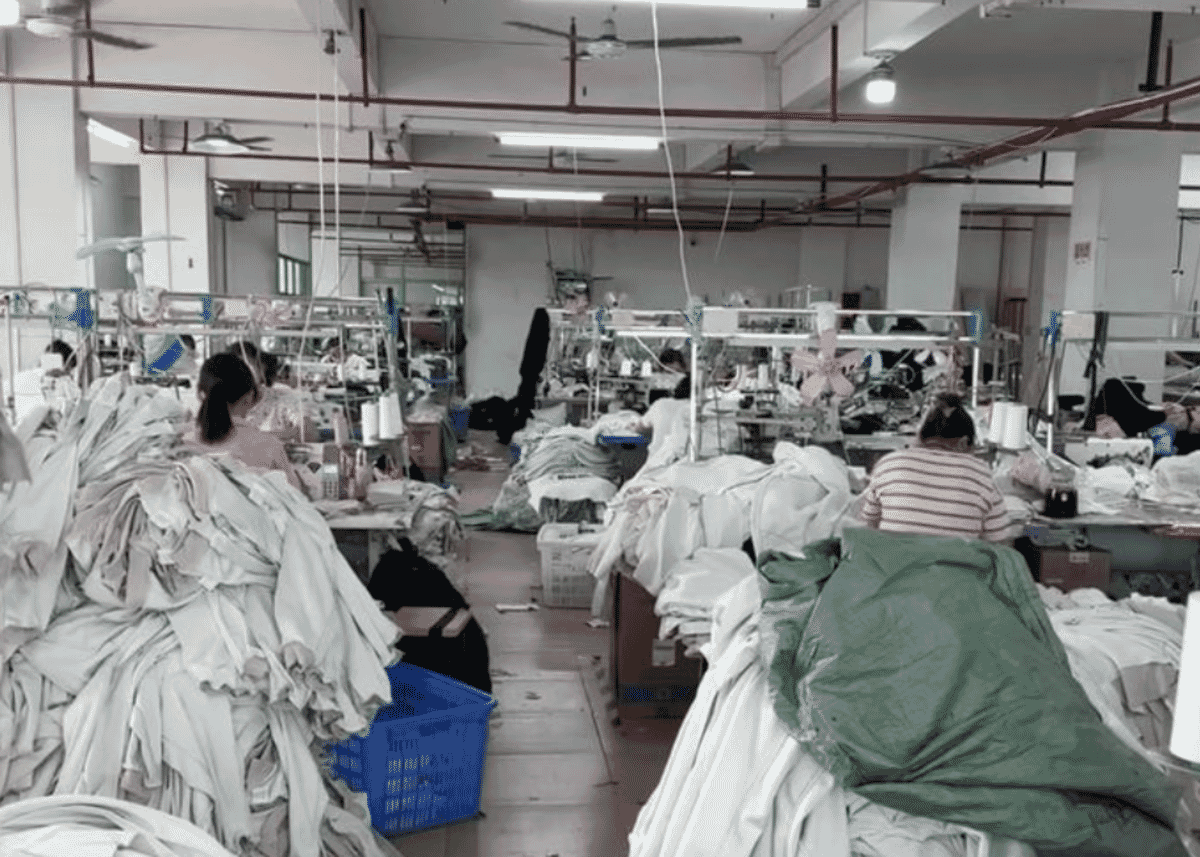
Knitted fabric is processed under tension. The loops are stretched during knitting, dyeing and finishing, and when the garment meets hot water and a tumble dryer the loops relax towards their natural shape. That relaxation is the shrinkage. It is usually larger in length than in width, which is why customers report a body and sleeves that got shorter while the chest still fits.
Two industrial controls deal with it before the fabric is cut. Compacting mechanically pushes the knit back towards a relaxed state. A wash process relaxes the fabric with water and heat, which is more thorough and costs more. Garment washing after sewing is a third option, often chosen for a washed or vintage look, and it changes the measurements again, so the pattern has to allow for it.
China has an industry standard for this product type. FZ/T 73020-2019, Knitted Casual Wear, issued by the Ministry of Industry and Information Technology, became effective on July 1, 2020, according to SGS. It applies to casual wear made mainly from knitted fabrics and does not cover clothing for infants and young children aged 36 months and below. It grades products as superior, first-class or qualified, and its intrinsic quality items include dimensional change after laundering, spirality after laundering, pilling, formaldehyde, pH and a range of colour fastness tests.
The detail of the shrinkage test is what matters for your spec. Under FZ/T 73020-2019, the washing follows the 4N programme of Type A washing machines in GB/T 8629-2017. Three test pieces are used and the number of washings is one. The pieces are hung to dry. For a top, the length change is calculated from the average of the front and back, left and right side lengths, and the width change from the back width.
That is a fair test for a standard, and it is a mild one compared with how many customers treat a hoodie. One wash and line drying will not show what three washes and a tumble dryer do. So write your own requirement into the spec:
- Name the wash and dry cycle you want the test to use, matching the care label you intend to print.
- Name the number of washes, because shrinkage often continues past the first cycle.
- Give the residual shrinkage you accept in length and width, in writing, before bulk fabric is ordered.
- Give finished measurements after washing in the size chart, so the factory grades the pattern for the garment the customer will actually own.
- Add spirality. A tubular body can twist after washing; the standard tests spirality for that reason, and side seams are the construction fix.
Quick read: China's knitted casual wear standard, FZ/T 73020-2019, tests dimensional change after one wash on the 4N programme of GB/T 8629-2017, with three test pieces hung to dry, measuring tops on the average of front, back and side lengths. Brands whose customers tumble dry should specify their own cycle, number of washes and residual shrinkage limit.
What Goes Into a Fleece Hoodie Spec?
A hoodie spec does not need to be long, but it needs to close every gap the factory would otherwise fill with its default. These are the lines that decide whether the bulk matches the sample.
| Line in the spec | What to write | Why it matters |
|---|---|---|
| Construction | French terry, loopback or brushed fleece | Same weight, different garment |
| Weight | The GSM target on finished fabric, tolerance, test method | Makes a light fabric a defect, not a debate |
| Yarn | Ring-spun or open-end, face and back | Hand-feel and print surface |
| Composition | Fibre content as it will appear on the label | Label law and shrinkage tendency |
| Stabilising | Compacting, fabric wash or garment wash | Controls shrinkage before cutting |
| Shrinkage | Cycle, number of washes, residual limit | The most visible failure after purchase |
| Measurements | Finished measurements after washing | What the customer actually wears |
| Rib | Rib with elastane at cuffs and hem | Recovery after a season of wear |
| Hood and drawcord | Panel count, lining, cord type, tips, eyelets | The biggest visible quality tell |
| Decoration | Method, placement, size, colours | Has to suit the fabric face |
Free tool: pressure-test your landed cost with the China production cost calculator. About a minute, and no email asked.
How Should a Fleece Hoodie Be Printed?
Four methods cover most hoodie decoration, and the fabric face decides which will work as much as the artwork does. A design approved on a flat swatch may not reproduce on brushed fleece at all.
Screen print is the volume standard: strong opacity, durable and cost-efficient at quantity, with a separate screen per colour, so artwork with many colours gets expensive. It sits less cleanly on a brushed face because the nap breaks up fine detail.
Puff and high-density prints raise the ink off the surface. They are popular in streetwear and need a stable fabric, because a raised print on a stretchy face cracks.
Embroidery is durable and reads as premium. It needs a stabiliser behind it on knitted fabric or the stitching distorts the fleece, and large fills on a heavy hoodie can stiffen a whole panel.
Direct-to-film transfer handles full-colour artwork with no screen cost, which suits small runs and complex designs. It is a surface application, so test how it wears on the actual fleece and after the wash cycle in your spec.
The recurring problem is the brushed nap itself. It is exactly what makes fleece soft and exactly what stops a print sitting flat. Where artwork is detailed, choose a smoother face, a cotton-faced fleece or a different method, and test the exact fabric and method combination rather than approving on a sample of something similar.
Which Construction Details Read as Quality?
Five details carry most of the quality a customer notices, and they are where cost is removed without changing the product photograph. That is why a cheaper quotation for the same picture is usually a different garment.
The hood. Two-panel hoods are cheaper and sit flatter; three-panel hoods have a centre panel that gives shape and a better fit around the head. A hood lined in the shell fabric looks far better than a single layer. This is the single biggest quality tell on a hoodie.
The drawcord. Flat or round, metal eyelets or none, tipped ends or raw. Cheap to upgrade, visible, and instantly legible to a customer.
The rib. Cuffs and hem take the most stress. Rib with elastane recovers and holds its shape; rib without it stretches out after a season of pushed-up sleeves.
The side seams. Tubular bodies have no side seam, which is cheaper and more prone to twisting after washing. Side-seamed bodies hang better and cost more.
The kangaroo pocket. Bar-tacked at the stress points or not. This is where a hoodie most often fails mechanically.
Quick read: The construction details that separate a brand hoodie from a blank are the hood (panel count and lining), the drawcord, rib with elastane at cuffs and hem, side seams rather than a tubular body, and bar-tacks on the kangaroo pocket. Each is invisible in a product photograph and obvious in the hand.
What Are the Drawstring Rules for Youth Hoodies?
If your range includes children's sizes, the drawcord stops being a design choice. In the USA, 16 CFR Part 1120 deems children's upper outerwear in sizes 2T to 16 or the equivalent, with one or more drawstrings, that does not conform to ASTM F 1816-97 a substantial product hazard. The regulation defines a drawstring as a non-retractable cord, ribbon or tape used to pull together parts of upper outerwear to provide closure.
The detail matters for hoodies in particular. The prohibition on hood and neck area drawstrings in ASTM F 1816-97 only applies to garments up to size 12, while waist and bottom drawstrings are covered up to size 16. The same regulation explains how sizes are read: girls' and boys' size Large is equivalent to size 12, and Extra-Large to size 16. A garment range that includes any covered size is treated as covered, so a hoodie sized 12 through 14 cannot carry a hood drawstring.
In Europe, the reference is EN 14682:2014, the standard on cords and drawstrings on children's clothing. SGS notes that its reference was published in the Official Journal in 2015, as a harmonised standard. The practical rule for a brand is simple: for youth sizes, leave the hood cord off or design a closure that meets the standard for each market, and tell the factory in the tech pack, because a cord added by habit on the line is a recall risk.
Where Are Hoodies Made in China?
Fleece and knit garment production sits where knitting and dyeing capacity and cut-and-sew capacity are close together. Our group's factories are in Guangdong, Zhejiang and Fujian. Guangdong, around Guangzhou and Dongguan, has a deep base of factories used to small and mid-sized brand orders, with trims and print houses nearby. Zhejiang carries large knit fabric capacity: China Daily reported that its textile and garment industry generated 1.12 trillion yuan ($162.21 billion) in revenue in 2025, 25.5 percent of the national total and first in China.
For most brand hoodie orders, the fleece may be knitted in one province and sewn in another, which is normal. What shortens the loop is having the garment factory and the print house close to each other, so a print that needs adjusting can be retested in days rather than shipped back and forth.
The Pre-Balance Check: What to Inspect Before You Pay
The balance payment is the last point at which you have leverage, and the goods are still in the factory. That makes it the right moment for an independent check against your spec and the approved sample. QIMA, an inspection company, describes its pre-shipment inspection as an examination conducted when 80% of your production order is complete, early enough to take corrective action before the order is finalised.
The sample size comes from ISO 2859-1, the sampling standard behind AQL inspection tables. At general inspection level II, the usual level, the table gives the sample size by lot size. You choose the acceptable quality limit (AQL) for each defect class, and the table gives an accept and reject number: for a sample of 125 at AQL 2.5, the order is accepted with 7 defects or fewer and rejected at 8.
Beyond the usual measurement, workmanship, colour and packing checks, a fleece hoodie inspection should include:
- Fabric weight: a GSM check on fabric from the bulk, using the method in your spec, compared with the approved weight and tolerance.
- Wash test on bulk pieces: a few hoodies from the lot washed and dried on your specified cycle, then measured against the after-wash size chart.
- Measurements: body length, chest, sleeve and hood opening on the sample pieces, against the tolerance in the tech pack.
- Twist: side seams or the body line checked after the wash test for spirality.
- Print and embroidery: adhesion, cracking on a stretch test, placement and colour against the approved strike-off.
- Rib and hood: rib recovery at cuffs and hem, hood panel count and lining as specified, drawcord tips and eyelets secure.
- Youth sizes: no hood or neck drawstrings where the market rules forbid them.
- Shading and pilling: panels from different rolls matching in colour, and the brushed face not pilling or matting on light rubbing.
- Labels and packing: fibre content and care label matching the spec, polybags, cartons and carton marks as agreed.
Make the balance depend on the report. If the wash test fails, the time to discuss a re-wash, a re-cut or a price adjustment is before the money moves, not after the cartons arrive.
Quick read: A pre-shipment inspection is run when at least 80% of a production order is complete, with the sample size taken from ISO 2859-1: at general inspection level II, a lot of 1,201 to 3,200 hoodies is sampled at 125, accepted at AQL 2.5 with 7 defects or fewer. For fleece, add a GSM check and a wash test on bulk pieces before the balance.
Where Hoodie Orders Fail
Five failures cover most hoodie complaints. Each one is invisible at approval and obvious after a wash or a week of wear, which is why each one has a line in the spec and a line in the inspection.
It shrinks in length. No stabilising, or a size chart measured unwashed. The customer finds it at home, not the factory.
It feels thinner than the sample. Weight was specified, construction and tolerance were not, and the bulk came in a different fleece at a similar GSM.
The print cracks. The wrong method for the fabric, or a raised print on a face with too much stretch.
The body twists. A tubular body. Side seams cost more and solve it.
The cuffs stretch out. Rib without elastane. It looks the same at delivery and fails within a season.
Where the Money Goes
| Element | Effect on cost | What to decide |
|---|---|---|
| Fleece weight | Direct, it is material | Match to climate and use |
| Yarn type | Ring-spun costs more | The cheapest real upgrade |
| Stabilising | An extra process before cutting | Never skip it |
| Hood construction | Panels and lining add labour | The biggest visible quality step |
| Decoration | Screens per colour, or per piece | Colour count drives screen cost |
| Rib and trims | Elastane rib costs more | Decides how it looks in year two |
| Testing and inspection | Lab and inspector fees | Paid once, before the balance |
Before you order hoodies
- Name the construction and the GSM together, on finished fabric, with a tolerance and a test method.
- Ask for ring-spun yarn, and say whether the fleece should have a cotton face.
- Ask how the fabric is stabilised, and get the residual shrinkage limit in writing.
- Give the wash cycle and number of washes for the shrinkage test, matching your care label.
- Give finished measurements after washing, not before.
- Choose the print method against the fabric face, and test that exact combination.
- Specify the hood (panels and lining), rib with elastane, side seams and pocket bar-tacks.
- For youth sizes, check the drawstring rules in every market you sell into.
- Book a pre-shipment inspection with a GSM check and a wash test before the balance.
Washing three bulk pieces before the balance takes an afternoon and prevents the complaint that dominates this category.
Conclusion
The hoodie is a simple garment with a specification most briefs get half right. The GSM is quoted, the construction is not, and the factory fills the gap with the fleece it runs most often. That single omission explains much of the distance between a reference garment and a sample.
Write the weight the way a contract needs it: on finished fabric, with a tolerance and a method such as ASTM D3776. Then ask for ring-spun yarn, which improves both the hand and the print surface for less than the cost of a heavier fabric.
On shrinkage, stop thinking about fibre and start asking about process. Know what China's FZ/T 73020-2019 test does, one wash and line drying, and decide whether that matches how your customers treat a hoodie. If it does not, put your own cycle, number of washes and residual limit in the spec, and give the size chart after washing.
Then use the balance. A pre-shipment inspection sized by ISO 2859-1, with a fabric weight check and a wash test on bulk pieces, tells you before shipment what your customers would otherwise tell you in reviews.
Our team places and manages production with the documented factories in our China group, from 100 pieces per style. Send a reference hoodie or a photo with your target fleece and market, and we place the order with a line that already sews that construction. Our team replies within 24 hours. Samples, invoices and shipping run straight between you and the factory; our fee is flat and we take nothing from the factory side.
Send your brief China factory list, $49No spec sheet yet? We draw one style as a factory-ready tech pack for $79. What the $79 covers.
Frequently Asked Questions
What is the difference between French terry and fleece?
French terry keeps uncut loops on the inside face, so it breathes well and drapes rather than standing away from the body. Brushed fleece starts as a looped fabric whose inside is brushed into a soft raised nap, which feels warmer and softer but breathes less and mats more readily. At the same GSM they are different garments, so name the construction as well as the weight.
What GSM should a hoodie be?
As working ranges, around 240 to 280 gsm reads as lightweight, 300 to 350 gsm as mid-weight and 380 to 450 gsm as heavyweight. These are shorthand, not a standard. In the spec, give the target GSM on finished fabric, a tolerance and the test method, such as ASTM D3776, and name the construction alongside it.
Why do hoodies shrink in length?
Knitted loops are stretched under tension during knitting, dyeing and finishing, and they relax when the garment meets heat and water, usually more in length than in width. Compacting or a wash process before cutting controls it. Specify the wash cycle, the number of washes and the residual shrinkage you accept, and give finished measurements after washing.
How does China's standard test hoodie shrinkage?
FZ/T 73020-2019, the industry standard for knitted casual wear, tests dimensional change on three pieces after one wash on the 4N programme of Type A washing machines in GB/T 8629-2017, hung to dry. For tops, length change is based on the average of the front, back and side lengths. If your customers tumble dry, write a stricter test into your own spec.
Are drawstrings allowed on children's hoodies?
In the USA, 16 CFR Part 1120 treats children's upper outerwear in sizes 2T to 16 with drawstrings that do not conform to ASTM F 1816-97 as a substantial product hazard; hood and neck drawstrings are prohibited up to size 12. In Europe the reference standard is EN 14682:2014. Confirm the rule for every market before producing youth sizes.
What should I check on a hoodie order before paying the balance?
Book a pre-shipment inspection when at least 80% of the order is complete. Beyond measurements, workmanship and packing, ask for a GSM check on bulk fabric, a wash test on a few bulk pieces measured against the after-wash size chart, a twist check, print adhesion, rib recovery and drawcord checks. The sample size comes from ISO 2859-1: 125 pieces for a lot of 1,201 to 3,200 at level II.
Sourcing notes: brand names and certification marks mentioned here belong to their owners. Standards, regulations and trade figures are summarised from the published sources listed below and were checked on 10 November 2026; they can change, and summaries by testing companies are not the standard text. Confirm the current rules for your market and agree test methods and terms directly with the factory before committing.
Where the figures come from
- World Bank WITS: China exports of HS 611020 (jerseys, pullovers, etc., of cotton, knitted), 2024.
- World Bank WITS: China exports of HS 611020, 2023.
- World Bank WITS: China exports of HS 611030 (jerseys, pullovers, etc., of man-made fibres, knitted), 2024.
- World Bank WITS: China exports of HS 611030, 2023.
- ASTM International: D3776/D3776M, Standard Test Methods for Mass Per Unit Area (Weight) of Fabric.
- SGS: China releases an updated product standard, FZ/T 73020-2019 (Knitted Casual Wear).
- ChineseStandard.net: FZ/T 73020-2019 Knitted casual wear, English translation preview (scope, washing programme, measurement).
- eCFR: 16 CFR Part 1120, Substantial product hazard list (children's upper outerwear drawstrings).
- SGS: Children's clothing safety, cords and drawstrings (EN 14682).
- QIMA: Pre-shipment inspection.
- QC Advisor: ISO 2859-1 sample size table and single sampling plan.
- China Daily Ningbo (2026): Zhejiang textile and garment revenue.
Related Reading
- Hoodie Manufacturer in China
- Sweater Manufacturers in China
- T-Shirt Suppliers in China
- Clothing Suppliers in China: How to Find and Vet a Factory
No commission and no mark-up on the factory price: the factory invoices you itself.