Labels are among the cheapest components in a garment and the one customers touch first. A scratchy neck label can undo a fabric decision that cost far more, and brands often find this out from returns rather than from sampling.
They can also delay a shipment, because trims carry their own minimums and their own lead times, and a garment waiting on labels is as late as one waiting on fabric.
This guide covers the label types, what each is made from, the woven constructions, the US and EU rules on what a label must say, why minimums run high, what China's label trade looks like in customs data, and how to check a label supplier before you commit.
Note: China Clothing Manufacturer is a group of documented clothing factories in China, producing for brands from 100 pieces per style. This guide quotes no label prices. The rules come from the US Federal Trade Commission and the EU textile regulation, the trade figures from UN Comtrade data published by the World Bank, and the rest is our editorial guidance. We confirm exact trim minimums and prices with the factory when you send a brief.
Key takeaways
- Four label types: woven, printed, heat transfer and leather or PU patch.
- Damask woven labels carry fine detail; taffeta is cheaper and coarser.
- Heat-transfer necks remove the physical label, and with it the itch.
- Label content is regulated: in the US by the FTC, in the EU by Regulation 1007/2011.
- Trim minimums often exceed the garment quantity on a first order, because loom set-up is a fixed cost.
- Trim lead times run separately from the garment: order labels at pre-production sample approval.
- China exported US$444.8 million of woven labels in 2024, mostly to garment-making economies (UN Comtrade via WITS).
What Label Types Are There?
Four, and they are made by different processes on different machines. Woven labels are produced on narrow-fabric looms. Printed labels are printed onto tape. Heat transfer is applied with heat and pressure and leaves no edge against skin. Leather and PU patches are a separate trade again. The type decides the supplier before it decides the look.
Woven labels are made on narrow-fabric looms, with the design woven into the tape rather than printed on it. Durable, they survive washing indefinitely, and the standard for brand identification.
Printed labels are printed onto satin, cotton tape or synthetic ribbon. Cheaper, faster, and they carry fine text and care symbols well. Print quality degrades with washing over time.
Heat transfer applies the marking directly to the fabric with no physical label at all. Nothing to itch, nothing to cut out, and it is why premium basics increasingly use it.
Leather and PU patches are cut, debossed or printed, then stitched on. Denim, outerwear and caps.
| Type | How it is made | Where it suits | What it costs you |
|---|---|---|---|
| Woven | Design woven into narrow-fabric tape on a loom | Brand identification, where the label is meant to last the garment | Loom set-up, and a stiff edge against skin unless the construction is specified softer |
| Printed | Printed onto satin, cotton tape or synthetic ribbon | Care symbols and fine text, where legibility matters more than longevity | Print quality degrades with washing over the life of the garment |
| Heat transfer | Applied to the fabric with heat and pressure, with no physical label | Premium basics and anything worn against skin | Nothing to itch and nothing to cut out, but it cannot carry a woven brand mark |
| Leather and PU patch | Cut, then debossed or printed, by a separate trade again | Denim, outerwear and bags, as an external brand mark | A different supplier on a different lead time from your other trims |
The type decides the supplier before it decides the look. Each is made on different machinery, and a supplier strong in one is not automatically able to produce the others.
Citation Capsule: Garment labelling divides into four production types: woven labels made on narrow-fabric looms with the design woven into the tape, printed labels applied to satin or ribbon, heat transfer applied directly to fabric with no physical label, and leather or polyurethane patches cut and stitched on. Each is produced on different machinery by different suppliers.
Not sure which label type suits your garment? Send a reference and we will tell you what it is and what it costs. No cost. Send it here.
Damask or Taffeta: Which Woven Label?
This is the specification that decides how a woven label looks and feels, and many brands are never asked. Damask is woven from fine yarn at high density and reads as the premium option. Taffeta is coarser and cheaper, and it can feel stiffer against skin. Satin woven has a smooth, shiny face and a soft hand.
Damask uses fine yarn at high density. It carries small text and detailed logos cleanly, has a soft hand, and costs more. It is the usual choice when a label carries a detailed logo or small type.
Taffeta is coarser and cheaper, with a slightly stiffer hand. Fine detail blurs, so it suits simple marks and larger text.
Satin woven has a smooth, shiny face and a soft hand. It holds less fine detail than damask and is often chosen for lingerie and occasionwear.
Two other fields that matter. Edge finish: ultrasonic cut is clean and slightly firm, heat cut is cheaper and can feel sharp, folded edges are softest. And fold type: centre fold, end fold, straight cut and loop fold each change how the label sits and how it is sewn in.
Why Do Neck Labels Itch, and How Do You Fix It?
Because a woven label is a stiff piece of narrow fabric with cut edges sitting against the most sensitive skin on the body. It is a design problem rather than a quality problem, and it has three solutions: print the information as a heat transfer, specify a softer weave construction, or move the label out of the neck entirely.
Heat transfer. Removes the label entirely. Nothing physical against the neck, and the marking is printed onto the garment. It is common on tees and other knitwear worn against skin, and our T-shirt suppliers guide covers the rest of a tee specification.
Softer construction. Damask rather than taffeta, folded edges rather than ultrasonic cut, and a smaller label.
Move it. Side seam or hem placement, with brand identification handled by heat transfer at the neck.
The test worth running: hold the sample label against the inside of your wrist for thirty seconds. If you notice it there, a customer is likely to notice it at the neck after a day's wear.
Skip the search: the China factory directory ($49) lists documented factories by category, city and capability, with the verification status of each. One-time payment, instant download.
Citation Capsule: Neck labels itch because a woven label is a stiff piece of narrow fabric with cut edges sitting against skin. Three fixes exist: heat transfer printing instead of a woven label, a softer weave construction, or relocating the label away from the neck. The first is the most common in modern apparel.
What Must a Care Label Legally Contain?
This is regulated content rather than a design decision, and the rules differ by market. In the United States, the FTC's Textile Rules require most textile products to show fibre content, country of origin and the identity of the manufacturer or another business responsible for the product, by name or by a Registered Identification Number (RN) (FTC Textile Rules, 16 CFR 303). Care instructions are required separately under the Care Labeling Rule, and the FTC puts that duty on manufacturers and importers, so a brand importing finished garments carries it rather than the factory.
Four elements come up most often, though the exact rules vary by market.
Fibre composition, as percentages, using recognised fibre names. It is easy to get wrong on goods bought as stock, because nobody tested it.
Care instructions, usually as symbols, sometimes requiring text in specified languages depending on the market.
Country of origin. Origin follows the goods rather than the brand, and relabelling does not change it.
Manufacturer or importer identification, by name or RN in the US, and in some other markets.
Specify these for your destination market rather than accepting a factory default, which will reflect whichever market that factory ships to most.
What the US Care Labeling Rule asks for
The FTC's guidance says care labels must be attached permanently and securely and stay legible for the useful life of the product. For a washable garment, the instructions cover whether to wash by hand or machine (with a water temperature if hot water would harm it), whether bleach can be used, how to dry it, and ironing where regular ironing is needed. A warning is required where a consumer could reasonably use a harmful method, such as "Do not iron" or "Wash separately".
Symbols can replace words, but only the ASTM system the rule names. The FTC's guidance states that ISO care symbols are similar but not identical, and are not currently acceptable in place of words. A label designed for Europe with ISO symbols alone may therefore not be enough for the US, which is worth settling before artwork goes to the weaver.
What the EU textile regulation asks for
In the EU, Regulation (EU) No 1007/2011 requires textile products to be labelled or marked with their fibre composition whenever they are made available on the market, and the labelling must be durable, easily legible, visible and accessible, and securely attached (Article 14). It must be in the official language or languages of the member state where the product reaches consumers, unless that country provides otherwise (Article 16). The regulation sets the fibre names you may use; it does not lay down a care labelling scheme, so check care-labelling expectations for each country you sell into.
For a brand selling into both markets, the practical answer is usually one of two: a composition and origin panel plus a care panel that satisfies both sets of rules, or separate label sets per market. Either way, the decision belongs in the tech pack, not in a message to the factory a week before cutting.
Citation Capsule: Label content is regulated rather than designed. In the US, the FTC requires fibre content, country of origin and the identity of the manufacturer or a responsible business (by name or RN), with care instructions under the separate Care Labeling Rule, where only ASTM symbols may replace words. In the EU, Regulation 1007/2011 requires a durable fibre composition label in the official language of the member state.
Why Are Trim Minimums Higher Than Your Order?
Because labels are made on narrow-fabric looms that need setting up, and the set-up is a fixed cost whatever the run length. Spread over a small run, it makes each label expensive, which is why label suppliers set minimums that often sit above a first garment order, and why adding a colourway moves trim cost more than adding units.
The result surprises many new brands: you order 300 garments and the label supplier quotes a minimum well above 300 labels. That is less a negotiating position than the economics of loom set-up.
Three ways to handle it. Accept the overage and hold labels for future orders, which is often the cheapest answer, since woven labels keep well if the branding does not change. Use printed rather than woven for a first run, since print set-up is cheaper. Or use heat transfer, which has different economics again.
What rarely works is asking the supplier to weave fewer for the same price. The set-up cost stays the same.
Citation Capsule: Trim minimums are set by loom set-up rather than by garment quantity. A narrow-fabric loom is set for a specific width, weave and colourway, and that set-up cost does not shrink with a smaller order. This is why label minimums often exceed a small brand's first garment run, and why colourway count moves trim cost more than piece count does.
How Long Do Labels Take?
Longer than brands plan for, and on a separate clock from the garment. Trims are ordered from a different supplier, made on different machines, and shipped separately to the factory. The label has to be in the building before cutting begins, not before sewing, because it is built into the garment as it is assembled.
The sequence is artwork, then a proof or strike-off for approval, then production, then shipping to the garment factory. The approval step sits with you, and it is where the delay usually happens.
The consequence is a scheduling trap. A factory ready to sew cannot sew without labels, and labels ordered when production starts arrive after production would have finished. Order trims when you approve the pre-production sample, not when bulk begins.
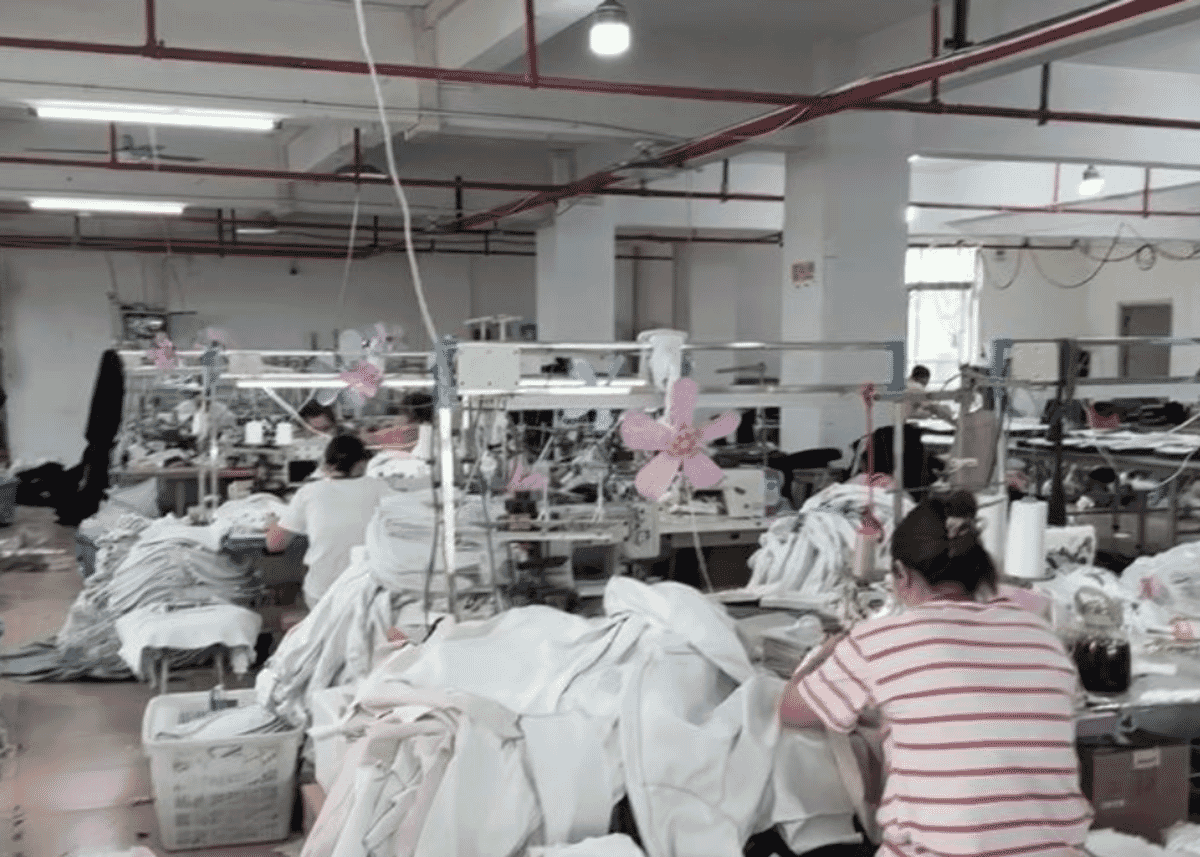
Two dates drive everything. Trims have to arrive at the factory before cutting starts, not before sewing does, because the label is inserted into a seam as the garment is built. A neck label that lands a week late does not delay finishing. It delays assembly, and the line has already been booked.
Citation Capsule: Labels are made by a separate supplier on a separate clock: artwork, strike-off, approval, production, then delivery to the garment factory. Because the label is sewn in as the garment is assembled, it has to be at the factory before cutting starts, so trims are best ordered at pre-production sample approval rather than at bulk start.
What About Hangtags and Packaging?
One of the cheapest places to look considered, and often left to the last minute. Four decisions sit here: hangtag stock and finish, the attachment method, the polybag, and carton marking. Each is inexpensive and each is visible to the customer or the freight forwarder, which is why leaving them late costs more than deciding them early.
Hangtag stock and finish. Card weight, uncoated or coated, foil, emboss, spot varnish. A heavier uncoated card with a single ink can read better than a thin glossy card with four colours, and can cost less.
Attachment. String, pin, or plastic barb. String reads premium; barbs read retail.
Polybag. Printed or plain, with or without size sticker and barcode. If you want recycled content, it is a specification field rather than an assumption. Our packaging suppliers guide covers the packaging side in more detail.
Carton marking. Unglamorous and a common source of warehouse receiving problems. Specify what goes on the outer carton before goods ship.
Where Label Orders Fail
Five failures, and every one of them is preventable at the specification stage. The colour is wrong because no physical reference was supplied. The text is illegible at the actual size. The care symbols do not match the fabric. The label goes in crooked or inverted. And the trims arrive after the garments are already sewn.
The colour is wrong. A logo approved on screen comes back woven in a different bronze, because screen colour and yarn colour are unrelated. Approve against a physical standard, in daylight, not against a PDF.
The text is illegible. Fine type specified on taffeta blurs, because the weave cannot resolve it. This is a construction mismatch rather than a factory error, and the fix is damask or larger type.
The care symbols are wrong for the fabric. Somebody copied the care instructions from a previous style. If the fabric changed and the label did not, customers wash the garment by instructions that damage it, and the responsibility sits with the brand or importer.
The label is sewn in crooked or upside down. A garment-factory problem rather than a label-supplier problem, and one that only surfaces at inspection. Specify placement with a measurement, not a description.
They arrive after the garments are sewn. Often the costliest failure, because the alternative is unpicking finished goods. It is entirely a scheduling problem.
One more worth naming, because it costs money quietly rather than loudly. Labels ordered against an old artwork file. For example, a brand refreshes its logo, updates the website and the packaging, and then the neck labels arrive carrying the previous mark because the trim supplier was working from an old file. Nobody notices until the goods land, and by then the choice is between shipping the wrong branding or unpicking finished garments.
The fix is a version number on the artwork file and a rule that the strike-off is checked against the current brand assets rather than against the last approved label. It takes a minute.
Where Are Label Suppliers?
Label and trim manufacture is a distinct trade from garment production. Label makers are usually separate businesses from the factories sewing your garments, which is why trim lead times run on their own clock and why a garment factory cannot simply absorb a late label order.
Guangdong is one of China's main garment provinces, and trim suppliers close to the sewing factory shorten the final handoff.
Zhejiang is China's largest textile and garment province by revenue: the sector generated 1.12 trillion yuan in 2025, 25.5 percent of the national total (China Daily Ningbo, 2026).
The practical decision: let your garment factory source trims unless you have a specific reason not to. They have the relationships, they carry the coordination, and a label delivered to the wrong address is their problem rather than yours.
What the trade data shows
Customs data gives a sense of scale. Under HS code 5807.10 (woven labels, badges and similar articles), China exported US$444.8 million in 2024, up from US$370.9 million in 2023, and about 37.2 million kilograms by weight, according to UN Comtrade data published in the World Bank's WITS database. That made China the largest reporting exporter, ahead of Hong Kong, China at US$268.3 million and Italy at US$60.7 million.
The destinations say more. The largest buyers were garment-producing economies rather than the big consumer markets. Hong Kong, Vietnam, Cambodia, Bangladesh and Myanmar took US$297.4 million between them, two-thirds of the total, while China's direct exports of woven labels to the United States were US$11.8 million (WITS). Labels travel to the sewing line and reach the customer inside the garment.
Citation Capsule: China exported US$444.8 million of woven labels and badges (HS 5807.10) in 2024, up from US$370.9 million in 2023, making it the largest reporting exporter (UN Comtrade data, World Bank WITS). Hong Kong, Vietnam, Cambodia, Bangladesh and Myanmar took 66.9% of that value, while direct exports to the United States were US$11.8 million.
For a brand, the read is simple: label making in China is a large, export-oriented trade in its own right, built to supply sewing factories. The supplier your factory already uses is part of that trade.
Where the Money Goes
| Component | What drives cost | Watch for |
|---|---|---|
| Woven label | Yarn density, size, colour count | Damask versus taffeta is the big lever |
| Printed label | Colour count, substrate | Cheaper set-up, shorter life |
| Heat transfer | Size, colour count, application | Applied at the garment factory |
| Hangtag | Card weight, finish, attachment | Finishes add more than ink does |
| Polybag | Size, print, recycled content | Own minimum, often large |
Our editorial summary of what drives trim cost; it quotes no prices. We confirm exact minimums and prices with the factory when you send a brief.
Try it free: get a directional FOB range per piece with the China production cost calculator. No signup to see the range.
How Do You Check a Label Supplier?
- Ask for physical samples in your specification, not a catalogue. Feel the edge finish.
- Get a strike-off before production and check the colour against your standard in consistent light.
- Business licence and registered scope, as with any supplier.
- Check OEKO-TEX where it matters. Labels sit against skin, and OEKO-TEX publishes a label check for certificate numbers.
- Wash-test the label with the garment. Print that fades and edges that fray often show up after a few washes rather than the first.
Before you order trims
- Decide the label type first: woven, printed, heat transfer or patch.
- For woven, specify damask or taffeta, the edge finish and the fold type.
- Hold a sample label against your wrist for thirty seconds before approving it.
- Specify care label content for your destination market, not the factory default.
- Ask the trim minimum early, and plan to hold the overage rather than negotiate it.
- Order trims when you approve the pre-production sample, not when bulk starts.
- Wash-test the label attached to the garment, not on its own.
Labels are a small cost and an avoidable cause of a late shipment. Ordering them early costs nothing.
How we work
- Our team reads the brief and replies within 24 hours. If China, or our group, is wrong for it, we say so.
- Production is placed with a documented factory we have visited in person, from 100 pieces per style.
- The factory quotes you, samples with you and bills you directly.
- You pay 30% to start bulk and the 70% balance only after a third-party inspection.
- No tech pack yet? We draw one for $79 per style.
For trims, send a photo or a physical reference label with the brief, and say which markets you sell into so the content and care panel is right. See how we work.
Conclusion
Labels cost little and decide a great deal. A damask label with a folded edge reads as a considered product; a taffeta label with a heat-cut edge can read as an afterthought, and customers notice.
The itch problem has a solution and it is heat transfer. If your garment is knitted and sits against skin, removing the physical label entirely is the answer many basics brands use.
Label content is regulated rather than designed. Specify it for the market you sell into: in the US the FTC Textile Rules and Care Labeling Rule, in the EU a fibre composition label under Regulation 1007/2011 in the local language. A factory default reflects whichever market that factory ships to most, and the responsibility sits with the importer.
And order them early. Trim minimums are set by loom set-up costs, and lead times run on a clock separate from the garment. A shipment held for labels is one of the most avoidable delays in apparel production.
We are a group of documented clothing factories in China, producing for brands from 100 pieces per style. Send the garment and a reference label: our team replies within 24 hours, then we place your production with a documented factory we have visited in person, with the label construction, minimum and lead time confirmed up front. You work directly with the factory. Flat fees, no factory commissions.
Get in contact Download the directory ($49)Need a tech pack? Get a factory-ready single-style tech pack for $79. See what's included.
Frequently Asked Questions
What is the difference between damask and taffeta labels?
Damask uses fine yarn at high density, carries small text and detailed logos cleanly, has a soft hand and costs more. Taffeta is coarser and cheaper with a stiffer hand, so fine detail blurs and it suits simple marks. Damask is the usual choice for a detailed logo or small type.
How do I stop neck labels itching?
Heat transfer removes the physical label entirely, printing the marking onto the garment, which is why many basics use it. Failing that, use damask rather than taffeta, folded edges rather than ultrasonic cut, and a smaller label, or move it to the side seam.
Why is the label minimum higher than my garment order?
Woven labels are made on narrow-fabric looms and the set-up is a fixed cost whatever the run length, so small runs are expensive per label. Woven labels keep well if the branding does not change, so accepting the overage is often cheaper than negotiating, or you can use printed labels or heat transfer for a first run.
What must a care label contain?
It depends on the market. In the US, the FTC requires fibre content, country of origin and the manufacturer or a responsible business (by name or RN), plus care instructions under the Care Labeling Rule. In the EU, Regulation 1007/2011 requires a durable fibre composition label in the official language of the member state. Specify for your destination rather than accepting the factory default.
When should I order labels and trims?
At pre-production sample approval, not when bulk production starts. Trims run on a separate lead time from the garment, and the approval step for artwork and strike-offs sits with you. A garment waiting on labels is as late as one waiting on fabric.
Can I use ISO care symbols on labels for the US?
Not on their own, according to the FTC. Symbols may replace words on US care labels only if they follow the ASTM system the Care Labeling Rule names; the FTC says ISO symbols are similar but not identical and are not currently acceptable in place of words.
Editorial note: all company names, certification marks and trademarks referenced here are the property of their respective owners. This guide quotes no label prices or minimums from any factory. Labelling rules are summarised from the FTC's published guidance and Regulation (EU) No 1007/2011, and trade figures are UN Comtrade data as published in the World Bank's WITS database, read on 2 November 2026. Rules and trade data change; confirm the labelling rules for your market and the terms directly with the factory before committing.
Sources
- US Federal Trade Commission: Threading Your Way Through the Labeling Requirements Under the Textile and Wool Acts.
- US Federal Trade Commission: Clothes Captioning, complying with the Care Labeling Rule.
- China Daily Ningbo (30 March 2026): Zhejiang textile industry embraces smart manufacturing, source of the 1.12 trillion yuan and 25.5 percent figures for 2025.
- Regulation (EU) No 1007/2011 on textile fibre names and related labelling and marking of the fibre composition of textile products, Articles 14 and 16.
- World Bank WITS, exporters of HS 580710 (2024): UN Comtrade data on woven label and badge exports by reporting economy.
- World Bank WITS, China exports of HS 580710 by destination (2024), with the 2023 table for the year-on-year comparison.
- OEKO-TEX Label Check: public verification of certificate numbers.
Related Reading
- Clothing Suppliers in China: How to Find and Vet a Factory
- Packaging Suppliers in China
- T-Shirt Suppliers in China
- Importing from China
No commissions. No markups. The factory bills you directly.