A woven shirt is the garment where workmanship is easiest to see. Every seam is on show, the collar sits at eye level, and a fault in either is visible from across a room. It is also one of the most standardised garments in clothing, which cuts both ways: most competent factories can make a decent shirt, and the gap between a good shirt and a poor one comes down to a short list of decisions that most briefs leave out.
Three of those decisions do most of the damage when they are missed. The collar, because it is built from layers that have to behave as one. The fusing that bonds those layers, because when it fails it fails after the customer's first wash. And the final inspection, because it is the last point at which a problem can be found before the goods are paid for and on the water.
This guide covers how shirting is specified, how collars are built and fused, the seams and stitch density worth writing down, shrinkage, labels and duty for the US, and how a pre-shipment inspection is sized and read.
Before you read: China Clothing Manufacturer places and manages production for brands from 100 pieces per style with documented factories in China. Trade, tariff and inspection figures in this guide come from the published sources listed at the end. Exact MOQ and price are confirmed with the factory once you send a brief.
What matters most
- China is the largest exporter of woven cotton shirts. It exported $1,227.5 million of men's cotton shirts (HS 6205.20) in 2024, 176.7 million pieces, ahead of India (WITS).
- Specify shirting as count, ply and weave. A higher count is a finer yarn; two-ply cloth is the usual marker of a quality shirting.
- The collar is a fusing job. Bubbling, the main fusing defect, is often invisible on the finished shirt and appears only after a wash.
- Fusing has three settings. Temperature, pressure and time come from the interlining supplier's data sheet and are checked on your fabric.
- Write stitch density as a number. One shirtmaker's guide puts a high quality dress shirt at 18 or more stitches per inch at collar and cuffs.
- Measure after washing. Neck and sleeve length are where shrinkage shows first.
- Size the final inspection by the table. At general inspection level II a lot of 1,201 to 3,200 shirts means opening 125 of them.
Where Do Woven Shirts for Export Come From?
China leads the trade data. In 2024 it exported $1,227.5 million of men's or boys' shirts of cotton, 176,749,000 pieces, the largest value of any single country in the World Bank's WITS tables. India followed with $696.4 million, then Germany with $546.1 million and Italy with $479.4 million (WITS). In shirts of man-made fibres the lead is wider: China exported $882.7 million and 188,166,000 pieces in 2024, against $110.9 million from Indonesia, the next country on the list (WITS).
The trend is softer than the ranking. China's cotton shirt exports were $1,574.2 million in 2019, fell to $941.7 million in 2020, recovered to $1,343.3 million in 2022 and were $1,227.5 million in 2024, about 22% below 2019 by value (WITS). Pieces moved the same way, from 233.9 million in 2019 to 176.7 million in 2024.
The United States was still the largest buyer in 2024, at $209.9 million, about 17% of the total, followed by Australia, Japan, Kazakhstan and Russia. In 2019 the US had taken $371.2 million, so US purchases of these shirts from China fell by about 43% over five years (WITS 2019, WITS 2024). Tariffs, buyer diversification and the pandemic all sit behind that number, and the data does not separate them.
Divide value by pieces and the figures say something about what is being shipped. China's cotton shirts were declared at an average of $6.95 each in 2024 and India's at $6.77, while Germany's averaged $19.56 and Italy's $55.22. Those are customs averages across every quality, so they are not prices you can quote against. They do show that a large share of China's volume is in the price band where fusing, stitch density and inspection decide whether the shirt holds up.
Two cautions on the numbers. They are declarations at export, before freight, duty and margin. And a country that had not reported 2024 data to UN Comtrade does not appear in the ranking, so treat it as a guide to where capacity is, not a complete league table.
Quick read: According to World Bank WITS data, China exported $1,227.5 million of men's or boys' woven cotton shirts (HS 6205.20) in 2024, 176.7 million pieces, more than any other single country but about 22% below its 2019 value. The average declared value was $6.95 a shirt.
How Is Shirting Specified?
By yarn count, ply and weave, written together. A shirting described only by its weave, or by a word like premium, has specified a third of itself, and the factory fills the rest with whatever it has.
Count. Cotton yarn is usually sized by the English cotton count, written Ne: the number of 840-yard lengths per pound. It is an indirect measure, so the higher the number, the finer the yarn (Wikipedia, Units of textile measurement). Shirtings are commonly quoted in counts such as 40s, 50s and 80s, and finer. Finer is smoother and lighter. It is also more delicate, which matters for a shirt washed every week.
Ply. Single ply is one yarn; two-ply twists two yarns together before weaving, and a quoted 2/80s means two 80s yarns plied. Two-ply cloth is stronger and holds its shape better. One shirtmaker's guide puts it this way: fabrics of 80s two-ply or greater are a great quality, while it is skeptical of 50s single-ply and very skeptical of 40s single-ply (Proper Cloth). Ask whether the ply applies to warp and weft or only one of them, because the quote often does not say.
Weave. Poplin is a plain weave, crisp and smooth. Twill shows a diagonal line, drapes more softly and resists creasing. Oxford is a basket weave, heavier and more casual. End-on-end alternates a coloured and a white yarn for a fine heathered look. Each is a different fabric, not a grade, so a sample in one does not approve another.
A useful line in a brief reads like this: all cotton, two-ply in warp and weft, poplin, sanforised, with the weight in grams per square metre. A line reading premium cotton tells the mill nothing.
For small runs, the cheapest way to get good cloth is usually a mill's stock range of solids, stripes and checks, which removes the weaving minimum. A custom stripe or check means a weaving run of its own, with its own minimum and lead time. Our guide to fabric suppliers in China covers how to buy from stock.
Quick read: Shirting is specified by yarn count, ply and weave together. Cotton count (Ne) is the number of 840-yard lengths per pound, so a higher number is a finer yarn. Two-ply cloth twists two yarns together and is stronger; one shirtmaker's guide calls 80s two-ply or greater a great quality and is skeptical of 50s single-ply.
Why Is the Collar the Hardest Part?
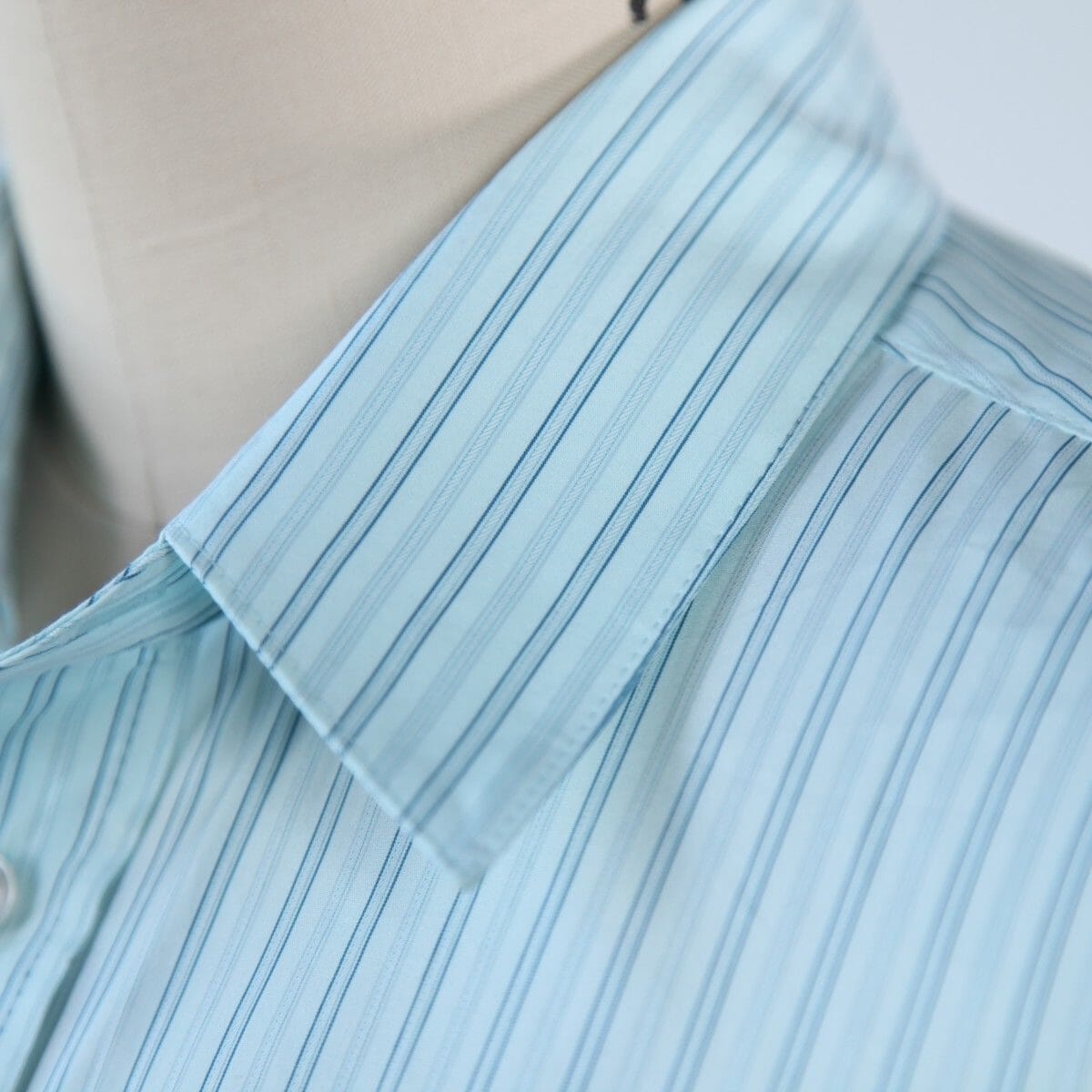
Because it is a small assembly of layers that must behave as one piece, and it sits where every fault is at eye level. A shirt collar is the top collar, the under collar and an interlining between them, joined to the shirt by a collar band. The interlining gives the structure, and how it is attached decides whether the collar reads crisp or limp after a year of washing.
There are two ways to attach it. Sewn interlinings are stitched between two layers of the fabric, whereas fusible interlinings are bonded to the fabric using heat and pressure (Apparel Resources). Almost all production shirts are fused, because fusing is fast and consistent. An unfused, sewn collar is softer and rolls; the same shirtmaker's guide notes that unfused collars generally require a bit more skill to finish well (Proper Cloth).
The collar also starts at the pattern, not at the fusing press. A pattern maker quoted in a trade feature on dress shirts explains that the collar band's curve has to follow the neck shape so the collar pulls evenly, and that the band's shoulder point has to line up with the body during sewing, which also governs whether the shirt folds without twisting (Apparel Resources). The same feature criticises block cutting, where collars are cut oversized, fused and trimmed afterwards, as a loss of both material and production, and recommends cutting the fabric exactly to the pattern.
Three things belong in the brief for every collar: fused or sewn, the interlining weight or stiffness you want, and the collar shape with its point length and spread as measurements. Left blank, you get the factory's house standard, which is usually a fused, medium-weight collar in whatever shape it runs most.
Quick read: A shirt collar is a top collar, an under collar and an interlining joined by a collar band. Sewn interlinings are stitched between the fabric layers; fusible interlinings are bonded with heat and pressure, which is what almost all production shirts use. Write fused or sewn, the interlining weight and the collar measurements into the brief.
How Does Collar Fusing Go Wrong?
In three main ways, and the worst one hides until after the sale. An interlining that is not used correctly can produce bubbling, which is localised delamination; strike back, where the glue comes back through the interlining; and strike through, where the glue penetrates the fabric and shows on the face side (Apparel Resources).
Bubbling is the one that reaches customers. A shirt-making feature in the same trade publication says that bubbling is the major defect of fusing, but it is not always visible on the finished garment, as it appears only after a wash (Apparel Resources). So a perfect-looking collar at inspection proves very little about the fusing. A washed sample does.
The settings. Fusing is a recipe of temperature, pressure and time, and the interlining supplier is meant to give all three for each interlining (Apparel Resources). As one published example, an interlining specialist quoted in that feature recommended, for a fine two-ply cotton dress shirting, a dial setting of 160 to 165 degrees Celsius for a glue-line temperature of 145 degrees, a pressure of 2 to 3 kg per square centimetre and 12 to 13 seconds in the press. That is one interlining on one fabric. The point is that a correct recipe is written down as numbers and checked, not guessed.
The glue. The same feature notes that HDPE adhesive has a high melting point, so the glue is unaffected by higher washing conditions, and a separate feature warns that classic lower-temperature cotton interlining with LDPE adhesive increases the risk of bubbling after a few dry cleans or home washes (Apparel Resources, Apparel Resources). For a shirt that will be washed hot or often, such as a uniform shirt, ask which adhesive the interlining uses.
The shrinkage. The garment fabric and the interlining should have the same shrinkage level. If they do not, one layer shrinks more than the other, which can leave the garment smaller than planned and pucker the seams (Apparel Resources). This is why the interlining has to be tested on your actual fabric, not approved from a swatch card.
The machine. A fusing equipment engineer quoted in the dress shirt feature warns that temperature swinging will lead to weak bonding and bubbles after washing, and that the difference between set and actual temperature should be no more than 5 degrees Celsius (Apparel Resources). You cannot check a thermostat from abroad, but you can ask how the factory verifies its fusing temperature and how often.
What to ask for, in practice: the interlining's name and its data sheet with temperature, pressure and time; a fusing record for your bulk; and a collar that has been through the wash test on your care label before the size set is approved. A factory that runs this routinely will not find the request unusual.
Quick read: Bubbling, or localised delamination, is the main collar fusing defect and often appears only after a wash, according to Apparel Resources. Fusing depends on temperature, pressure and time from the interlining supplier's data sheet; one published dress shirt recipe used a 145 degree glue line, 2 to 3 kg per square centimetre and 12 to 13 seconds.
Which Seams and Stitches Should You Specify?
The ones you can check by hand on a reference shirt, plus one number. Single-needle side seams, flat-felled seams, a split yoke, pattern matching and stitch density all cost a little more time or cloth, and all are visible on the finished garment, which makes them a reliable way to read a factory's standard.
| Construction | What it is | How to check it | The cheaper alternative |
|---|---|---|---|
| Single-needle side seam | Sewn in two passes with one needle | One line of stitching on the outside | A twin-needle pass, two parallel lines, quicker to pucker |
| Flat-felled seam | Seam allowance folded over so the raw edges are enclosed | Inside out, no overlocked edge at side seam or armhole | An overlocked seam, visibly unfinished inside |
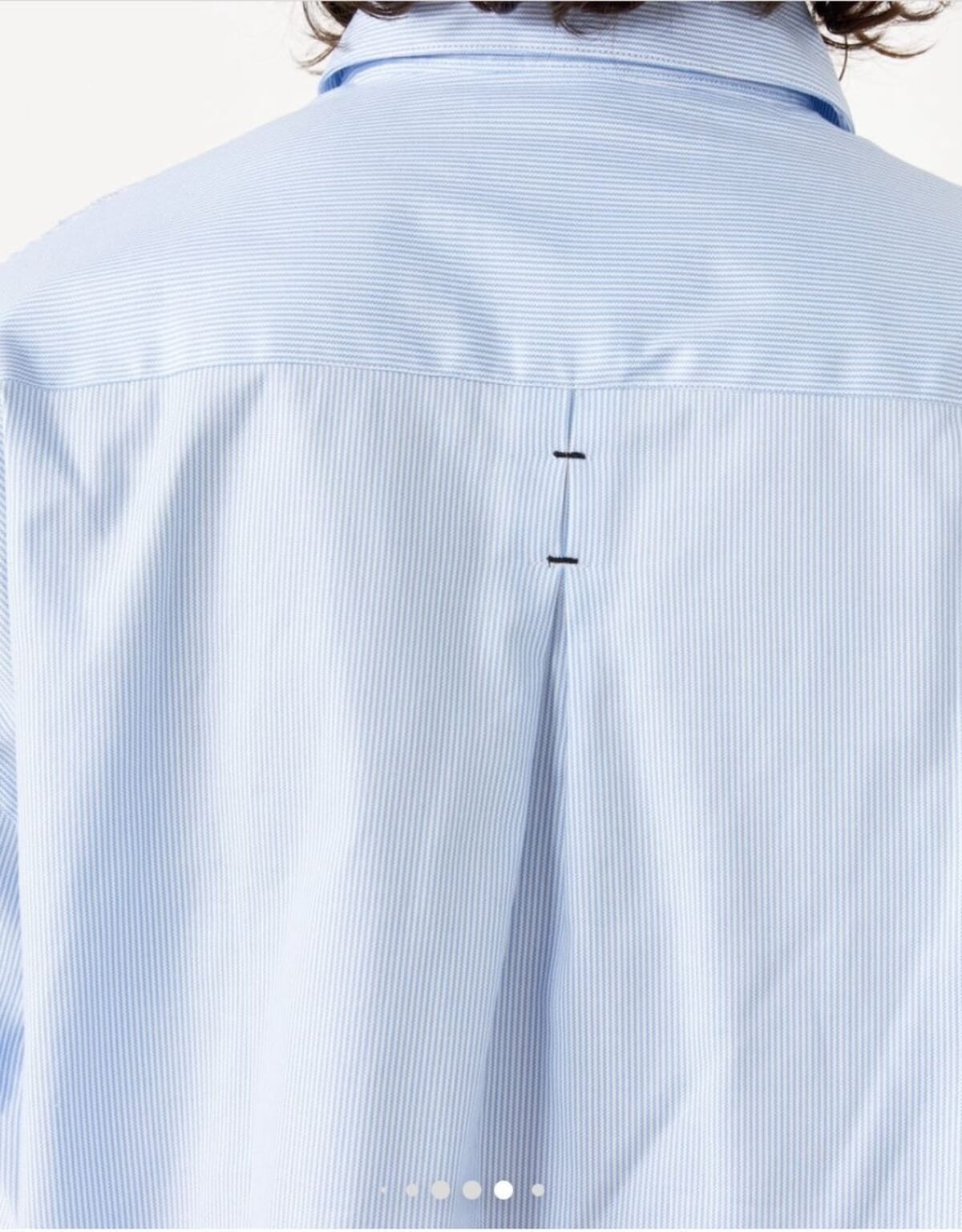
| Split yoke | Back yoke cut in two pieces joined at the centre | A centre-back seam on the yoke; a chevron on stripes | A one-piece yoke |
| Pattern matching | Stripes and checks lined up across seams and pockets | Pocket, placket, yoke and sleeve against the body | Pieces cut wherever they fall on the lay |
Flat-felled seams fold over the edge of the fabric and stitch the fold down, so the fold encases the raw edges and protects them from fraying (Wikipedia, Flat-felled seam). On a shirt they are common at the side seam and armhole, and they are why a good shirt turned inside out shows no overlocking.
A split yoke is made of two pieces of fabric; a true split yoke has the two pieces cut at an angle, on the bias (Proper Cloth). It lets the grain follow the shoulder and, on a stripe, produces a mirrored chevron at the centre back. It uses more cloth and more labour.
Pattern matching is the detail with the widest gap between how much a customer notices it and what it costs. A menswear guide lists the places that should match on a checked shirt: shoulder to sleeve, pocket, split yoke, sleeve to sleeve placket, and the shirt fronts with the front placket (Gentleman's Gazette). Matching a check across a pocket means cutting the pocket from a specific place in the cloth, which wastes fabric. Unless the brief says so, it will not be done.
Stitch density is the number to write down. It is counted in stitches per inch, it can be checked on any shirt with a ruler, and a low count is one of the quiet ways a low price is achieved. The same shirtmaker's guide says a high quality dress shirt should have at least 18 stitches per inch around the cuffs and collars, while some casual shirts are sewn with thicker thread and fewer stitches (Proper Cloth). Pick the figure that suits your shirt, write it into the tech pack for collar, cuff, placket and main seams, and it becomes a pass or fail condition at inspection rather than an opinion.
Thread belongs beside it. Name the thread type and colour matching rule, because a substituted thread changes both the look of the topstitching and how long the seams last. If you do not yet have a tech pack that carries these numbers, we can draw one.
Quick read: Five construction points are visible on a finished shirt: single-needle side seams, flat-felled seams, a split yoke, pattern matching and stitch density. One shirtmaker's guide says a high quality dress shirt should have at least 18 stitches per inch around cuffs and collars; writing a minimum into the tech pack makes it checkable at inspection.
How Is Shrinkage Controlled?
At the fabric stage, and then confirmed on the finished shirt. It matters more on a shirt than on most garments because the two measurements a wearer notices first, the neck and the sleeve length, are both tight.
The fabric control is sanforisation, a treatment that reduces shrinkage from washing by stretching, shrinking and fixing the woven cloth in both length and width before cutting. Cloth treated this way may be labelled with a shrink-proof value, for example under 1% (Wikipedia, Sanforization). Ask whether the shirting is sanforised and for the residual shrinkage figure in writing, measured by a stated wash method.
The garment control is measuring after washing. A factory that measures a dry, unwashed shirt against your size chart is checking a garment your customer will never wear. Give finished measurements after the wash on your care label, and approve neck and sleeve on a washed sample.
The interlining has to move with the fabric. As covered above, a collar whose interlining shrinks differently from the shell will pucker or bubble, so the wash test that checks your measurements is also the test that checks your fusing.
Quick read: Shirting shrinkage is controlled first by sanforisation, which stretches, shrinks and fixes the cloth before cutting and can bring residual shrinkage under 1%, and then by approving neck and sleeve measurements on a washed sample rather than a dry one.
What Do Labels and Duty Involve for the US?
Two rules for the label and one line in the tariff. Under the FTC Care Labeling Rule, manufacturers and importers must attach care labels so they can be seen or easily found when the product is offered for sale, and it is an unfair practice to fail to possess, prior to sale, a reasonable basis for all regular care information (16 CFR Part 423). A care symbol copied from a similar shirt is not a reasonable basis; a wash test on your fabric and collar is.
Fibre content follows the Textile Act rules: fibres present at 5 percent or more of the total fibre weight are named by their generic names, such as cotton, polyester or linen (16 CFR Part 303). For care and content labels made in China, see our guide to label manufacturers in China.
On duty, men's or boys' woven shirts of cotton that are not hand-loomed fall under US tariff subheading 6205.20.20, with a general rate of 19.7% (USITC HTS). Goods from China can carry additional duties on top of the general rate, and those have changed often, so check the current position for your HTS line before you price a range.
Quick read: Under the FTC Care Labeling Rule, manufacturers and importers must attach care labels and possess a reasonable basis for all care information before sale. Men's woven cotton shirts enter the US under HTS 6205.20.20 at a general duty rate of 19.7%, before any additional duties on goods from China.
How Does a Pre-Shipment Inspection Work?
It is a random sample of the finished, packed goods, sized by a table and judged against limits agreed in advance. On timing, most inspection companies and most importers agree to start after 100% of the quantity is finished and 80% of the order quantity is fully packed (QualityInspection.org). QIMA describes it as a final check carried out when production is at least 80% complete, with sampling that follows ISO 2859-1 or ANSI/ASQ Z1.4 and defects classed as critical, major or minor (QIMA).
The sample size comes from the lot size and the inspection level. General inspection level II is the usual starting point; level III is stricter and level I less strict (Apparel Search). At level II, an order of 1,201 to 3,200 shirts means inspecting 125 of them, and an order of 3,201 to 10,000 means 200.
The AQL sets how many defective pieces the sample may contain. In ISO 2859-1 the AQL is defined as the quality level that is the worst tolerable, and importers usually set different AQLs for critical, major and minor defects (QualityInspection.org). QualityInspection.org's worked example uses 2.5 for major defects and 4.0 for minor ones. For a sample of 125 that means the lot passes with up to 7 major defectives and fails at 8 (Apparel Search AQL 2.5), and passes with up to 10 minor defectives and fails at 11 (Apparel Search AQL 4.0).
Two rules from the same tables are easy to miss. Counting is by defective units, not individual defects, so a shirt with three faults counts once. And passing does not guarantee that the lot contains fewer defects than the AQL percentage; AQL sampling does not replace laboratory testing or measurement checks (Apparel Search).
What the inspector checks on a shirt should be written down before the inspection, as a checklist attached to the order:
- Collar: points the same length and shape, no visible glue, no puckering at the band, collar sits symmetrically on the body.
- Fusing: a few collars and cuffs from the sample washed on the care label setting and checked for bubbling.
- Measurements: neck, chest, body length and sleeve against the size chart and tolerance, on washed pieces where the order requires it.
- Stitching: stitches per inch counted at collar, cuff and placket against the tech pack figure; no skipped or broken stitches.
- Pattern matching at pocket, placket and yoke on striped or checked cloth.
- Buttons and buttonholes: secure, clean-cut, aligned; button pull checked where required.
- Labels, folding, packing and carton marks against the packing instructions.
Decide in advance which faults are critical, major and minor. A bubbled collar or a wrong neck size is not a minor defect, and an inspection that files it as one will pass a lot your customers will return.
Quick read: Most inspection companies start a pre-shipment inspection when 100% of the quantity is finished and 80% is packed. At general inspection level II, a lot of 1,201 to 3,200 shirts means inspecting 125; at AQL 2.5 for major defects the lot passes with up to 7 defective pieces and fails at 8.
Where Do Shirt Orders Fail?
Five failures cover most of what goes wrong, and each traces back to something the brief did not say.
- The collar bubbles after washing. Weak fusing, the wrong adhesive or an interlining that shrinks differently from the shell. It shows after the customer's first wash, well past any dry inspection.
- The pattern does not match at the pocket. Matching was never specified, so the pocket was cut wherever it fell on the lay.
- The neck shrinks. Unsanforised fabric, or measurements approved on an unwashed sample.
- Seams pucker. Low stitch density, a substituted thread, or a twin-needle seam where single-needle was expected.
- The sleeve twists. A sleeve pitch or pattern fault rather than a sewing one, which no amount of inspection fixes after cutting.
For the factory side of the same problem, our guide to finding and vetting clothing suppliers in China covers checking the company itself, and our guide to suit manufacturers in China covers fused and canvassed construction in tailoring.
Checklist Before You Order Shirts
Before you order woven shirts
- Fabric written as fibre, count, ply (warp and weft), weave and weight; sanforised, with residual shrinkage in writing.
- Collar: fused or sewn, interlining name and data sheet, collar shape and measurements.
- Fusing: temperature, pressure and time recorded for bulk; washed collar approved before the size set.
- Stitches per inch written for collar, cuff, placket and main seams; thread type named.
- Single-needle or flat-felled seams, split yoke and pattern matching stated where you want them.
- Finished measurements after washing, with tolerances, especially neck and sleeve.
- Care label backed by a wash test; fibre content named generically.
- Pre-shipment inspection: level, AQL for critical, major and minor, and a shirt checklist attached to the order.
None of this is unusual for a shirt factory that does the work properly. Written down, it turns most shirt quality questions from arguments into measurements.
We are a group of documented clothing factories in China. Send a reference shirt or a specification, and we place production with the factory in our group built for the product. Our team replies within 24 hours. Samples, invoices and shipping run straight between you and the factory; our fee is flat and we take nothing from the factory side.
Send your brief China factory list, $49No spec sheet yet? We draw one style as a factory-ready tech pack for $79. What the $79 covers.
Frequently Asked Questions
Why does a shirt collar bubble after washing?
The bond between the collar fabric and its fusible interlining has failed in places, which is called delamination. Common causes are wrong fusing temperature, pressure or time, an adhesive that does not stand up to washing, or an interlining that shrinks differently from the fabric. It often appears only after a wash.
What does two-ply mean in shirting?
Two yarns are twisted together before weaving. Two-ply cloth is stronger and holds its shape better than single-ply cloth of a similar count, which is why it is the usual marker of a quality shirting.
How many stitches per inch should a shirt have?
There is no single legal figure. One shirtmaker's guide says a high quality dress shirt should have at least 18 stitches per inch around the cuffs and collars. Choose your figure and write it into the tech pack so it can be checked.
When should a pre-shipment inspection happen?
Most inspection companies and importers start when 100% of the quantity is finished and at least 80% is packed, so the sample represents the goods that will ship.
How many shirts are checked in an AQL inspection?
It depends on the lot size and inspection level. At general inspection level II, a lot of 1,201 to 3,200 pieces means inspecting 125, and a lot of 3,201 to 10,000 means 200.
What is the US duty on men's cotton shirts?
Men's or boys' woven cotton shirts that are not hand-loomed fall under HTS 6205.20.20 with a general rate of 19.7%. Goods from China can carry additional duties on top.
Sourcing notes: all company names, certification marks and trademarks referenced here are the property of their owners. Trade figures are customs declarations reported to UN Comtrade. Duty rates are general rates and do not include additional duties. Fusing settings quoted are one published example, not a standard. Reviewed and updated 16 November 2026 by David Stan.
Where the figures come from
- World Bank WITS: Top exporters of HS 620520 (men's or boys' shirts of cotton), 2024.
- World Bank WITS: Top exporters of HS 620530 (men's or boys' shirts of man-made fibres), 2024.
- World Bank WITS: China exports of HS 620520, 2024.
- World Bank WITS: China exports of HS 620520, 2023.
- World Bank WITS: China exports of HS 620520, 2022.
- World Bank WITS: China exports of HS 620520, 2021.
- World Bank WITS: China exports of HS 620520, 2020.
- World Bank WITS: China exports of HS 620520, 2019.
- Wikipedia: Units of textile measurement: English cotton count.
- Gentleman's Gazette: Dress shirt guide.
- Proper Cloth: High quality dress shirts.
- Apparel Resources: Making collars and cuffs for high quality dress shirts.
- Apparel Resources: Interlining in shirt making, December 2018.
- Wikipedia: Flat-felled seam.
- Wikipedia: Sanforization.
- eCFR: 16 CFR Part 423, Care Labeling of Textile Wearing Apparel.
- eCFR: 16 CFR Part 303, Rules and Regulations under the Textile Fiber Products Identification Act.
- US International Trade Commission: Harmonized Tariff Schedule, subheading 6205.20.
- QualityInspection.org: Final product inspections: should the whole order be ready?
- QualityInspection.org: What does AQL mean?
- QIMA: Pre-shipment inspection procedure.
- Apparel Search: 2.5 AQL chart for the fashion industry.
- Apparel Search: 4.0 AQL chart for the fashion industry.
Related Reading
- Suit Manufacturers in China
- Shengzhou Ties: Silk and Interlining
- Fabric Suppliers in China
- Label Manufacturers in China
- T-Shirt Suppliers in China
- Clothing Suppliers in China: How to Find and Vet a Factory
No commission and no mark-up on the factory price: the factory invoices you itself.