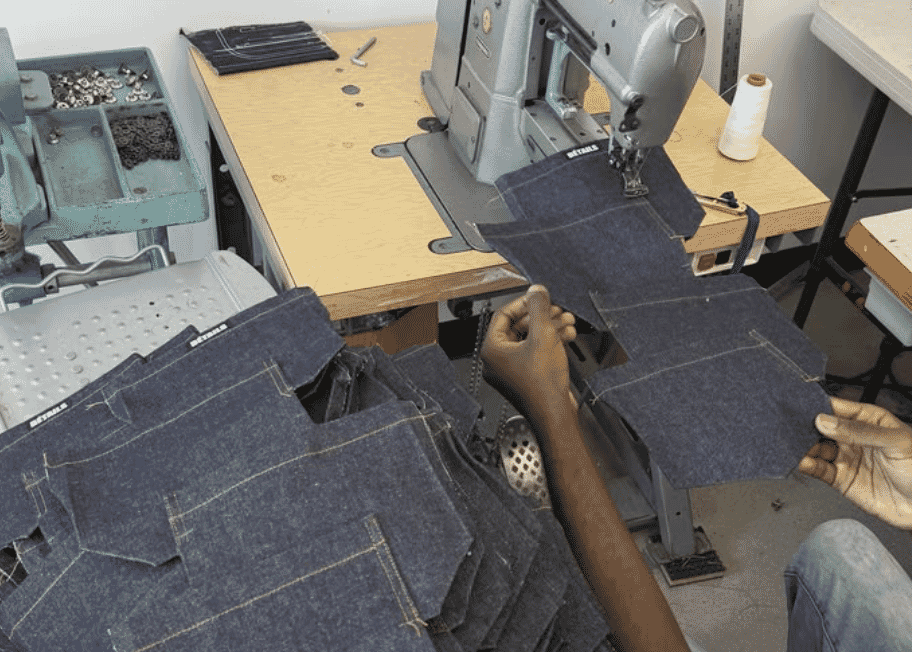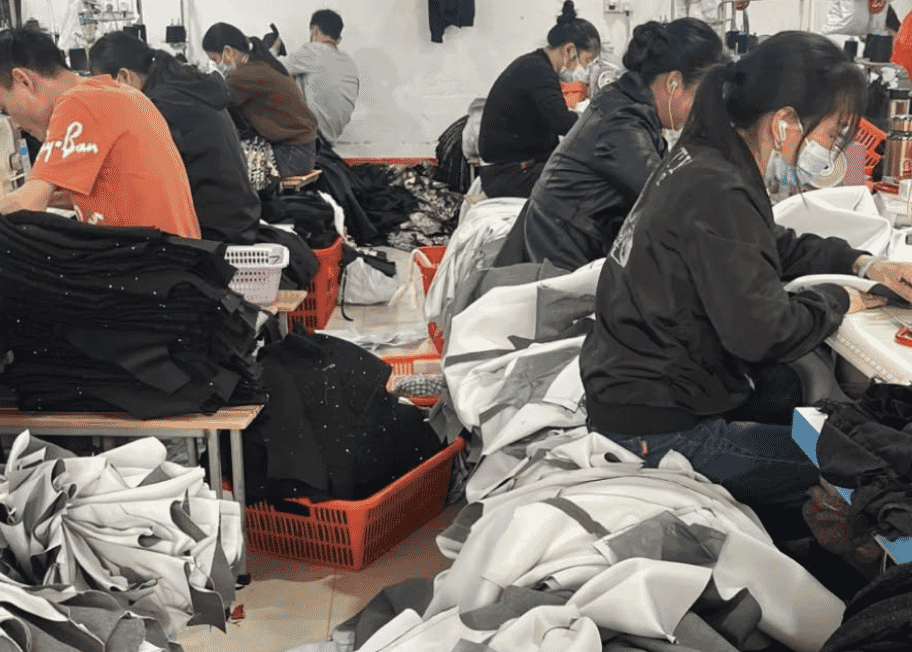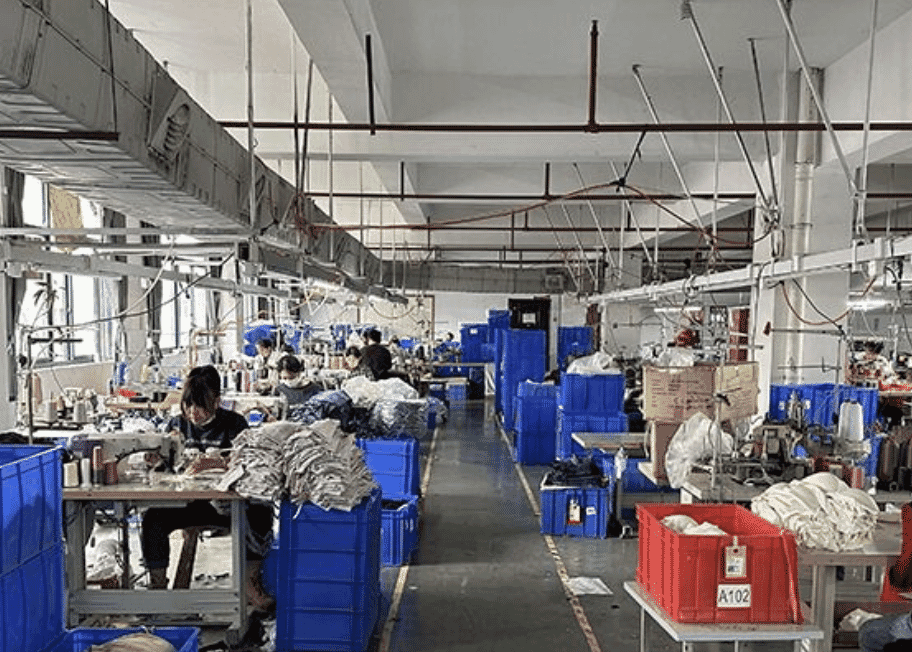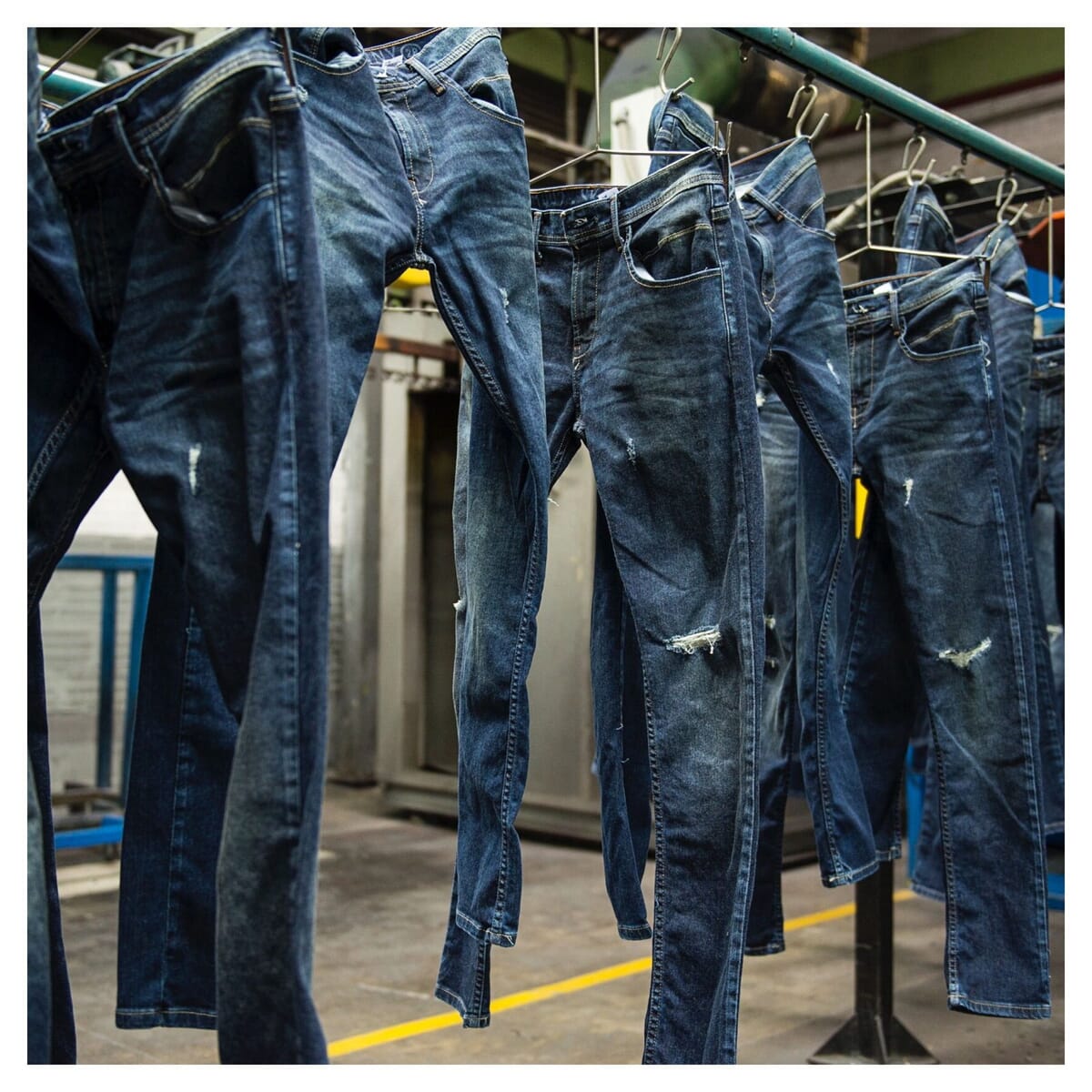
A pair of jeans is made twice. The first time, a sewing line cuts and assembles flat, stiff, dark denim. The second time, a laundry washes, abrades, bleaches, softens and presses it into the product the customer actually sees. The wash sets the colour, the fade, the hand feel, much of the final shrinkage and a good part of the defect list.
Xintang, on the east side of Guangzhou, is the best-known place in China where both halves happen close together. It is also a place with a documented pollution history, and that history is about the laundry, not the sewing.
This guide covers what a buyer should know about jeans from Xintang: what the cluster is, what the laundry does and why it decides the order, what the 2010 pollution findings and later clean-up campaigns mean for your supplier questions, why sandblasting still belongs in the specification, which published test methods cover shrinkage and colour transfer, and how to size and time the inspection before the balance is paid.
Before you read: China Clothing Manufacturer places and manages clothing production with documented factories in Guangdong, Zhejiang and Fujian. Trade, standards, environmental and inspection facts in this guide come from the published sources listed at the end. For what we produce in denim and how an order runs, see our denim manufacturer in China page.
What matters most
- Xintang is the denim town. A March 2026 report from Guangdong media says it accounts for one in every three pairs of jeans worldwide and ships 2.5 million pairs every day.
- The laundry makes the product. A US Customs ruling on men's denim pants describes the order of work: cut and sewn, then washed, trim applied, ironed and packaged.
- The pollution record is real. Greenpeace found heavy metals in 17 of 21 water and sediment samples from Xintang and Gurao in 2010 (Global Times).
- Ask about the laundry by name. Clean-up campaigns since then have shut washing, bleaching and dyeing plants in parts of Xintang, so where your jeans are washed matters.
- Ban sandblasting in writing. An Al Jazeera investigation found it still used in some Xintang factories in 2015.
- Test after the wash. Shrinkage (AATCC TM135, or ISO 6330 with ISO 5077) and crocking (AATCC TM8, ISO 105-X12) mean most on the finished, washed jean.
- Inspect before the balance. At general inspection level II a lot of 501 to 1,200 pairs means opening 80 of them.
Quick read: In Xintang the sewing line and the laundry are often different businesses. Name the laundry, approve a physical wash standard, ban sandblasting, test shrinkage and crocking on washed pairs, and tie the 70% balance to an AQL inspection of the finished goods.
What Is Xintang and Why Do Jeans Come From There?
Xintang is a town in Zengcheng district (Wikipedia), in the eastern part of Guangdong's capital city, Guangzhou. A report published by the Guangdong media outlet South (newsgd.com) on 28 March 2026 calls it the Denim Capital of the World, says it is about the size of Manhattan, and reports that it accounts for one in every three pairs of jeans worldwide, shipping 2.5 million pairs of jeans every day. The same report describes high-end fabrics there such as recycled denim from sea waste, silk denim and cashmere denim, and refers to Xintang's denim industrial parks.
Older figures are smaller and use different measures, which is worth knowing before you repeat any of them. In 2012 China Daily, citing Greenpeace, said Xintang produces 260 million pairs every year and that more than 40 percent of the goods are exported to the United States, the European Union, Russia and other countries. In 2015 a Guangzhou magazine, That's, wrote that if you bought your jeans abroad there was a one-in-three chance they were made in Xintang, that the probability rises to one in two for jeans bought within China, and that the town's factories pump out over 800,000 pairs of jeans every day.
None of these numbers is an official census, and they do not agree with each other. What they agree on is the shape of the place: a very large concentration of jeans production in one town, with fabric, sewing, trims and washing all within reach.
The same 2015 article describes how that concentration is laid out. Different processes are separated by street: one road lined with rooms of sewing machines, an adjacent alley devoted to fastening metal buttons and zippers, while all washing and dyeing takes place in yet another section of town (That's). For a buyer that layout has a practical meaning. The factory that quotes you and sews your jeans may not be the business that washes them.
Quick read: Xintang, in Guangzhou's Zengcheng district, is known as the Denim Capital of the World. A March 2026 report from Guangdong media says it accounts for one in every three pairs of jeans worldwide and ships 2.5 million pairs every day; older reports cite 260 million pairs a year (China Daily, 2012). Sewing, trims and washing sit in separate parts of town.
What Does the Laundry Actually Do to a Pair of Jeans?
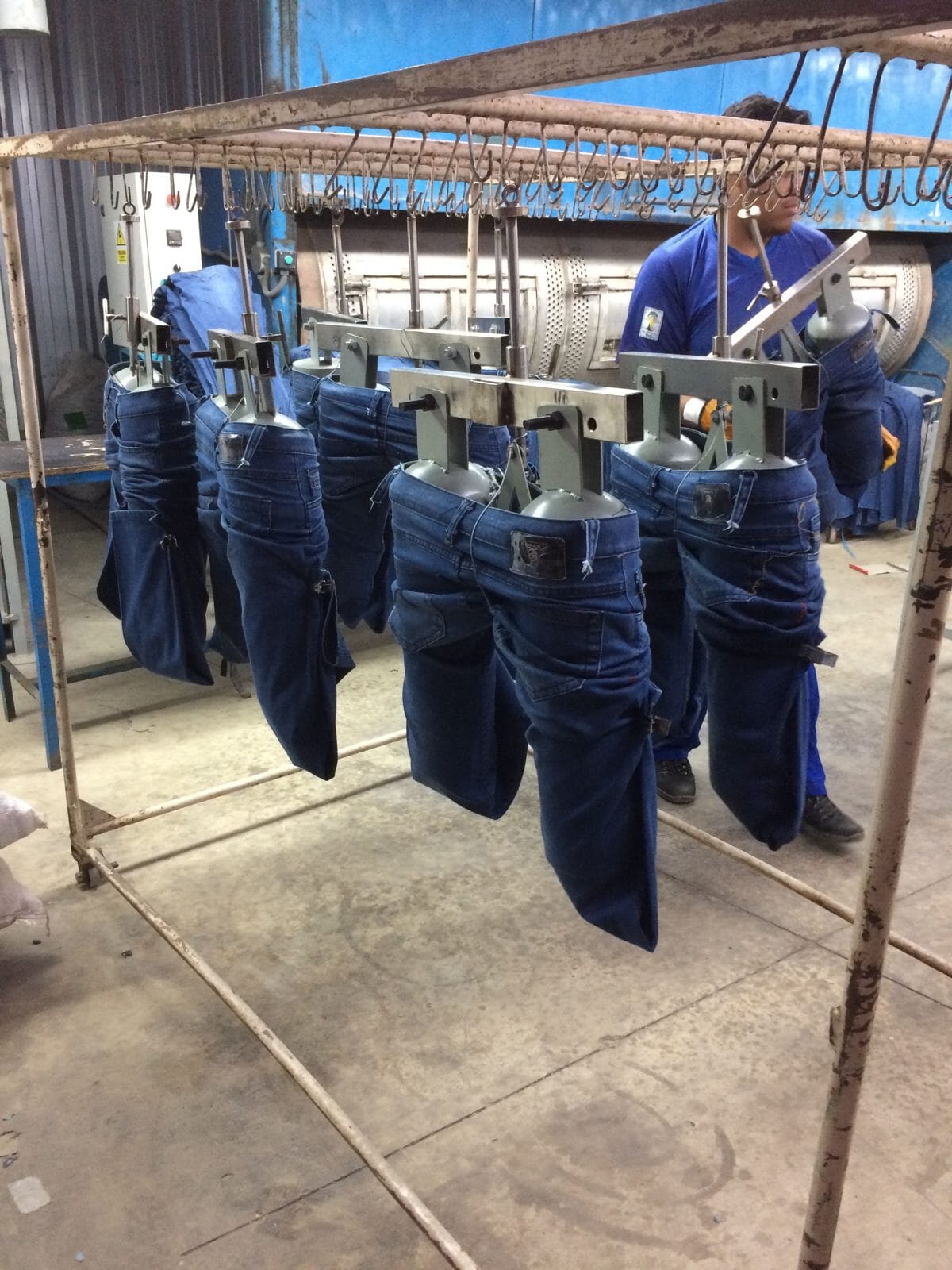
It turns a sewn garment into a finished product. A US Customs ruling on men's denim pants, HQ H280295 from April 2017, sets out the sequence in plain words: the denim fabric is cut and sewn into a finished pair of men's denim pants, then the pants are washed, trim is applied, the pants are ironed, and they are packaged for shipment. The garment in that ruling was described as 98% cotton / 2% elastane men's denim pants, classified under subheading 6203.42.4011.
Washing is where the look is made. Stonewashed jeans are usually produced either by washing the jeans with pumice in a rotating drum, or by using chemicals to create the appearance without the drum; the pumice acts like sandpaper on the jeans, removing some of the dye (Wikipedia: Stonewashing). The same article notes that the use of cellulase enzymes to modify the appearance of jeans is commonly called biostoning, and that the use of pumice made the stone washing process harder to control.
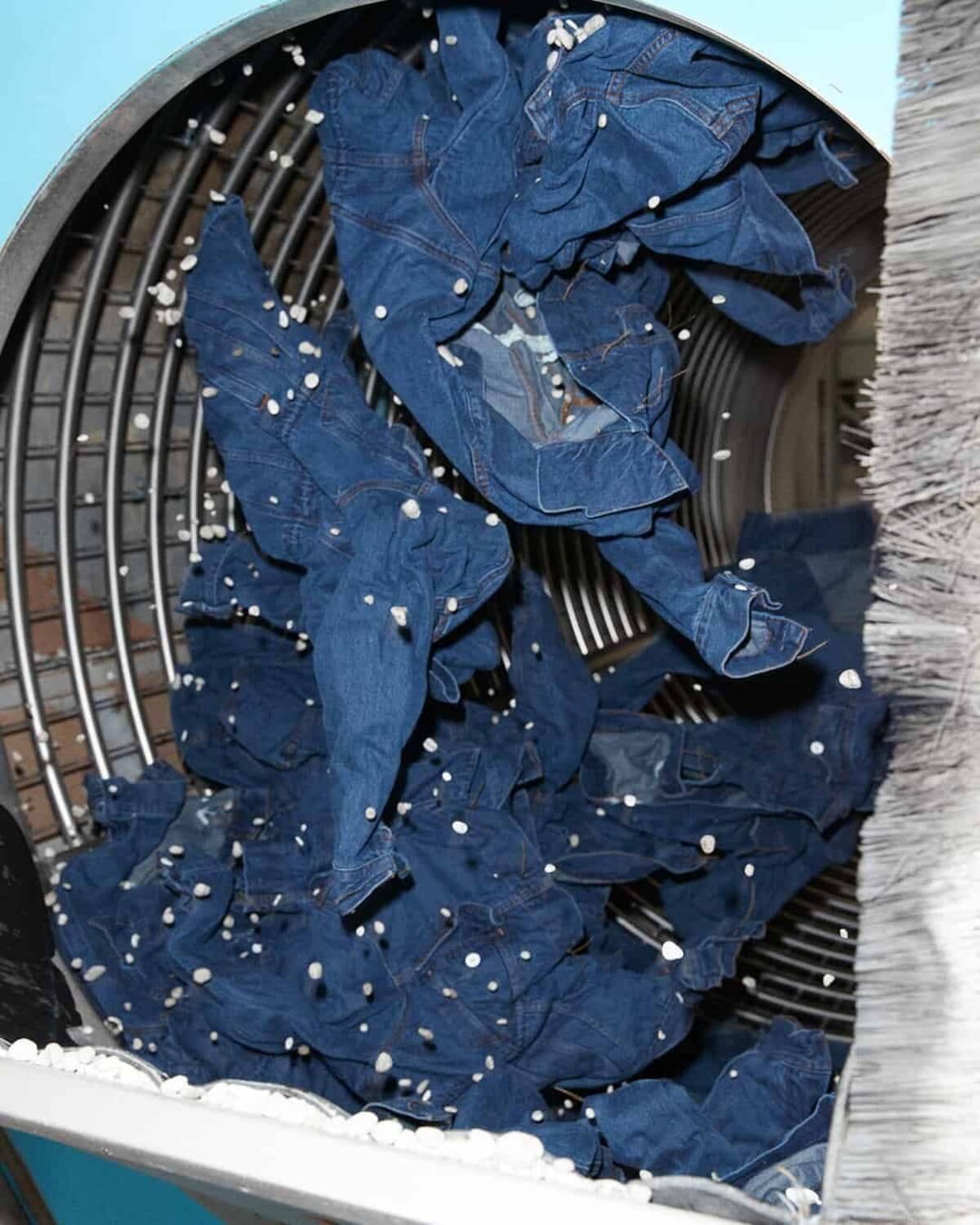
That last point is the one buyers feel. A wash is a recipe run on a machine with a load of garments, and every variable in it moves the result: how long the load runs, how full the drum is, how much abrasive or enzyme goes in, the water temperature, the order of the steps. Two laundries running what both call the same wash can produce visibly different jeans, and the same laundry can drift between the first and the last load of your order.
The laundry also changes the size. Woven cotton shrinks when it is first washed, which is why denim mills pre-shrink fabric. Sanforization is a treatment for fabrics to reduce shrinkage from washing; it works by stretching, shrinking and fixing the woven cloth in both length and width before cutting and producing (Wikipedia: Sanforization). Even sanforised denim keeps moving when a garment is washed hard, so the pattern has to be made for the size after the wash, not before it.
This is why an approved sample of washed jeans is a recipe check as much as a style check. It tells you what that laundry produced on that day with that fabric lot. Bulk is a separate question, and the specification has to carry enough detail for anyone to tell whether bulk matches.
Quick read: A 2017 US Customs ruling on 98% cotton / 2% elastane men's denim pants describes the order of work: cut and sewn, then washed, trim applied, ironed and packaged. Stonewashing uses pumice in a rotating drum or chemicals; enzyme washing is called biostoning. Sanforization pre-shrinks the cloth, but the garment wash still moves the size.
What Is the Xintang Pollution Story, and Does It Still Matter?
It matters because it is about the step that decides your product. In December 2010 Greenpeace released a report on two textile towns in Guangdong, Xintang and Gurao, based on studies it ran from April through October that year. According to the Global Times report on its release, laboratory testing found heavy metals such as copper, cadmium and lead in 17 out of 21 samples of water and sediment from the two places, and one sediment sample from Xintang contained cadmium at concentrations 128 times in excess of national environmental standards.
The same report quoted a Greenpeace campaigner explaining why: dyeing, washing, bleaching and printing are among the dirtiest processes in the textile industry, requiring high volumes of water as well as heavy metals and other chemicals. Greenpeace also released figures showing there had been 133 textile industrial clusters around the country since 2001, so Xintang was never the whole story (Global Times).
Local reporting kept the subject alive. The 2015 That's article recalls a Pearl River tributary awash in indigo near Xintang in 2010, describes the polluted waterways as a direct result of dyeing and washing the jeans, and says those concerns were among the causes of city-wide riots in 2011. China Daily reported in 2012 that, according to the Ministry of Environmental Protection, the textile industry used as much as three times the global average of clean water to produce the same amount of fabric (China Daily).
Clean-up has come in campaigns. A trade news site, Tradetextile, reported that Xintang Town completed the cessation of sewage discharge rectification for a first batch of nine heavily polluting enterprises in the Shapu area in January 2019, and that Xintang Town and the Zengcheng District Branch of the Municipal Ecological Environment Bureau then rectified a second batch of four. The production electricity, boilers and sewage pumps of washing, bleaching and dyeing enterprises were shut down, and the report says that since 2018, 16 sites in the Shapu area had been cleaned up, with the remaining 3 to be closed before December 31, 2020.
Moving a polluter is not the same as fixing it. In the same 2012 China Daily piece, Ma Jun, director of the Institute of Public and Environmental Affairs, warned that without strengthened supervision, the relocation of polluters simply means that they will take the pollution along with them (China Daily). For a brand, the useful conclusion is narrow. The risk sits with whoever washes your jeans, and you can only judge it if you know who that is.
So the questions to ask a Xintang supplier are specific. Is the wash done in-house or at a separate laundry? What is the laundry called and where is it? Will the same laundry run the sample and the bulk? Can you see its current environmental permit and how it treats its wastewater? A supplier that cannot name its laundry cannot tell you whether the wash on your approved sample will be the wash on your bulk, and cannot answer the environmental question either.
Quick read: Greenpeace's 2010 study of Xintang and Gurao found heavy metals in 17 of 21 water and sediment samples, with one Xintang sediment sample at 128 times the national cadmium standard (Global Times). Later campaigns cut power, boilers and sewage pumps at washing, bleaching and dyeing plants in Xintang's Shapu area (Tradetextile).
Why Does Sandblasting Still Belong in the Specification?
Because it has been reported in Xintang well after brands said they had stopped using it. Sandblasting involves fine sand being channelled into an air gun and sprayed at high pressure onto denim to make the fabric look worn, and it can lead to a fatal respiratory disease known as silicosis (Al Jazeera).
FashionUnited's summary of the history: in 2004 a Turkish doctor found the link between sandblasting and silicosis, several major brands and Turkey then banned the technique, and in 2010 the Killer Jeans campaign persuaded 40 other major denim brands to ban sandblasting as well (FashionUnited). A later report by worker-rights groups including SACOM, the Clean Clothes Campaign, War on Want and the IHLO, based on about 170 interviews with garment workers from six clothing plants in Guangzhou, found evidence that the method was still used by at least five factories in southern China.
In March 2015 a year-long Al Jazeera investigation reported poorly ventilated, dusty factories at Xintang, where an estimated 260 million pairs of jeans are produced each year, and found that some of them used sandblasting. Workers speaking anonymously confirmed the practice continued.
The buyer's response is simple and costs nothing. Write "no sandblasting" into the specification and the purchase order as a condition of acceptance, ask the factory and the laundry how each abrasion effect on your jeans is achieved, and ask the inspector to look at the laundry floor if the laundry is visited. A worn look on the thighs, seat or knees can be produced by hand sanding and by other methods; the specification should say which method you accept.
Quick read: Sandblasting sprays fine sand at high pressure onto denim and can cause silicosis. After a 2004 medical link, brands and Turkey banned it and 40 more brands followed in 2010, yet a later report found it in at least five factories in southern China and a 2015 Al Jazeera investigation found it in some Xintang factories.
How Do You Write the Wash Into the Specification?
With a physical standard, a written description and tolerances. Words like mid-blue or vintage mean different things to different laundries, so the wash is defined by an object everyone holds.
- A signed wash standard. Keep one approved washed pair yourself, leave one with the factory and one with the laundry. Label all three with the date and the fabric lot.
- Shade limits. Approve a lightest and a darkest acceptable pair, or a shade band, so the inspector has something to compare bulk against.
- Effect placement. Mark where whiskers, honeycombs, fading and abrasion go, how large they are and how many, on a flat drawing or photos of the approved pair.
- Fabric and lot. Name the denim, its composition and weight, and say whether bulk must come from the same fabric lot as the approved sample.
- Measurements after the wash. Give the size chart for the finished, washed garment, with tolerances, and say which points matter most (waist, inseam, front rise, thigh, leg opening).
- The laundry. Name it, and say that a change of laundry needs your written approval and a new wash sample.
- Prohibited processes. No sandblasting, plus any chemicals your market or customer restricts.
The size chart deserves a second look. Because the garment wash shrinks the jean, the factory cuts a larger pattern than the finished size. If the factory's pattern allowance is wrong for your fabric and wash, every pair in bulk will be off in the same direction. Checking finished measurements on washed bulk, not on the sewn garment before washing, is the only check that catches this.
Fabric lot matters for the same reason. Indigo denim is dyed in batches, and different batches can wash to slightly different shades even under the same recipe. Where a range must look uniform on a shelf, ask for bulk from one fabric lot, or ask the factory to keep lots separate and show you a washed pair from each.
Which Laboratory Tests Matter for Jeans?
Two properties cause most denim complaints that a laboratory can predict: how much the jean shrinks when the customer washes it, and how much indigo rubs off onto other things. Both have published methods on each side of the Atlantic.
Shrinkage (dimensional change). In the US the usual reference is AATCC Test Method 135, Dimensional Changes of Fabrics after Home Laundering, intended for the determination of dimensional (length and width) changes of fabrics when subjected to home laundering procedures; it provides four washing temperatures, three agitation cycles and four drying procedures (AATCC). In Europe and much of Asia the pairing is ISO 6330, which specifies domestic washing and drying procedures for textile testing, with ISO 5077, which specifies a method for the determination of the dimensional change of fabrics, garments or other textile articles after those washing and drying procedures.
ISO 6330:2021 provides 16 washing procedures for a front-loading reference machine (Type A), 12 for a top-loading agitator machine (Type B) and 7 for a top-loading pulsator machine (Type C), and six drying procedures including line dry, flat dry and tumble dry (EVS). ISO 3759 covers the preparation, marking and measuring of fabrics and garments for these dimensional change tests (EVS). Because the result depends on the procedure, the specification should name the method, the washing procedure, the drying procedure and the number of cycles, not just a percentage.
Colour transfer (crocking). AATCC Test Method 8 is designed to determine the amount of colour transferred from the surface of coloured textile materials to other surfaces by rubbing, with white test cloths both dry and wet; the transfer is graded against the Gray Scale for Staining or the Chromatic Transference Scale (AATCC). ISO 105-X12 specifies a method for determining the resistance of the colour of textiles to rubbing off and staining other materials, and also allows one test with a dry rubbing cloth and one with a wet rubbing cloth (EVS).
For dark indigo jeans the wet test deserves particular attention, since a damp jean is what rubs against light sofas, car seats and bags. AATCC's own scope notes that washing, drycleaning, shrinkage, ironing and finishing may affect the degree of colour transfer, and that the test may be made before, after, or before and after any such treatment. For jeans, test the washed garment: the laundry changes the surface the customer will rub.
Colour fastness to washing. ISO 105-C06 covers the resistance of the colour of textiles to domestic or commercial laundering. Its single test closely approximates one laundering, and its multiple test may in some cases approximate up to five launderings at temperatures not exceeding 70 °C (EVS). It is worth adding when a jean is sold with light trims, contrast stitching or pocket bags that can pick up indigo in the wash.
None of these methods sets a pass mark on its own. The buyer and supplier agree the grade or percentage. If you have no in-house levels yet, ask the testing laboratory what it commonly sees requested for washed denim, decide your own numbers, and write them into the order before production.
Quick read: For jeans, test shrinkage with AATCC TM135 (four washing temperatures, three agitation cycles, four drying procedures) or ISO 6330 with ISO 5077, and colour transfer with AATCC TM8 or ISO 105-X12, which both use dry and wet rubbing cloths. AATCC notes that washing and finishing affect crocking, so test the washed jean.
When and How Should Jeans Be Inspected?
Before the balance is paid, on finished and washed goods. One of the most common payment structures in China manufacturing is 30/70: 30% down when the order is placed and the remaining 70% due before shipment, which, as the law firm Harris Sliwoski puts it, means the buyer pays in full before ever receiving or inspecting the goods. The firm's advice is to negotiate terms so that the 70% balance is due only after a quality inspection has been conducted and approved.
Timing follows from the wash. Most inspection companies and importers agree to start a final inspection after 100% of the quantity is finished and 80% of the order quantity is fully packed (QualityInspection.org). QIMA describes pre-shipment inspection as carried out when production is at least 80% complete, with sampling that follows ISO 2859-1 or ANSI/ASQ Z1.4. For jeans, finished means washed, dried, trimmed, pressed and tagged; an inspection of unwashed garments tells you about the sewing and nothing about the wash.
The sample size comes from a table. At general inspection level II, which Apparel Search calls the usual starting point (level III is stricter and level I less strict), a lot of 501 to 1,200 pairs means inspecting 80; at AQL 2.5 for major defects the lot passes with up to 5 defective pieces and fails at 6, and at AQL 4.0 for minor defects it passes with up to 7 and fails at 8 (Apparel Search AQL 2.5, AQL 4.0).
What the inspector checks on denim goes beyond a standard garment list:
- Shade against the standard, in daylight or a light box, pair by pair across the sample, and between cartons. Shade differences between the legs of one pair are a defect in their own right.
- Wash effects against the approved pair: placement, size and intensity of whiskers, fading and abrasion; no patches the recipe did not ask for.
- Finished measurements on washed pairs, at the points named in the specification.
- Hardware: rivets and buttons firmly set, no sharp edges, zips running freely, no corrosion or discolouration from the wash.
- Seams and stitching: no broken stitches at the seat, crotch and belt loops, which take the most strain; hems even.
- Twist: a side seam that rotates towards the front of the leg after washing.
- Residues and smell: stone dust in pockets, chemical odour, damp cartons.
- A crocking rub on site with a white cloth, as a quick indicator before the laboratory report.
If the order has several washes, inspect each as its own lot or make sure the sample is drawn from every wash. A lot that mixes a light wash and a dark wash can pass on average while one wash fails.
Quick read: Under the common 30/70 structure the balance is due before shipment, so make it payable only after an approved inspection (Harris Sliwoski). Inspect washed, finished jeans once production is complete and mostly packed. At general inspection level II a lot of 501 to 1,200 pairs means opening 80; at AQL 2.5 the lot fails at 6 major defectives.
How Big Is China in Jeans and Denim?
Customs data do not separate jeans from other cotton trousers at the six-digit level that every country reports, so the closest view uses two codes: HS 6203.42 for men's or boys' trousers of cotton and HS 6204.62 for women's or girls' trousers of cotton. Both include jeans, and both include chinos and other cotton trousers.
In 2024 China exported $4,417.4 million of men's or boys' cotton trousers and $6,406.1 million of women's or girls' cotton trousers, according to World Bank WITS data. In 2019 the figures were $4,487.0 million and $6,131.6 million. The United States was the largest single market for both in 2024, taking $727.8 million of the men's and $1,869.5 million of the women's.
China was the largest exporter of both codes in 2024. For men's or boys' cotton trousers the next single countries were Germany at $2,348.3 million, Italy at $1,115.4 million and Turkey at $948.8 million; for women's or girls' cotton trousers they were Turkey at $1,399.3 million, Spain at $1,119.6 million and Germany at $1,087.5 million (WITS, WITS).
The fabric tells a second story. In 2024 China was also the largest exporter of heavy cotton denim, HS 5209.42 (85% or more cotton, over 200 g/m2), at $634.7 million, ahead of Pakistan at $508.5 million, India at $225.9 million and Turkey at $223.5 million (WITS).
And the largest buyers of China's denim fabric were Bangladesh ($167.0 million), Cambodia ($151.5 million) and Vietnam ($85.8 million) (WITS). In other words, part of China's denim leaves the country as fabric, to be made up elsewhere, which is one reason a buyer comparing Xintang with another country is often comparing laundries and sewing, not fabric.
Where Do Denim Orders From China Go Wrong?
Most denim problems trace back to the wash, and to something that was not written down.
- The bulk wash does not look like the sample. The sample was washed in a small load, or at a different laundry, or from a different fabric lot. Fix: one named laundry, a signed wash standard, shade limits, inspection against them.
- The jeans come out a size small or long. The pattern allowance did not match the fabric's shrinkage in that wash. Fix: test shrinkage on the bulk fabric with your wash before cutting, and measure washed bulk.
- Indigo on the customer's sofa. Wet crocking was never tested, or was tested on raw fabric. Fix: AATCC TM8 or ISO 105-X12 on the washed jean, with an agreed grade.
- The laundry changed. Capacity was short, so part of the order went to another laundry without telling you. Fix: a written rule that a laundry change needs approval and a new wash sample.
- An effect you did not approve. Abrasion appears where the drawing did not show it, or is produced by a method you excluded. Fix: placement drawings and a written list of prohibited processes.
- Mixed shades in one carton. Pairs from different wash loads or fabric lots were packed together. Fix: ask for packing by lot and check shade between cartons at inspection.
None of these is unusual for a competent denim supplier to control. Each becomes a dispute only when the standard it should be measured against was never agreed.
Checklist Before You Order Jeans From Xintang
Before the balance on a jeans order
- The laundry is named, and a change of laundry needs your written approval.
- You hold a signed, washed approval pair, and the factory and laundry hold matching ones.
- Shade limits or a shade band are agreed and labelled.
- Effect placement is drawn, and sandblasting is prohibited in writing.
- The size chart is for the washed garment, with tolerances.
- Shrinkage and crocking methods, procedures and pass levels are written into the order and tested on washed pairs.
- The pre-shipment inspection is booked on washed, finished goods, sized from the AQL table, with the denim checks above.
- The 70% balance is payable only after the inspection report is approved.
Written down, this list turns the laundry from the least visible step of a jeans order into the most checked one, while there is still time and money to act on what the inspection finds.
We are a group of documented clothing factories in China. Send your specification or a reference pair, and we place production with the factory in our group built for the product. Our team replies within 24 hours. Samples, invoices and shipping run straight between you and the factory; our fee is flat and we take nothing from the factory side.
Send your brief Get a tech pack ($79)No tech pack yet? Get a factory-ready single-style tech pack for $79, with your wash standard, washed measurements and test requirements written in. See what's included.
Conclusion
Xintang earned its name by putting every step of a pair of jeans within a short drive. That is its strength for a buyer, and it is also why the step that decides the product, the wash, can happen in a business the buyer never hears about.
The town's pollution record and the reports of sandblasting are both about that hidden step. So is most of what goes wrong on a denim order. The practical answer is the same for all three: know who washes your jeans, define the wash with a physical standard, test shrinkage and colour transfer on washed pairs, and inspect washed, finished goods before the balance is paid.
Frequently Asked Questions
Where is Xintang?
Xintang is a town in the eastern part of Guangzhou, the capital of Guangdong province, in Zengcheng district. Guangdong media call it the Denim Capital of the World.
How many jeans does Xintang make?
Reports differ. A March 2026 report from Guangdong media says one in every three pairs of jeans worldwide and 2.5 million pairs a day; China Daily cited 260 million pairs a year in 2012. None is an official census.
Is Xintang still polluted?
Greenpeace found heavy metals in 17 of 21 water and sediment samples from Xintang and Gurao in 2010. Later campaigns shut washing, bleaching and dyeing plants in parts of Xintang. Ask your supplier which laundry washes your jeans and how it treats its wastewater.
Which test should I use for jeans shrinkage?
AATCC TM135 is the usual US method; ISO 6330 with ISO 5077 is the usual ISO pairing. Name the washing and drying procedure and the number of cycles, and test the washed garment.
What is crocking on jeans?
Crocking is colour rubbing off onto other surfaces. AATCC TM8 and ISO 105-X12 test it with dry and wet rubbing cloths. Test the washed jean, not the raw fabric.
Is sandblasting banned in China?
Many brands banned sandblasting after its link to silicosis, but later investigations, the most recent in 2015, reported it still in use in some factories in Guangdong, including Xintang. Prohibit it in your specification and purchase order.
How many pairs are checked in a pre-shipment inspection?
It depends on the lot size and inspection level. At general inspection level II, a lot of 501 to 1,200 pieces means inspecting 80, and a lot of 1,201 to 3,200 pieces means 125.
Sourcing notes: all company names, certification marks and trademarks referenced here are the property of their owners. Production figures for Xintang are as reported by the news sources cited and are not official statistics. Environmental and sandblasting findings are described as reported; they are not claims about any particular factory. Trade figures are customs declarations reported to UN Comtrade. Test methods are named from the standards bodies' published scopes; pass levels are for buyer and supplier to agree. Reviewed and updated 18 November 2026 by David Stan.
Where the figures come from
- Wikipedia: Xintang (place names in Guangdong).
- South (newsgd.com): Phone-light denim can be your next travel must-have, 28 March 2026.
- That's (thatsmags.com): Denim sings the blues: the forgotten plight of Xintang jeans factories, 14 January 2015.
- Global Times: Greenpeace exposes toxic textile hazards, 2 December 2010.
- China Daily: Fashion houses 'need to clean up their act', 20 April 2012.
- Tradetextile: Xintang printing and dyeing factories will be cleared.
- Al Jazeera: Sandblasting still used in Chinese jeans factories, 11 March 2015.
- FashionUnited: Sandblasted jeans still causing distress, July 2013.
- US Customs and Border Protection: Ruling HQ H280295, 6 April 2017.
- Wikipedia: Stonewashing.
- Wikipedia: Sanforization.
- AATCC: TM135, dimensional changes of fabrics after home laundering.
- AATCC: TM8, colorfastness to crocking: crockmeter.
- Estonian Centre for Standardisation (EVS): EN ISO 6330:2021, domestic washing and drying procedures for textile testing.
- Estonian Centre for Standardisation (EVS): EN ISO 5077:2008, determination of dimensional change in washing and drying.
- Estonian Centre for Standardisation (EVS): EN ISO 3759:2011, preparation, marking and measuring for dimensional change tests.
- Estonian Centre for Standardisation (EVS): EN ISO 105-X12:2016, colour fastness to rubbing.
- Estonian Centre for Standardisation (EVS): EN ISO 105-C06:2010, colour fastness to domestic and commercial laundering.
- Harris Sliwoski: China manufacturing payment terms: the real risk behind 30/70 TT.
- QualityInspection.org: Final product inspections: should the whole order be ready?
- QIMA: Pre-shipment inspection procedure.
- Apparel Search: 2.5 AQL chart for the fashion industry.
- Apparel Search: 4.0 AQL chart for the fashion industry.
- World Bank WITS: China exports of HS 620342 (men's or boys' cotton trousers), 2024.
- World Bank WITS: China exports of HS 620342, 2019.
- World Bank WITS: China exports of HS 620462 (women's or girls' cotton trousers), 2024.
- World Bank WITS: China exports of HS 620462, 2019.
- World Bank WITS: Top exporters of HS 620342, 2024.
- World Bank WITS: Top exporters of HS 620462, 2024.
- World Bank WITS: Top exporters of HS 520942 (denim, 85% or more cotton, over 200 g/m2), 2024.
- World Bank WITS: China exports of HS 520942 by partner, 2024.
Related Reading
- Denim Manufacturer in China
- Fabric Suppliers in China
- Guangzhou Clothing Manufacturers
- Textile Factories in China
- Shirts from China
- Clothing Suppliers in China: How to Find and Vet a Factory
No commission and no mark-up on the factory price: the factory invoices you itself.