Most gym wear problems can be found on a table with a tape measure. One cannot. A legging that goes see-through when the wearer squats looks perfect flat, looks perfect on a hanger and looks perfect on a mannequin. It only fails in the one position the product is bought for: stretched to the limit over a body that is bending.
That makes opacity an inspection problem as much as a fabric problem, and it puts a date on it. On a typical China order the last real leverage a brand has is the balance payment. Once the balance is paid and the cartons are on the water, a sheer batch is the brand's problem. Before the balance is paid, it is still the factory's.
This guide is about that window. It covers what went wrong in the best-known sheer legging case, how to write a squat test into a specification, the laboratory tests that sit behind it, and how a pre-shipment inspection is sized and timed so that the squat test happens before the money moves.
Before you read: China Clothing Manufacturer places and manages production for brands from 100 pieces per style with documented factories in China. Trade, standards and inspection figures in this guide come from the published sources listed at the end. For fabrics, MOQ and cost, see our separate guide to activewear manufacturers in China.
What matters most
- A legging can meet its specification and still be sheer. In the 2013 recall of black yoga pants, the brand said it had not changed the specifications.
- The squat check is the test. One brand's own disclaimer told customers to do a couple of Down Dogs in bright bottoms to check coverage.
- Write it into the spec. Who wears it, which size, which colour, what light, and what counts as a fail.
- Back it with lab tests. Stretch and growth, pilling, and colourfastness to perspiration and rubbing each have published methods.
- Tie the balance to the inspection. A law firm advises making the 70% balance due only after a quality inspection is conducted and approved.
- Size the inspection from the table. At general inspection level II, a lot of 501 to 1,200 pieces means opening 80 of them.
- China dominates the category. It exported $4,075.4 million of women's synthetic knit trousers (HS 6104.63) in 2024, about six times the next country (WITS).
Quick read: Opacity fails only at full stretch on a body, so a squat test on the palest colour must be written into the specification, repeated on bulk pieces drawn at random in the pre-shipment inspection, and passed before the balance is paid.
What Happened in the Best-Known Sheer Legging Case?
In March 2013 Lululemon pulled its black yoga pants from store shelves after finding that the material was revealing too much, according to an Associated Press report carried by the Christian Science Monitor. The pants made up about 17 percent of all women's pants and crop pants in its stores. The company cut its first-quarter revenue forecast to between $333 million and $343 million, from prior guidance of $350 million to $355 million.
Two details matter more than the size of the recall. The first is that the company insisted it had not changed the specifications for the clothing (AP via CSM), and that the problem did not occur because it changed specifications or switched suppliers (ABC7). In other words, a specification existed, it was followed, and the product was still sheer. Whatever the spec measured, it did not measure coverage at full stretch.
The second is how the problem was found. The company said it first began to understand the extent of the problem on March 11, as part of its weekly call with store managers, who voiced worries about sheerness (ABC7). A Cowen analyst quoted in the same report suspected a serious lapse in the company's quality assurance program if customers had reported it to stores first. The defect was found by customers, after sale.
Later coverage summarised in Retail Dive quoted the New York Times reporting that some women returning the pants were told to put them on and bend over so staff could judge how sheer they were. That is a squat test, run at the wrong end of the supply chain.
There was also a hint of how the brand itself thought about coverage. Some light-coloured pants on sale at the time carried a disclaimer recommending that customers do a couple of Down Dogs in brightly coloured bottoms to make sure they were happy with the fit and coverage (ABC7). The same report said the company had earlier had sheerness problems with certain swimsuits for spring 2012, and problems with bright dyes bleeding.
The lesson for a smaller brand ordering from China is not that any one factory or fabric was at fault. It is that the test that finds sheerness is a body test, and that it has to be part of approval and inspection, not something customers discover.
Quick read: In March 2013 Lululemon withdrew black yoga pants that made up about 17 percent of women's pants and crop pants in its stores after they proved too sheer, while insisting it had not changed the specifications (Associated Press). Store managers raised the sheerness concerns; a disclaimer on bright bottoms told customers to do a couple of Down Dogs to check coverage.
Why Does a Legging Pass Flat and Fail in a Squat?
Because stretch opens the knit. A knitted fabric is made of interlocking loops, and when it is pulled in two directions at once the loops open and the yarns spread apart. The same fabric that is dense at rest lets more light through at full extension, and the seat and thigh of a legging are stretched furthest when the wearer squats or folds forward.
Three things make that worse. A smaller size on a larger body stretches the fabric further. A pale or bright colour shows skin and underwear where black hides them. And strong light from behind or above, the kind found in many gyms and studios, shows what normal indoor light does not. This is why a range developed and approved in black can pass every check and then draw complaints only in its lighter colourways.
It is also why fabric weight on its own does not settle the question. Heavier fabric puts more material between the light and the skin, but the yarn, the knit structure, the elastane content and the finishing all change how far the loops open. Two fabrics of the same weight can behave differently in a squat. The only reliable answer is to test the actual fabric, in the actual colour, on a body.
Bulk adds one more variable. The fabric in your bulk order comes from production lots that were not the lot your sample was cut from. Dyeing, knitting tension and finishing can vary from lot to lot, so a sample that passed is evidence about the sample, and a squat test on bulk pieces is evidence about the order.
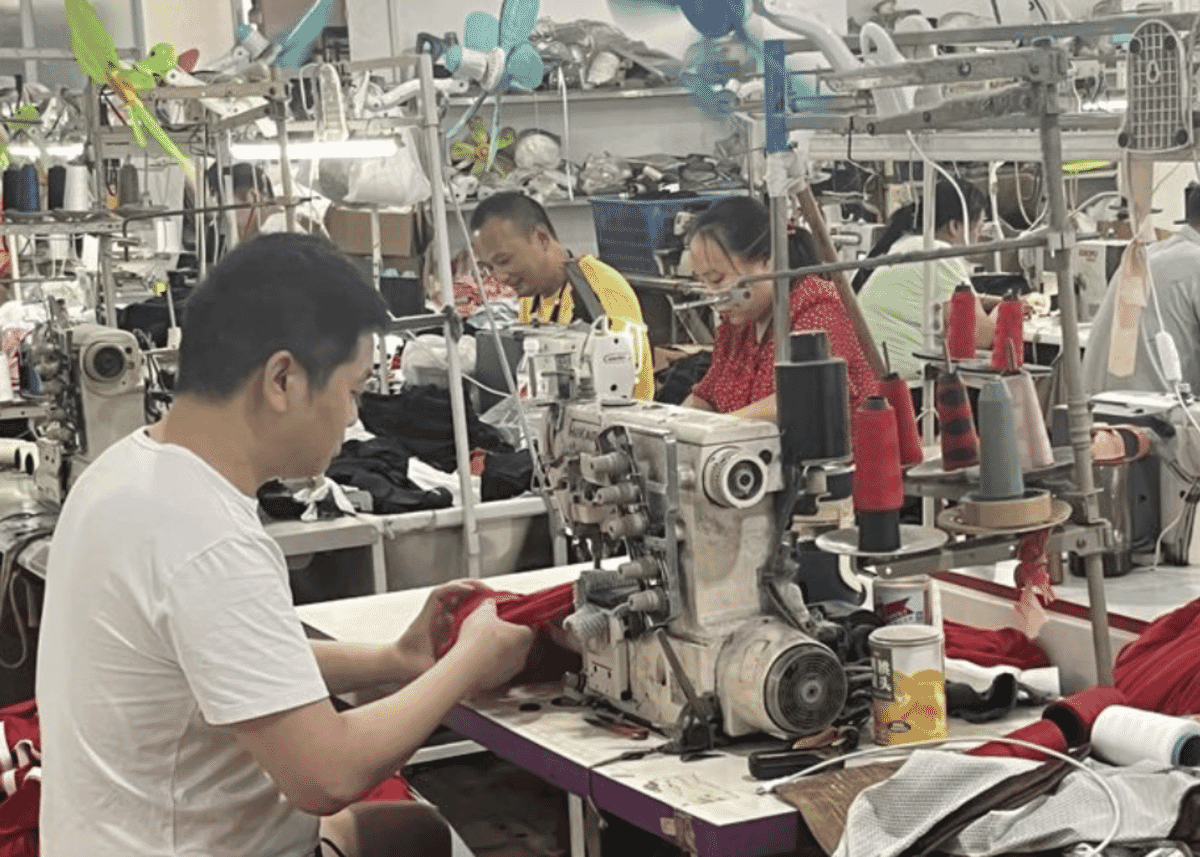
Quick read: Knitted fabric is made of loops that open when stretched in two directions, so a legging that is opaque at rest can show skin at full extension in a squat. Pale colours, a tight size and strong light make the failure visible; black hides it. Fabric weight alone does not predict the result, so the actual fabric and colour must be tested on a body.
How Do You Write a Squat Test Into the Spec?
As a short protocol with a pass or fail answer. The squat check is a practical test rather than a laboratory method, so if it is not written into the specification it will be run differently by every person who runs it, or not at all. A useful protocol fixes six things.
| Element | What to write | Why it matters |
|---|---|---|
| Wearer | A person, not a form, wearing the size the protocol names | A dress form does not bend, and the fabric only opens on a moving body |
| Size | The size that stretches the fabric most on that wearer | A loose fit can hide a fabric that will fail on most customers |
| Colour | Every colourway, starting with the palest | Dark colours conceal openness that pale ones show |
| Positions | Deep squat, forward fold, lunge | Seat, back thigh and inner thigh are each stretched by a different movement |
| Light | Daylight or a bright light behind the wearer, viewed from behind | Weak overhead light hides what a bright gym shows |
| Pass or fail | No skin, underwear or underwear lines visible; compared with the approved reference piece | Turns an opinion into a decision an inspector can record |
Keep a reference piece. When a sample passes, seal one piece, label it as the approved coverage standard, and keep one at the factory and one with you. At inspection the question becomes whether the bulk piece is at least as opaque as the sealed piece under the same conditions, which is far easier to judge than an absolute standard.
Photograph it the same way every time. Same distance, same light, same positions, from behind. Photos taken this way at sample stage, size set and bulk can be compared side by side, and they give you something concrete to send the factory when a result changes.
Add a hand stretch on the table. Stretching the seat panel over a light source, a lamp or a window, is a quick screen between body tests. It does not replace the body test, but it lets an inspector check more pieces and pick out a suspect carton fast.
Run it at three points. On the approval sample, so the fabric and colour are proven before bulk fabric is bought. On the first pieces off the line, so a bad fabric lot is caught while it can still be replaced. And on randomly drawn pieces at the pre-shipment inspection, so the result describes the goods that will actually ship.
Classify the defect before the inspection. A sheer seat is not a cosmetic blemish. Decide in writing that visible skin or underwear in the squat test is a major defect at least, or that any failure in the test rejects the colourway, so the inspector does not have to make that call on the day.
Quick read: A squat test protocol names the wearer, the size, the colourways starting with the palest, the positions (deep squat, forward fold, lunge), the light (bright, from behind) and the pass condition: no skin or underwear visible compared with a sealed reference piece. Run it on the approval sample, the first bulk pieces and randomly drawn pieces at pre-shipment inspection.
Which Lab Tests Sit Behind the Squat Test?
Four groups of test cover what the squat check does not. The squat test tells you about coverage on the day. Laboratory methods tell you whether the fabric keeps its stretch, its surface and its colour over wear and washing. Each method below is a published standard; the pass levels are not set by the standard itself and have to be agreed between buyer and supplier.
| Property | Published method | What it covers |
|---|---|---|
| Stretch and growth, low-power knits | ASTM D2594 | Fabric stretch and fabric growth of knitted fabrics for low-power stretch uses |
| Tension and elongation of elastic fabrics | ASTM D4964 | Wide or narrow elastic fabrics on a constant-rate-of-extension tester, at agreed loop tensions |
| Elasticity of fabrics | EN 14704-1, now EN ISO 20932-1 | Strip or loop tests of elasticity and related properties |
| Pilling | ASTM D3512 (random tumble), ASTM D4970 (Martindale) | Pills and related surface changes on knit and woven fabrics |
| Colour vs sweat | ISO 105-E04 | Resistance of textile colour to human perspiration |
| Colour vs rubbing | ISO 105-X12 | Colour rubbing off and staining other materials |
Stretch and recovery. A legging that stretches but does not come back bags at the knee and the seat, and a baggy seat is also a less opaque one. ASTM D2594 covers fabric stretch and fabric growth of knitted fabrics intended for low-power stretch, and it states that it is not applicable to fabrics intended for support or other applications requiring high-power stretch (ASTM D2594). That distinction matters for gym wear: a compression legging is a high-power fabric, and the standard points to other methods for those.
For elastic fabrics, ASTM D4964 covers the measurement of tension and elongation of wide or narrow elastic fabrics made from elastomers, on a constant-rate-of-extension tensile tester (ASTM D4964). Its scope says the loop tensions and elongations at which results are determined must be selected or mutually agreed, and that laundering procedures, the temperature and the number of washing and drying cycles also require mutual agreement. In practice that is a line in your specification, not something the lab decides for you.
In Europe, EN 14704-1:2005 described methods using strips of fabric or loops to measure elasticity and related properties of fabrics, excluding narrow fabrics. The Estonian standards body lists EN ISO 20932-1:2020 after it in the standard's history (EVS), so ask a laboratory which edition it runs before you compare reports.
Pilling. Inner thighs rub on every stride, and pilling there is one of the first signs of wear a customer sees. ASTM D3512 determines the propensity of a fabric to form pills and related surface changes using the random tumble pilling tester, and is generally applicable to woven and knitted apparel fabrics (ASTM D3512). ASTM D4970 does the same with the Martindale tester, and allows the fabric to be laundered or dry cleaned before testing as agreed (ASTM D4970). ASTM's own note on D3512 is worth repeating to anyone setting a pass level: pilling in actual wear varies more with general conditions of use and individual wearers than replicate specimens do in the lab.
Colourfastness to perspiration. Gym wear is worn wet with sweat, which is one reason bright dyes bleed. ISO 105-E04 specifies a method for determining the resistance of the colour of textiles of all kinds and in all forms to the action of human perspiration (EVS, ISO 105-E04:2013). For a range with white trims or a two-colour panel, ask for staining results as well as colour change.
Colourfastness to rubbing. ISO 105-X12:2016 specifies a method for determining the resistance of the colour of textiles to rubbing off and staining other materials (EVS, ISO 105-X12:2016). A dark legging that rubs off on a pale bench, a bag strap or a white sports bra fails in a way that the squat test will never show.
What to ask for. A test report from an independent laboratory on the bulk fabric lot, not only on the development fabric; the edition of each method; the agreed pass level written beside it; and the pre-treatment, such as the number of washes, where the method allows one. If you have no in-house levels yet, start by asking the laboratory what it commonly sees requested for performance leggings, and then write your own numbers down.
Quick read: Published methods sit behind the squat test: ASTM D2594 for stretch and growth of low-power knits (not high-power support fabrics), ASTM D4964 for tension and elongation of elastic fabrics at agreed loop tensions, EN 14704-1 (replaced by EN ISO 20932-1:2020) for elasticity, ASTM D3512 and D4970 for pilling, and ISO 105-E04 and ISO 105-X12 for colourfastness to perspiration and rubbing.
Why Tie the Squat Test to the Balance Payment?
Because that is when the brand still has leverage. One of the most common payment structures in China manufacturing is 30/70: 30% down when the order is placed and the remaining 70% due before shipment, which, as the law firm Harris Sliwoski puts it, means the buyer pays in full before ever receiving or inspecting the goods.
The same firm describes two scenarios its manufacturing lawyers see repeatedly. In one, defects are discovered after the goods arrive and the factory will not take them back or offers a discount on the next order. In the other, a pre-shipment inspection reveals widespread defects, and the factory says the deposit has already been spent on production and offers to fix the goods or discount the order. It adds that most lawsuits are not worth the cost, especially for small or mid-sized orders under $50,000 to $100,000 (Harris Sliwoski).
Its first recommendation is the one this guide is built around: negotiate terms so that the 70% balance is due only after a quality inspection has been conducted and approved. It also advises inspecting early and often rather than waiting for the final pre-shipment inspection, and treating 30/70 as a trial for initial, smaller orders rather than a permanent standard (Harris Sliwoski).
For gym wear, the practical version is a clause in the purchase order that names the inspection, the AQL, and the squat test protocol, and states that the balance is released when the inspection passes. A factory that runs its own opacity checks will not object to the clause. A factory that does object has told you something useful before production starts.
Inspecting early matters especially for opacity, because the cure for a sheer fabric is a different fabric. If the first bulk pieces fail the squat test, the fabric lot can still be replaced before it is all cut and sewn. If the failure is found only at pre-shipment, the choices are a delay while the order is remade, a discount, or shipping a product you know is sheer.
Quick read: Under the common 30/70 structure, the 70% balance is due before shipment, so the buyer pays in full before inspecting the goods. Harris Sliwoski advises making the balance due only after a quality inspection is conducted and approved, and inspecting early. For gym wear, write the squat test into that inspection and catch a sheer fabric lot on the first bulk pieces.
How Is the Pre-Shipment Inspection Sized and Timed?
By a sampling table, once nearly everything is packed. On timing, most inspection companies and most importers agree to start inspection after 100% of the quantity is finished and 80% of the order quantity is fully packed (QualityInspection.org). QIMA describes pre-shipment inspection as a final check when production is at least 80% complete, with sampling that follows ISO 2859-1 or ANSI/ASQ Z1.4 and defects classed as critical, major or minor, and says reports are provided on the same day as the inspection (QIMA).
The same QualityInspection.org article advises importers to allow two full days for each inspection, to receive the report and, if needed, agree corrections with the supplier, and notes that this does not mean shipments are delayed by two days (QualityInspection.org). Build those days into the plan between the end of packing and the balance date.
The sample size comes from the lot size and the inspection level. General inspection level II is the usual starting point; level III is stricter and level I less strict (Apparel Search). At level II, a lot of 501 to 1,200 leggings means opening 80 of them, and a lot of 1,201 to 3,200 means 125.
The AQL sets how many defective pieces that sample may contain. In ISO 2859-1 the AQL is defined as the quality level that is the worst tolerable, and importers usually set different AQLs for critical, major and minor defects (QualityInspection.org). With 2.5 for major and 4.0 for minor defects, a sample of 80 passes with up to 5 major defectives and fails at 6 (Apparel Search AQL 2.5), and passes with up to 7 minor defectives and fails at 8 (Apparel Search AQL 4.0).
Two points from the same tables are easy to forget. Counting is by defective units, not individual defects, so a legging with three faults counts once. And AQL sampling does not replace laboratory testing or measurement checks (Apparel Search). The squat test is a functional check that the inspector runs on a subset of the drawn sample; it does not need to be run on all 80 pieces to be useful, but the pieces it is run on must come from the random draw, not from a pile the factory has set aside.
How many squat tests? The standards do not say, so decide it in advance. A workable rule is a fixed number of pieces per colourway, drawn from different cartons, with the palest colourway always included, and a rule that one clear failure triggers a check of more pieces from that colourway before the lot is judged.
Quick read: Most inspection companies start a pre-shipment inspection when 100% of the quantity is finished and 80% is packed, and QualityInspection.org advises allowing two days per inspection. At general inspection level II, a lot of 501 to 1,200 pieces means inspecting 80; at AQL 2.5 for major defects the lot passes with up to 5 defective pieces and fails at 6.
What Should the Inspector Check on Gym Wear?
Everything a normal garment inspection covers, plus the functional checks that only matter on stretch garments. Write the list down and attach it to the order, so the inspector, the factory and you are reading the same document.
- Squat test to the written protocol on randomly drawn pieces from every colourway, palest first, compared with the sealed reference piece.
- Seams under stretch. Pull each main seam to the fabric's working stretch: no cracked stitches, no popped threads, no seam grin showing the stitch through the face.
- Waistband. Width and height to spec, elastic fully enclosed, no twisting, recovers after a firm stretch; drawcord and pocket where specified.
- Gusset. Present, correctly shaped and aligned, with the seams meeting cleanly at its points.
- Colour. No shading between panels of the same garment, and colour consistent with the approved standard across cartons.
- Measurements. Waist relaxed and extended, hip, rise, inseam and leg opening against the size chart and tolerance.
- Surface. No snags, holes, dropped stitches, oil marks or shiny pressure marks from pressing on synthetic fabric.
- Labels. Fibre content, care, origin and size labels present and matching the order; packing and carton marks to the packing instructions.
For US labelling, the FTC rules under the Textile Act define spandex as a manufactured fibre in which the fibre-forming substance is a long chain synthetic polymer comprised of at least 85 percent of a segmented polyurethane, and give 96 percent Acetate 4 percent Spandex as an example of disclosing a fibre that has a clearly established functional significance at that amount (16 CFR Part 303). So a small elastane content can be disclosed by name where it has a clear functional purpose. A trademarked fibre name on a label is a separate question, with its own rules in the same part.
On customs, synthetic leggings can be classified as trousers rather than hosiery. A US Customs ruling classified a pair of women's capri-length leggings of 89 percent polyester and 11 percent spandex jersey knit under subheading 6104.63.2006, the line for women's trousers of synthetic fibres (CBP ruling N301191). That is also the product group in the trade figures below; confirm your own classification and current duty for your exact product before you price a range.
Quick read: A gym wear inspection adds functional checks to the usual list: the squat test on random pieces from every colourway, seams pulled to working stretch, waistband recovery, gusset alignment, panel shading, relaxed and extended waist measurements and labels. Under 16 CFR Part 303, spandex is a fibre of at least 85 percent segmented polyurethane.
How Big Is China in This Category?
Larger than any other single country by a wide margin. In 2024 China exported $4,075.4 million of women's or girls' knitted trousers of synthetic fibres (HS 6104.63), 1,473 million items, according to World Bank WITS data (WITS). The United States was its largest market, taking $1,298.8 million, about 32% of the total.
The value rose from $3,013.8 million in 2019 to $4,420.8 million in 2021, eased in 2022 and 2023, and stood at $4,075.4 million in 2024 (WITS 2019, WITS 2021). The next largest single-country exporters in 2024 were Germany at $676.5 million, Cambodia at $575.4 million and Spain at $263.3 million (WITS).
What the scale means for a brand is choice rather than safety. There are a great many factories in China that make leggings and gym sets, and the difference between them is in fabric sourcing, process control and how they inspect. The figures say nothing about which of them will pass your squat test. Your protocol and your inspection do.
Quick read: World Bank WITS data show China exported $4,075.4 million of women's or girls' knitted trousers of synthetic fibres (HS 6104.63) in 2024, about six times the value of the next single country, Germany ($676.5 million). The United States took $1,298.8 million, about 32% of China's total.
Where Do Gym Wear Orders Go Wrong?
Five failures account for most of the trouble, and each one traces back to a test that was not written down or not run on bulk.
- Sheer in pale colours. The range was approved in black, and the pale colourway was never squat-tested before bulk fabric was bought.
- Sheer in bulk but not in the sample. A different fabric lot, and no squat test on the first bulk pieces.
- Baggy knees and seat after a few wears. No stretch and recovery requirement in the spec, so none was tested.
- Pilling on the inner thigh. No pilling method or level agreed, and a fabric chosen on hand-feel alone.
- Colour on the bench or the bra. No colourfastness to rubbing or perspiration required for a dark or bright colour.
Every item on that list is cheaper to prevent than to fix, and every one can be turned into a line in the specification and a check in the inspection. For the factory side of the same problem, see our guide to finding and vetting clothing suppliers in China, and for related stretch products, our guides to swimwear manufacturers in China and bra manufacturers in China.
Checklist Before You Pay the Balance
Before the balance on a gym wear order
- Squat test protocol written: wearer, size, colourways (palest first), positions, light, pass condition.
- Sealed reference piece kept at the factory and with you for every colourway.
- Squat test passed on the approval sample and on the first bulk pieces, with photos taken the same way.
- Lab report on the bulk fabric lot: stretch and recovery, pilling, colourfastness to perspiration and rubbing, each with the method edition and an agreed level.
- Purchase order states that the balance is released after the inspection passes.
- Pre-shipment inspection booked for when 100% is finished and 80% packed, with two days allowed for the report.
- Inspection level, AQL for critical, major and minor, and a gym wear checklist attached to the order.
- Squat test failures classed in advance as major defects or a colourway rejection.
- Labels checked: fibre content with generic names, care and origin.
None of this asks a competent gym wear factory to do anything unusual. Written down, it turns the most expensive gym wear failure from a customer complaint into an inspection result, while there is still time and money to act on it.
We are a group of documented clothing factories in China. Send your specification or a reference piece, and we place production with the factory in our group built for the product. Our team replies within 24 hours. Samples, invoices and shipping run straight between you and the factory; our fee is flat and we take nothing from the factory side.
Send your brief Get a tech pack ($79)No tech pack yet? Get a factory-ready single-style tech pack for $79, with your squat test and inspection checklist written in. See what's included.
Frequently Asked Questions
How do you test leggings for squat-proofing?
Have a person wear the size that stretches the fabric most, in the palest colourway, and do a deep squat, a forward fold and a lunge in bright light viewed from behind. The legging passes if no skin or underwear is visible compared with a sealed approved reference piece.
Is there an ISO or ASTM standard for the squat test?
The squat check is a practical body test rather than a laboratory method, so write your own protocol into the specification. Published methods cover the related properties: stretch and growth, elastic tension and elongation, pilling, and colourfastness to perspiration and rubbing.
Why do leggings pass in black and fail in light colours?
Stretch opens the knit in every colour, but black hides skin and underwear while pale and bright colours show them. A range approved only in black can pass and still fail in its lighter colourways.
When should the balance be paid on a China order?
Under the common 30/70 structure the balance is due before shipment. A law firm that handles these disputes advises making the 70% balance due only after a quality inspection has been conducted and approved.
How many pieces are checked in a pre-shipment inspection?
It depends on the lot size and inspection level. At general inspection level II, a lot of 501 to 1,200 pieces means inspecting 80, and a lot of 1,201 to 3,200 pieces means 125.
What HS code are synthetic leggings imported under?
They can be classified as women's trousers of synthetic fibres. A US Customs ruling classified women's capri leggings of polyester and spandex jersey knit under subheading 6104.63.2006. Confirm the classification for your own product.
Sourcing notes: all company names, certification marks and trademarks referenced here are the property of their owners. The 2013 recall is described as reported by the news sources cited; it is not a claim about any factory. Trade figures are customs declarations reported to UN Comtrade. Test methods are named from the standards bodies' published scopes; pass levels are for buyer and supplier to agree. Reviewed and updated 17 November 2026 by David Stan.
Where the figures come from
- Christian Science Monitor (Associated Press): Yoga pants recall hits Lululemon stores, 19 March 2013.
- ABC7 Chicago: Lululemon yoga pants recall after garments too sheer, 20 March 2013.
- Retail Dive: How a recall can actually help, and not just hurt, a retailer's brand.
- Harris Sliwoski: China manufacturing payment terms: the real risk behind 30/70 TT.
- ASTM International: D2594, stretch properties of knitted fabrics having low power.
- ASTM International: D4964, tension and elongation of elastic fabrics (CRE tester).
- Estonian Centre for Standardisation (EVS): EN 14704-1:2005, determination of the elasticity of fabrics.
- ASTM International: D3512/D3512M, pilling resistance, random tumble pilling tester.
- ASTM International: D4970/D4970M, pilling resistance, Martindale tester.
- Estonian Centre for Standardisation (EVS): EN ISO 105-E04:2013, colour fastness to perspiration.
- Estonian Centre for Standardisation (EVS): EN ISO 105-X12:2016, colour fastness to rubbing.
- eCFR: 16 CFR Part 303, Rules and Regulations under the Textile Fiber Products Identification Act.
- US Customs and Border Protection: Ruling N301191, 11 July 2019.
- QualityInspection.org: Final product inspections: should the whole order be ready?
- QualityInspection.org: What does AQL mean?
- QIMA: Pre-shipment inspection procedure.
- Apparel Search: 2.5 AQL chart for the fashion industry.
- Apparel Search: 4.0 AQL chart for the fashion industry.
- World Bank WITS: Top exporters of HS 610463 (women's or girls' trousers etc. of synthetic fibres, knitted), 2024.
- World Bank WITS: China exports of HS 610463, 2024.
- World Bank WITS: China exports of HS 610463, 2023.
- World Bank WITS: China exports of HS 610463, 2022.
- World Bank WITS: China exports of HS 610463, 2021.
- World Bank WITS: China exports of HS 610463, 2020.
- World Bank WITS: China exports of HS 610463, 2019.
Related Reading
- Activewear Manufacturers in China
- Swimwear Manufacturers in China
- Bra Manufacturers in China
- Underwear from China
- Fabric Suppliers in China
- Clothing Suppliers in China: How to Find and Vet a Factory
No commission and no mark-up on the factory price: the factory invoices you itself.